A prehistoric meteorite crash created a massive blue eye in the Swedish landscape that would eventually become the spiritual home of the nation's folk identity.
About Lake Siljan
The Devonian impact that created Lake Siljan was so powerful it turned the local limestone layers on their side, creating a unique geological record that scientists still study today. Historically, the lake was the center of the Swedish iron and timber trades, with Mora serving as a vital terminus for trade routes. The 19th century saw a romantic revival here, as artists like Anders Zorn moved back to the lake to capture the 'pure' Swedish life that they feared was disappearing in the south. This artistic movement turned the lake into a cultural destination, ensuring that the specific dialects and decorative arts of Dalarna were preserved as national treasures.
Nearly 377 million years ago, a massive meteorite
Nearly 377 million years ago, a massive meteorite slammed into the heart of Sweden, creating a ring-shaped depression that eventually filled with the deep, blue waters of Lake Siljan. This landscape in the Dalarna region is widely considered the cradle of Swedish folk tradition, a place where the Midsummer poles stay up all year and the houses are painted a uniform, iron-oxide red. The water here possesses a glassy clarity, reflecting a shoreline of dense birch forests and the white steeples of historic churches. The setting is exceptionally fresh, smelling of pine needles and the faint sound of church boats rowing across the surface during summer festivals. It is a region where geography and mythology are inseparable, and the crater's rim provides a natural amphitheater for a culture that has remained fiercely protective of its roots.
“Nearly 377 million years ago, a massive meteorite slammed into the heart of Sweden, creating a ring-shaped depression that eventually filled with the deep, blue waters of Lake Siljan.”
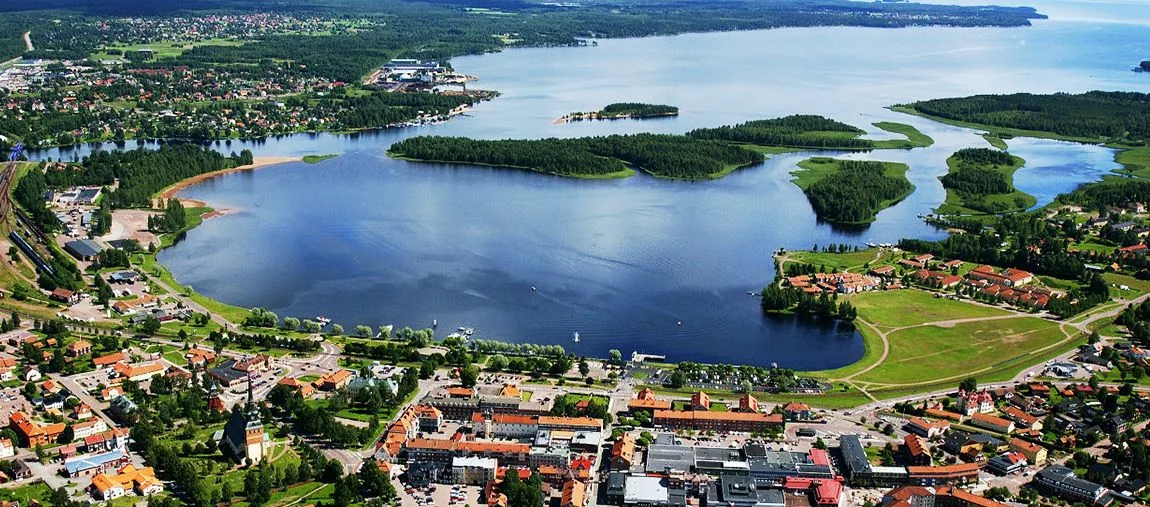
Lake Siljan, Sweden
The Siljan Ring is the largest
The Siljan Ring is the largest impact crater in Europe, and its unique geology has shaped the lives of everyone who settled here. In the 16th century, the lake’s surrounding villages became the birthplace of modern Sweden when Gustav Vasa fled here to rally the local peasantry against Danish rule. These 'Dala-men' became the backbone of his army, securing Swedish independence and cementing Dalarna’s status as the nation’s patriotic heartland. Over the centuries, the isolation created by the hilly terrain allowed ancient crafts to flourish, from the carving of the iconic Dala horses in Nusnäs to the distinctive folk music that still rings out at the Bingsjö gathering. The lake was the primary highway for these communities, with massive wooden boats ferrying hundreds of villagers to church every Sunday.
Standing on the long pier at Leksand, you
Standing on the long pier at Leksand, The water’s temperature is a bracing reminder of the lake’s depth. The soft, mossy earth beneath your feet as you hike the trails along the Tällberg slopes, where the views of the lake open up like a landscape painting. The light at midsummer is legendary, a soft, eternal violet that never quite fades into darkness, making the red cottages glow with an impossible intensity. The vibrant folk costumes worn by locals during parish festivals, which are not costumes to them but a living lineage. The sound of the 'nyckelharpa', a traditional keyed fiddle, often drifts through the air near the lakefront, its resonant strings capturing the melancholic beauty of the Swedish North. Those who come find their most profound moment at the Naturum Siljan, where the sheer scale of the prehistoric impact is finally explained through the limestone cliffs. Regional trains run from Stockholm to the main lakeside towns of Leksand and Mora, a journey of approximately three to four hours. Driving is the preferred method for those wishing to circle the lake and visit the smaller villages like Tällberg and Rättvik. The 'Siljansleden' hiking trail offers a more intimate way to see the crater rim, stretching over 340 kilometers through the woods. In summer, traditional steamboats still ply the waters, offering a nostalgic perspective on the shoreline that has remained largely unchanged for a century.
The Experience
At the front is the scent of wood-fired saunas and the cold, metallic tang of the lake water as you swim off a private dock in Tällberg. Audibly, the of traditional rowing boats, called 'kyrkbåtar,' creates a rhythmic splashing that feels like a heartbeat for the region. The majority overlook the small village of Nusnäs, where you can watch craftsmen hand-carve Dala horses from local pine, their knives moving with a speed that only comes from decades of muscle memory. The light at the Sollerön island sunset creates a silver path across the water that seems to lead directly into the forest. Part of the historical weight of the place when you stand in Mora and realize you are at the finish line of the Vasaloppet, the world’s oldest cross-country ski race.
Why It Matters
Lake Siljan is more than a body of water; it is a geological anomaly that preserved a cultural one. It represents the resilience of Swedish folk traditions and serves as a living museum of the country’s foundational myths. The landscape provides a sense of continuity that is rare in the modern world, linking the prehistoric earth to the contemporary Swedish soul.
Why Visit
Visit Lake Siljan if you want to see the Sweden of your imagination, the red houses, the maypoles, and the deep, silent forests. While Stockholm is the brain of the country, Siljan is the heart. It is the only place where you can stand in a prehistoric crater and feel the pulse of a living history that refuses to modernize.
Insider Tips
- 1
Rent a bike in Leksand and cycle to the village of Tällberg for the most elevation and the best panoramic views of the water.
- 2
Visit the Zorn Museum in Mora to see how the lake's light influenced one of Sweden's greatest painters.
- 3
Check the local parish calendars for 'Kyrkbåtsrodd,' when traditional church boats race across the lake in July.
- 4
The tap water in this region is exceptionally high quality; carry a reusable bottle and fill it from any tap.
- 5
Drive to the top of Fryksås fäbod for a view that encompasses the entire Siljan Ring and the sprawling wilderness beyond.