“Three kilometers of limestone were built to protect medieval merchants not from foreign empires, but from their own neighbors in the countryside.”
About Visby City Wall
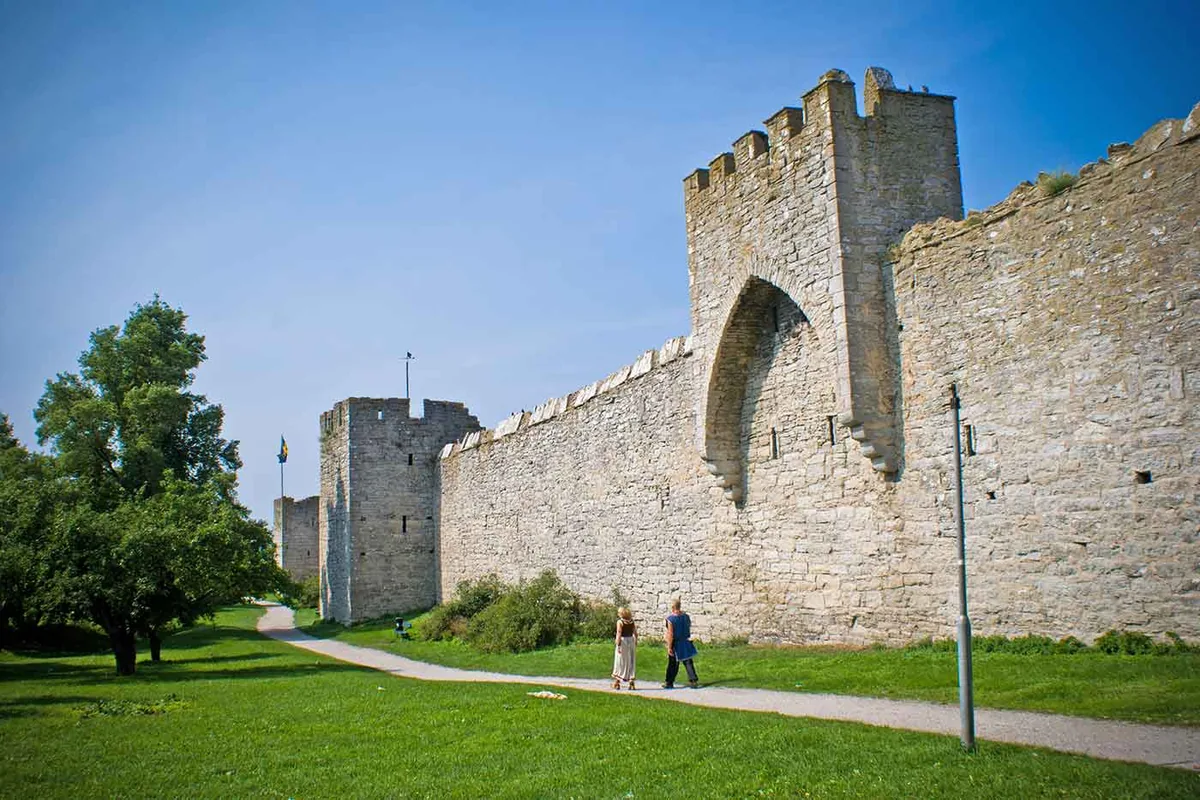
The Visby City Wall was constructed in several stages, with the oldest section, the Powder Tower (Kruttornet), dating back to the 1150s. By the late 13th century, the wall reached its full height of six meters and featured dozens of hanging towers supported by wooden beams. During the 1361 Danish invasion, the wall remained unbreached, yet the city surrendered to save itself from fire. Over the following centuries, the wall lost its military purpose and parts were used as granaries or even dwellings. Its preservation is largely due to the town's poverty in the 18th century, which prevented the demolition of the wall for building materials, accidentally saving one of the world's great archaeological treasures.
What Visby City Wall actually is
Gotland’s coastline is guarded by 3.4 kilometers of gray limestone and defensive history. The Visby City Wall is the strongest and best-preserved medieval fortification in Scandinavia, a jagged ring of stone that has encircled the 'City of Roses and Ruins' since the 13th century. The walk along its base, you pass thirty-six defensive towers that rise like silent sentinels against the Baltic winds. The wall separates the winding, cobblestoned core of the old Hanseatic port from the modern sprawl beyond, acting as a physical border between the present day and the Middle Ages. Its surface is a patchwork of weathered rock, moss, and the scars of ancient sieges, glowing with an ethereal silver light during the long summer twilights. The scale of medieval ambition is laid bare in every mortar-joint and crenellation.
The Visby City Wall is the strongest and best-preserved medieval fortification in Scandinavia, a jagged ring of stone that has encircled the 'City of Roses and Ruins' since the 13th century.
Background
The wall was built not just to keep out foreign invaders, but to protect the wealthy merchants of Visby from the disgruntled farmers of Gotland’s countryside. Construction began in the mid-1200s, during a period when Visby was the most important hub of the Hanseatic League. The tension between the city and the rural population exploded in 1288 in a brief civil war, leading the townspeople to heighten the wall and add more towers. In 1361, the wall witnessed its most tragic chapter when King Valdemar Atterdag of Denmark invaded. A brutal battle took place just outside the gates, where thousands of local farmers were slaughtered. The wall stood firm, but the city was forced to pay a massive ransom, marking the beginning of a slow decline from which Visby never recovered as a commercial power.
The best way to feel the wall’s presence
The best way to feel the wall’s presence is to walk the outer perimeter at dawn. The way the limestone changes color as the sun rises, shifting from a cold blue to a warm, sandy gold. In your ears of the Baltic Sea is never far away, blending with the rustle of ivy that clings to the ancient masonry. A hint of the sheer thickness of the stone at the arched gates, like the Dalmansporten, where the air is noticeably cooler and the echo of your footsteps is sharp. People generally gather at the Powder Tower, the oldest part of the wall, but the real magic is found in the quiet stretches near the Norderport, where the grass is long and the ruins of medieval churches peek over the battlements like skeletal giants.
Visby is located on the island of Gotland
Visby is located on the island of Gotland, accessible via a three-hour ferry ride from Nynäshamn or Oskarshamn on the mainland. There are also frequent flights from Stockholm to Visby Airport, which is just a ten-minute taxi ride from the city wall. Once you arrive at the harbor, the wall is impossible to miss, it looms directly over the town. The entire old city within the wall is pedestrian-friendly, and the best way to explore the fortifications is by renting a bicycle and riding the path that circles the entire structure.
Visby is located on the island of Gotland, accessible via a three-hour ferry ride from Nynäshamn or Oskarshamn on the mainland.
The Experience
Right away, the small 'arrow slits' that offer narrow, cinematic views of the rose gardens inside the town. The wall doesn't feel like a ruin; it feels like a living part of the city’s geography, with modern life flowing through its ancient gates every day. Passing through the Maiden's Tower, you might feel a chill as you recall the legend of the girl supposedly walled up alive there for betraying the city. The most memorable moment is often the view from the cliffs at the northern end, where the wall descends toward the sea and the orange roofs of the town cluster together in its protection.
Why It Matters
The Visby City Wall is a UNESCO World Heritage site and the most complete example of a Hanseatic fortified town. It is a rare physical record of the socio-economic tensions of the Middle Ages and a masterpiece of military architecture. For Sweden, it is the primary symbol of Gotland’s unique history, separate from the mainland’s cultural arc.
Why Visit
The rare chance to walk around an entire medieval city without a single break in the fortifications. While most European city walls were torn down to make room for cars, Visby’s remains a total, immersive loop. It is the closest you can get to walking through a history book, with the added bonus of the Baltic breeze and the scent of wild roses.
✦ Insider Tips
- 1
Climb to the top of the Klinten hill for the most iconic photograph of the wall snaking down toward the sea.
- 2
Look for the scars in the stone near the Jungfrutornet, which are said to be marks from Danish cannonballs.
- 3
Visit the Gallows Hill (Galgberget) just north of the wall to see the three stone pillars where medieval executions took place.
- 4
The path on the outside of the wall is much more scenic and offers a better sense of its defensive scale than the inside path.
- 5
The Dalmansporten gate is the highest point of the wall and offers a great perspective of the multi-layered construction.