A human spine carved in marble inspired a 190-meter skyscraper that rotates ninety degrees to face the sea, marking the exact spot where a giant shipyard crane once stood.
About Turning Torso
The Turning Torso replaced the Kockums Crane, which had been the symbol of Malmö’s industrial might for decades. When the crane was sold and moved to South Korea in 2002, residents reportedly wept, seeing it as the end of an era. The tower’s construction was a high-stakes gamble that cost nearly double its original budget, but it succeeded in attracting new residents and businesses to the derelict harbor. It paved the way for the 'Bo01' sustainable city exhibition, turning a contaminated industrial site into one of the most environmentally friendly neighborhoods in the world.
What Turning Torso is
On the edge of the Öresund strait in Malmö, a tower of white marble and glass performs a slow, ninety-degree twist toward the sky. The Turning Torso is the world's first 'twisting' skyscraper, a 190-meter residential spire that has become the definitive symbol of Malmö’s transition from an industrial shipyard to a sustainable tech hub. Designed by Santiago Calatrava, the building is composed of nine pentagonal segments that stack on top of one another, rotating slightly as they rise. The result is a structure that feels fluid and organic, as if it were a living organism reaching for the light. At its base, The sharp, angular geometry of the steel skeleton that holds the twist in place, contrasting with the soft, blue-gray waters of the sea behind it.
“On the edge of the Öresund strait in Malmö, a tower of white marble and glass performs a slow, ninety-degree twist toward the sky.”
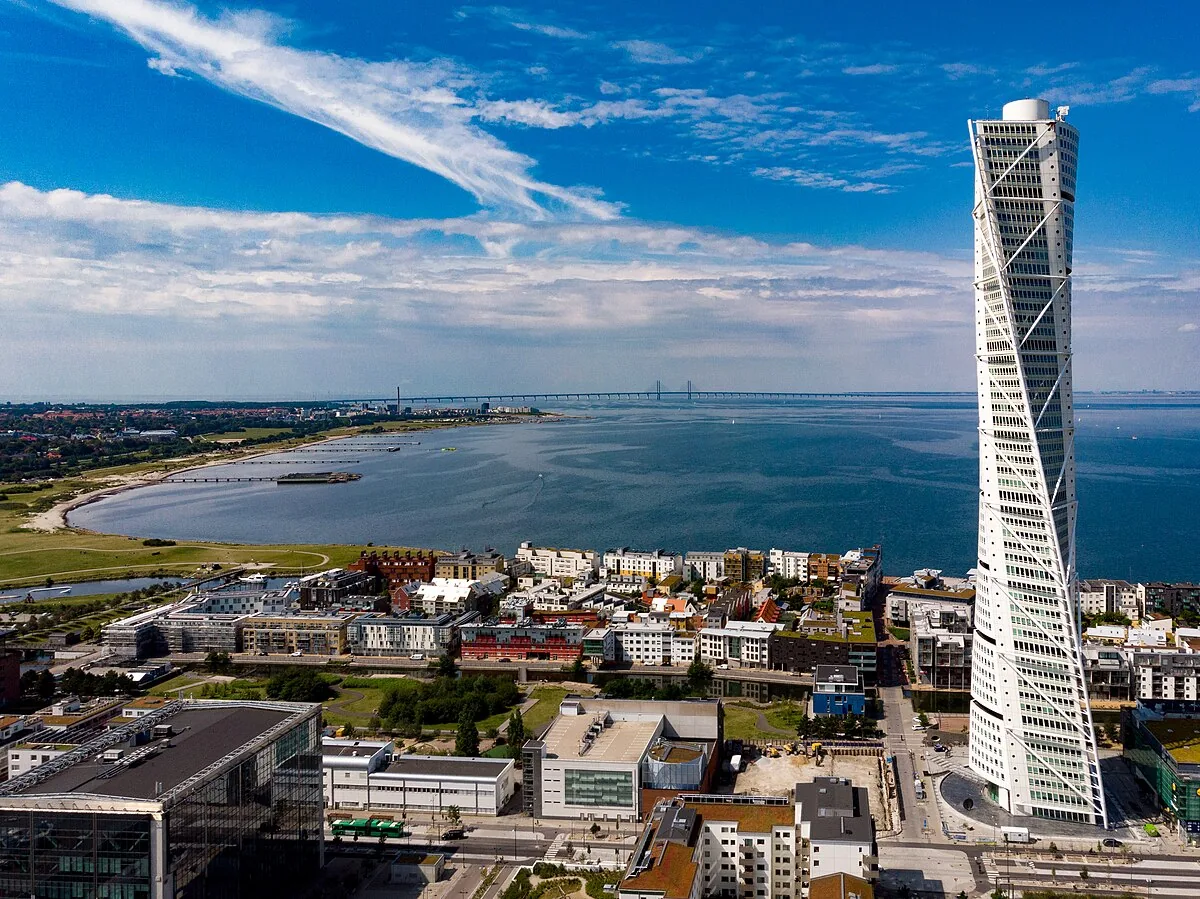
Turning Torso, Sweden
The inspiration for the tower came
The inspiration for the tower came from a white marble sculpture by Calatrava himself, called 'Twisting Torso,' which depicted a human spine in a state of rotation. In the late 1990s, Malmö was struggling after the closure of its famous Kockums shipyard; the city needed a new landmark to signal its rebirth. Johnny Örbäck, a local housing executive, saw the sculpture and convinced Calatrava to build it on the site of a former shipyard crane. Construction was an engineering nightmare, requiring a massive core that could withstand the unique torque forces of the twist. Completed in 2005, it became the tallest building in Scandinavia, a position it held for nearly two decades while sparking a global trend for spiraling architecture.
Approaching the Turning Torso from the Västra Hamnen
Approaching the Turning Torso from the Västra Hamnen (Western Harbor) district, the building’s appearance changes with every step you take. From one angle, it looks like a slender, elegant pillar; from another, it seems to lean precariously over the promenade. The constant wind from the Öresund, which carries the scent of salt and the sound of waves crashing against the stone embankments. While the building is primarily residential and closed to the public, the surrounding neighborhood is a masterclass in modern Scandinavian design. Right away, the vibrant, eco-friendly apartments, the wooden sun-decks where locals swim in the chilly sea, and the way the tower’s white facade reflects the changing light of the Nordic sky, turning pink at sunset and a ghostly silver under the moon. The Turning Torso is located in the Västra Hamnen district of Malmö. It is a pleasant twenty-minute walk or a short bus ride (Line 2) from Malmö Central Station. The district is almost entirely pedestrian and cyclist-friendly, making it one of the most pleasant areas in the city to explore on foot. For those arriving from Copenhagen, the Öresund Bridge makes Malmö a quick 35-minute train journey away, and the tower is clearly visible from the bridge crossing the water.
The Experience
The opening is the way the light catches the individual glass panels, which are all flat despite the curved appearance of the building. The clatter of the wind through the steel exoskeleton creates a low, musical hum that is unique to this site. Those who come overlook the small sculptures and water features at the base of the tower, which Calatrava designed to integrate the building with the earth. Standing directly beneath the 'twist' is a disorienting experience that makes you feel the sheer ambition of the engineering. The view of the tower against the massive Öresund Bridge at sunset is the quintessential Malmö photograph.
Why It Matters
The Turning Torso is a pioneer of 'neo-futurist' architecture and the first building in the world to utilize a twisted form. It represents the cultural and economic reinvention of Malmö and serves as a global benchmark for sustainable urban living. Its influence can be seen in skyscrapers from Dubai to Shanghai, but it remains the most elegant and proportional of them all.
Why Visit
You visit because it is one of the few buildings that actually looks better than its architectural renderings. It is the soul of Malmö’s new identity, located in a district where you can see the future of urban life directly. It’s the rare landmark that feels equally connected to the sky, the sea, and the city’s industrial past.
Insider Tips
- 1
The building is only open to the public for a few weeks in the summer; check the HSB Turning Torso website for these rare ticketed slots.
- 2
The best photo angle is from the Daniaparken swimming area, where the tower's full height is mirrored in the sea.
- 3
Eat at one of the sustainable cafes in Västra Hamnen to see why this neighborhood is considered a global model for green living.
- 4
Look for the sculpture by the base that mirrors the building's twist; it's the original inspiration for the project.
- 5
Visit at night when the tower is subtly lit, highlighting the separation between the nine architectural segments.