“These coral ruins hold one of the oldest mosques in mainland East Africa, a 13th-century Swahili town that thrived centuries before Bagamoyo's caravans.”
About Kaole Ruins
Kaole was a Shirazi-era Swahili settlement that prospered from around the 1200s on Indian Ocean trade, before silting harbours and shifting commerce led to its decline and the rise of nearby Bagamoyo. Its mosques and pillar tombs, built of coral stone, survive as one of the most important medieval Swahili archaeological sites on the Tanzanian mainland.
What Kaole Ruins actually is
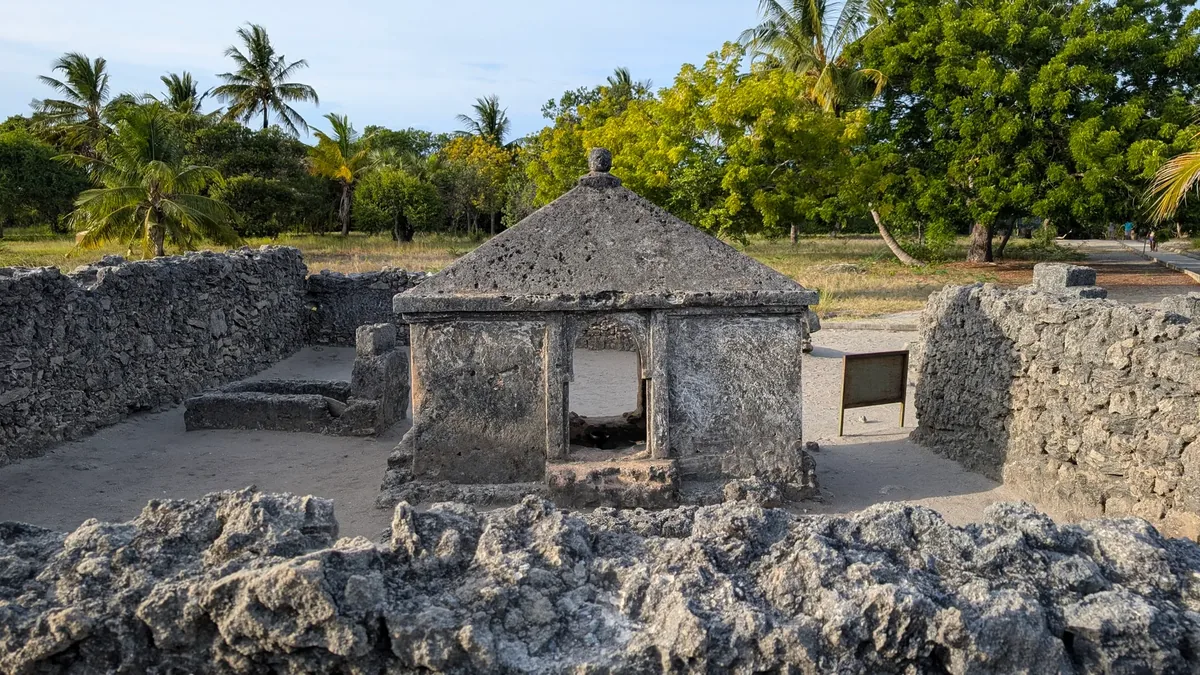
The Kaole Ruins lie just south of Bagamoyo, the weathered remains of an early Swahili town that flourished centuries before the caravan trade made Bagamoyo famous. Among coral-stone mosques and tombs lost in coastal scrub, they include one of the oldest mosques in mainland East Africa, evidence of the deep history of Islam and trade along the Swahili coast.
The Kaole Ruins lie just south of Bagamoyo, the weathered remains of an early Swahili town that flourished centuries before the caravan trade made Bagamoyo famous.
Among the Oldest Mosques in East Africa
Kaole was a thriving Shirazi trading settlement from around the 13th century, linked to the wider Indian Ocean world of the Swahili coast. Its ruins include a 13th-century mosque, among the earliest known on the mainland, with a finely worked prayer niche, alongside another later mosque and a cluster of pillar tombs in the distinctive Swahili style. The site shows that organised Islamic coastal towns existed here long before the colonial and caravan eras.
The Experience
Exploring, you find a quiet, atmospheric site of roofless coral-stone walls, the skeletal arches of old mosques and the tall pillar tombs that mark important graves, all half-claimed by trees and coastal vegetation. A small museum displays imported Chinese and Islamic pottery found here, proof of Kaole's far-reaching trade connections. The peace and antiquity contrast with Bagamoyo's later, darker history nearby.
Why It Matters
The Kaole Ruins reveal the deep, cosmopolitan roots of Swahili coastal civilisation, centuries before European contact, when Islam, trade and a distinctive urban culture already linked East Africa to Arabia, Persia, India and China. They are a key site for understanding the medieval Indian Ocean world.
They are a key site for understanding the medieval Indian Ocean world.
Why Visit
One of the oldest mosque sites in East Africa and an atmospheric medieval Swahili town of coral ruins and pillar tombs, just outside Bagamoyo.
✦ Insider Tips
- 1
See the 13th-century mosque, among the oldest on the East African mainland.
- 2
Look at the Swahili pillar tombs and the small site museum.
- 3
Imported pottery here shows Kaole's Indian Ocean trade links.
- 4
Combine it with Bagamoyo's Old Fort just to the north.