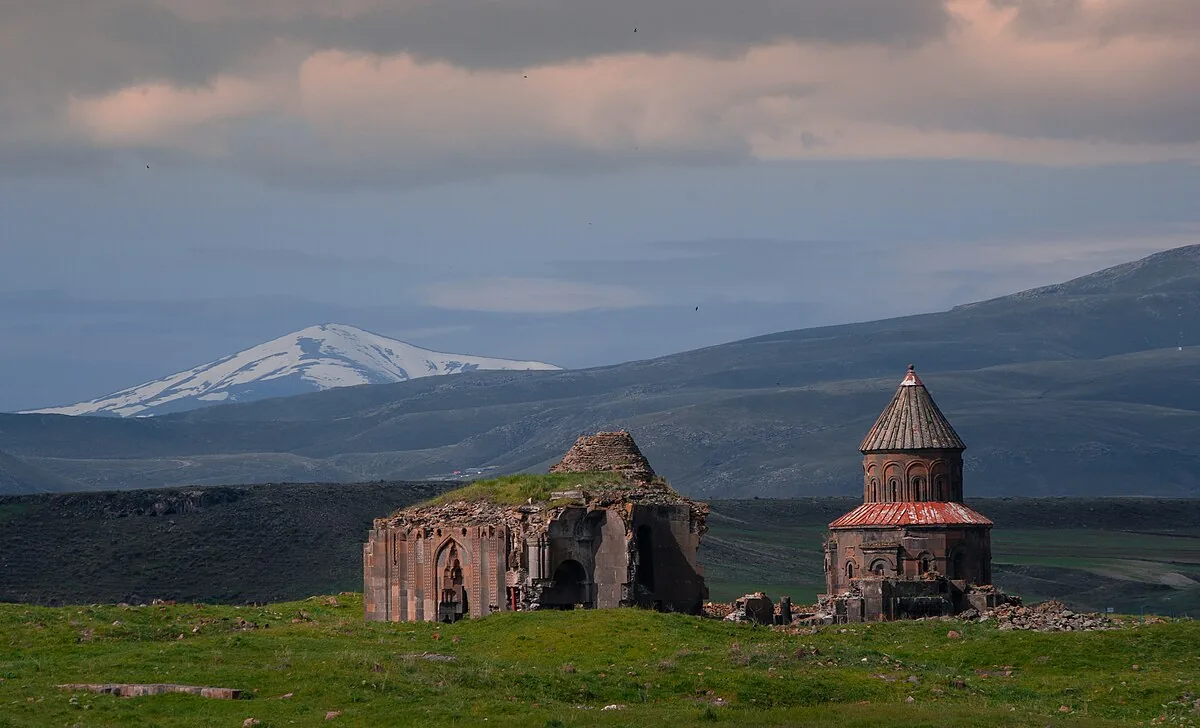
“A thousand years ago, this silent field of grass was a golden metropolis of a hundred thousand souls, boasting a skyline of churches that influenced the cathedrals of Europe.”
About Ani
Ani was a laboratory of architectural innovation, most notably seen in the Cathedral of Ani, completed in 1001 by the architect Trdat, the same man who helped repair the dome of Hagia Sophia. The city also houses the Menuçehr Mosque, the first mosque built by the Seljuk Turks in Anatolia, featuring an octagonal minaret that overlooks the Armenian border. The site is a complex layer of religious history, where Zoroastrian fire temples sit near Christian cathedrals and Islamic shrines. Because the stone used is a soft volcanic tufa, the ruins are particularly vulnerable to the harsh winters of the Anatolian highlands, making current stabilization efforts a race against time.
What Ani actually is
On a desolate plateau at the far eastern edge of Turkey, the ghost of a once-mighty metropolis stands in stark silhouette against the Armenian border. Ani, known in the 10th century as the 'City of 1001 Churches,' was the capital of a powerful Armenian kingdom and a vital hub on the Silk Road, rivaling Constantinople and Baghdad in its wealth and splendor. Today, it is a vast field of broken cathedrals, crumbling city walls, and a lonely mosque, all scattered across a landscape of waving yellow grass. The Akhurian River carves a deep gorge beneath the ruins, serving as a silent, impassable boundary between two nations. It is perhaps the most evocative ruin in the world, a place where the wind is the only resident and the scale of the loss is almost beyond comprehension.
On a desolate plateau at the far eastern edge of Turkey, the ghost of a once-mighty metropolis stands in stark silhouette against the Armenian border.
The Bagratid Armenians made Ani their capital
The Bagratid Armenians made Ani their capital in 961 AD, ushering in a golden age of architecture and commerce. It was a cosmopolitan city of over 100,000 people, where master builders experimented with pointed arches and clustered piers long before they appeared in the Gothic cathedrals of Europe. Its decline was a slow, painful erosion caused by a succession of invaders, Byzantines, Seljuk Turks, and Mongols, compounded by a devastating earthquake in 1319. By the 18th century, the city was completely abandoned. For much of the 20th century, it was a restricted military zone, forgotten by the outside world until its 'rediscovery' and eventual recognition as a UNESCO World Heritage site in 2016.
The air is thin and piercingly
The air is thin and piercingly cold, even in the height of summer, smelling of dry grass and ancient stone. The constant, low-frequency moan of the wind as it tunnels through the roofless naves and the distant, rhythmic rushing of the river far below in the canyon. Moving through the massive double walls of the city, The immense scale of the defense and the rough, volcanic tufa stone that gives the ruins their distinctive reddish-brown hue. First, the heartbreaking beauty of the Church of the Redeemer, which stands split exactly in half by lightning, a vertical section of a building exposed to the sky. The light is vast and horizontal, casting shadows that stretch for miles across the empty plateau, making the red stone of the ruins glow like cooling embers.
Ani is located about 45 kilometers
Ani is located about 45 kilometers from the city of Kars, which is the only practical base for visitors. Kars is reachable by domestic flights from Istanbul or the famous Doğu Ekspresi (Eastern Express) train, a 24-hour journey across the heart of Anatolia. From Kars, there are daily minibuses to the ruins, though hiring a private driver for the day is the preferred method for those who want to explore the site at their own pace. Be prepared for a significant amount of walking, as the ruins are spread across a massive, exposed area with very little shade or shelter.
Ani is located about 45 kilometers from the city of Kars, which is the only practical base for visitors.
The Experience
A sense of profound isolation as you walk toward the Church of Saint Gregory of Tigran Honents, the interior of which is still covered in remarkably vivid 13th-century frescoes. The hum of your own footsteps is often the only thing you hear for hours, making the sudden appearance of a golden eagle soaring overhead feel like a major event. The deep ruts in the stone near the gates, made by the wheels of Silk Road caravans that haven't passed through here in seven hundred years. The most haunting moment is standing by the broken bridge at the bottom of the gorge, looking across the river to the Armenian guard towers just a few hundred yards away. It is a place where history isn't just old; it feels abandoned.
Why It Matters
Ani is the most important site of medieval Armenian architecture in existence. It represents a vanished bridge between Eastern and Western building traditions and is a product of to the sophisticated urban culture of the Silk Road. Culturally, it is a site of deep longing and significance for the Armenian diaspora, making its preservation a sensitive and vital international effort.
Why Visit
Visit Ani because there is no other place on the planet where ruin feels so pure. Most archaeological sites are surrounded by visitor centers and cafes, but Ani is just the stones, the wind, and the border. It is the ultimate destination for those who want to experience the true, melancholic majesty of a lost civilization.
✦ Insider Tips
- 1
Bring your passport, as the proximity to the border means there are occasionally military checkpoints on the road from Kars.
- 2
The site is enormous; bring plenty of water and a hat, as there is absolutely no shade on the plateau and the sun is deceptively strong at this altitude.
- 3
Hire a local guide in Kars; the history of Ani is incredibly complex and the best stories are hidden in the carvings that you might otherwise walk past.
- 4
Look for the 'Church of the Redeemer' specifically; it is the most photographed ruin because it was split perfectly in two by a lightning strike in 1957.
- 5
Check the weather forecast for Kars carefully; if snow is predicted, the site can become invisible and dangerous to navigate in a matter of hours.