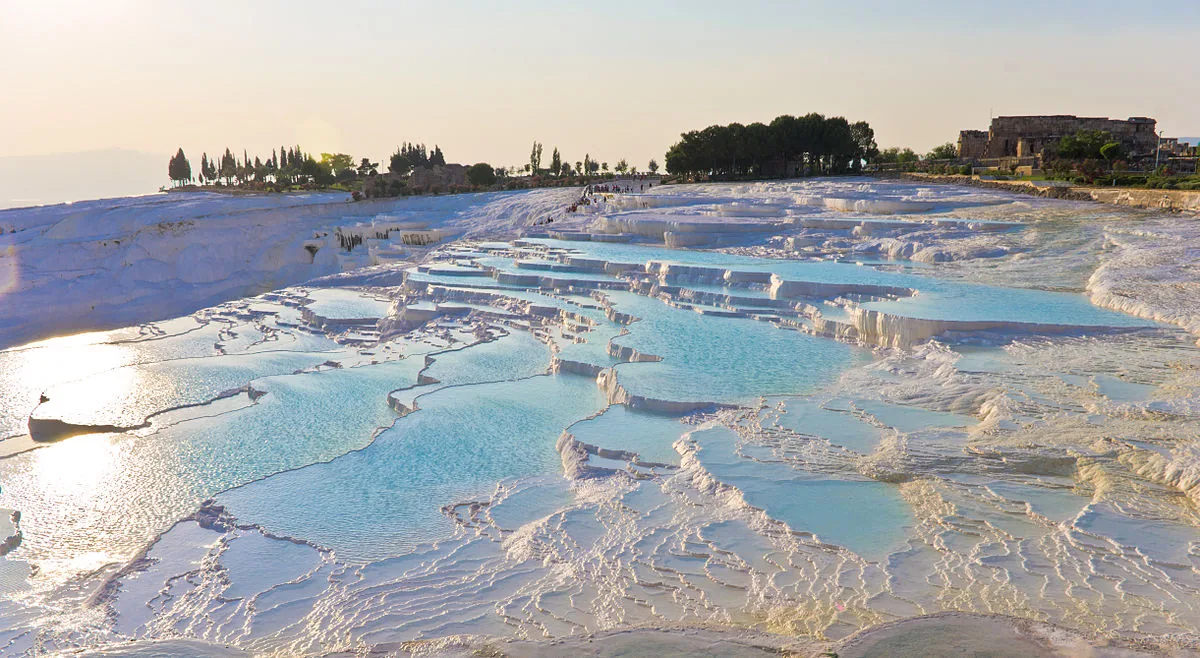
Twenty-four stone lions stand guard along a marble road that forces every visitor to bow their head in a subtle, engineered act of national mourning.
About Anıtkabir
The construction was a massive undertaking during the difficult post-war years, requiring the leveling of an ancient tumulus that had occupied the hill since the Phrygian era. The Hall of Honor features a ceiling decorated with 15th and 16th-century Turkish carpet and rug patterns, rendered in gold leaf and mosaics. The museum beneath the plaza contains Atatürk’s personal effects, including his custom-made cars and a library of thousands of books with his hand-written notes in the margins, offering a surprisingly intimate look at the private intellect of a public icon.
About Anıtkabir
High on a hill overlooking the modern sprawl of Ankara, a limestone fortress of memory is the final resting place of Mustafa Kemal Atatürk, the founder of the Republic of Turkey. Anıtkabir is more than a tomb; it is a meticulously choreographed architectural statement of national identity. Built in a style known as the Second National Architecture Movement, it blends Hittite, Seljuk, and Ottoman motifs into a modern, minimalist monument of staggering scale. The complex is divided into four main parts: the Road of Lions, the Ceremonial Plaza, the Hall of Honor, and the Peace Park. Here, the atmosphere is one of intense reverence, where the rhythmic goose-steps of the honor guard provide the only beat to a pervasive, dignified silence.
“High on a hill overlooking the modern sprawl of Ankara, a limestone fortress of memory is the final resting place of Mustafa Kemal Atatürk, the founder of the Republic of Turkey.”
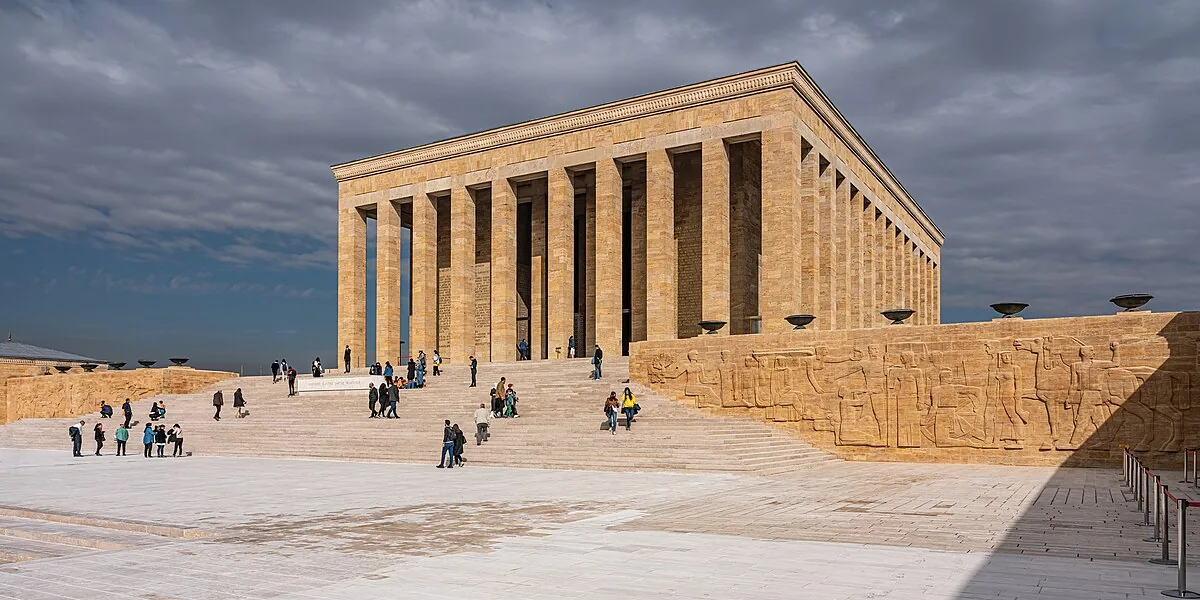
Anıtkabir, Turkey
Following Atatürk’s death, 1938
Following Atatürk’s death in 1938, an international competition was held to design a monument that would reflect his legacy of secularism and modernization. The winning design by Turkish architects Emin Onat and Orhan Arda took nine years to complete, finally opening in 1953. Every stone used in the construction was sourced from different parts of Turkey, symbolizing the unity of the new nation. The site also houses the tomb of İsmet İnönü, the second president, and a vast museum detailing the War of Independence. It remains the most important site of pilgrimage in the country, especially on national holidays when hundreds of thousands of people gather in the plaza to pay their respects to the man who dragged the nation into the 20th century.
The air is clean and smells of the thousands of trees that make up the Peace Park, a quiet green buffer from the city traffic. The sharp, echoing crack of the guards' boots on the marble as they perform the changing of the guard, a ceremony that happens with clockwork precision. The walk down the Road of Lions, The texture of the travertine beneath your feet, designed with wide gaps between the stones to force you to walk slowly and look down in a gesture of subconscious respect. What catches you is the light in the Hall of Honor is dim and filtered through high windows, illuminating the 40-ton marble sarcophagus in a soft, ethereal glow. The silence inside is heavy, broken only by the occasional hushed whisper of a visitor. The view from the plaza offers a panoramic perspective of Ankara, a city that exists in its modern form because of the man buried beneath you.
Located in central Ankara, Anıtkabir
Located in central Ankara, Anıtkabir is easily accessible by the Ankaray light rail system to the Tandoğan (now Anadolu) station. From there, it is a short, well-marked walk to the entrance. Taxis are common and inexpensive, but walking through the Peace Park is the most thematic way to approach the monument. Security is tight but professional, and there is no entry fee, though visitors are expected to dress and behave with decorum.
“Located in central Ankara, Anıtkabir is easily accessible by the Ankaray light rail system to the Tandoğan (now Anadolu) station.”
The Experience
A surge of collective emotion when you stand in the Ceremonial Plaza, which can hold up to 15,000 people. The sound of the wind through the tall flagpoles creates a low-pitched hum that seems to vibrate through the limestone. First, the meticulous detail in the bronze reliefs depicting the battles of the War of Independence, where the faces of the soldiers are etched with a weary, realistic grit. The most poignant moment is standing before the sarcophagus, where people from all walks of life, students, soldiers, and elderly villagers, stand in a long, silent line to offer a prayer or a moment of reflection. It is the secular heart of the nation, pulsating with a quiet, fierce pride.
Why It Matters
Anıtkabir is the definitive architectural expression of the Turkish Republic. It represents the transition from the imperial Ottoman past to a modern, western-facing state. Beyond its political weight, it is a masterpiece of 20th-century monumental architecture, utilizing light, scale, and traditional motifs to create a space that is both intimidating and deeply moving.
Why Visit
Visit to understand the modern Turkish soul. You cannot grasp the complexities of Turkey today without understanding the profound influence of Atatürk. Anıtkabir is the one place where you can see how his memory is preserved, celebrated, and utilized as a unifying force. It is as much a temple to an idea as it is to a man.
Insider Tips
- 1
Time your visit to coincide with the changing of the guard, which typically happens every hour on the hour; it is one of the most precise displays of military discipline in the world.
- 2
Allow at least two hours for the museum beneath the hall; the dioramas of the Gallipoli and Sakarya battles are incredibly detailed and immersive.
- 3
The walk from the entrance through the Peace Park is nearly a kilometer long, so be prepared for a significant amount of walking before you reach the monument.
- 4
Look for the stones inscribed with Atatürk's 'Address to the Youth'; it is a text that every Turkish student knows by heart and remains a foundational document of the state.