Drop a single coin on the stage floor and the sound will travel clearly to a spectator sitting sixty feet above in the very last row of stone benches.
About Aspendos Theatre
The theatre was part of a larger, wealthy city known for its trade in salt, oil, and wool. Marcus Aurelius was the reigning emperor during its construction, a time of relative stability that allowed for such grand civic projects. Unlike Greek theatres that were carved into hillsides, this Roman design is largely self-supporting, utilizing massive barrel vaults to hold the weight of 12,000 spectators. Its later life as a Seljuk palace added layers of plaster and decoration that served as a protective skin for the original Roman brickwork, effectively mothballing the site for the modern era.
Aspendos Theatre in short
Among the countless ruins scattered across the Mediterranean, the theatre at Aspendos holds a distinction that feels almost impossible: it is still loud. While most ancient stages are silent skeletons of crumbling marble, this Roman masterpiece remains a living venue, its acoustics so precise that a whisper from the orchestra floor reaches the highest tier of the cavea. The massive scaenae frons, or stage building, stands two stories high, remarkably intact with its architectural ornamentation. It looms over the landscape like a giant stone sentinel, a reflection of an era when public spectacle was the lifeblood of the empire. To sit on its weathered limestone benches is to realize that Roman engineering was not just about strength, but about an obsession with perfect, immersive sound.
“Among the countless ruins scattered across the Mediterranean, the theatre at Aspendos holds a distinction that feels almost impossible: it is still loud.”
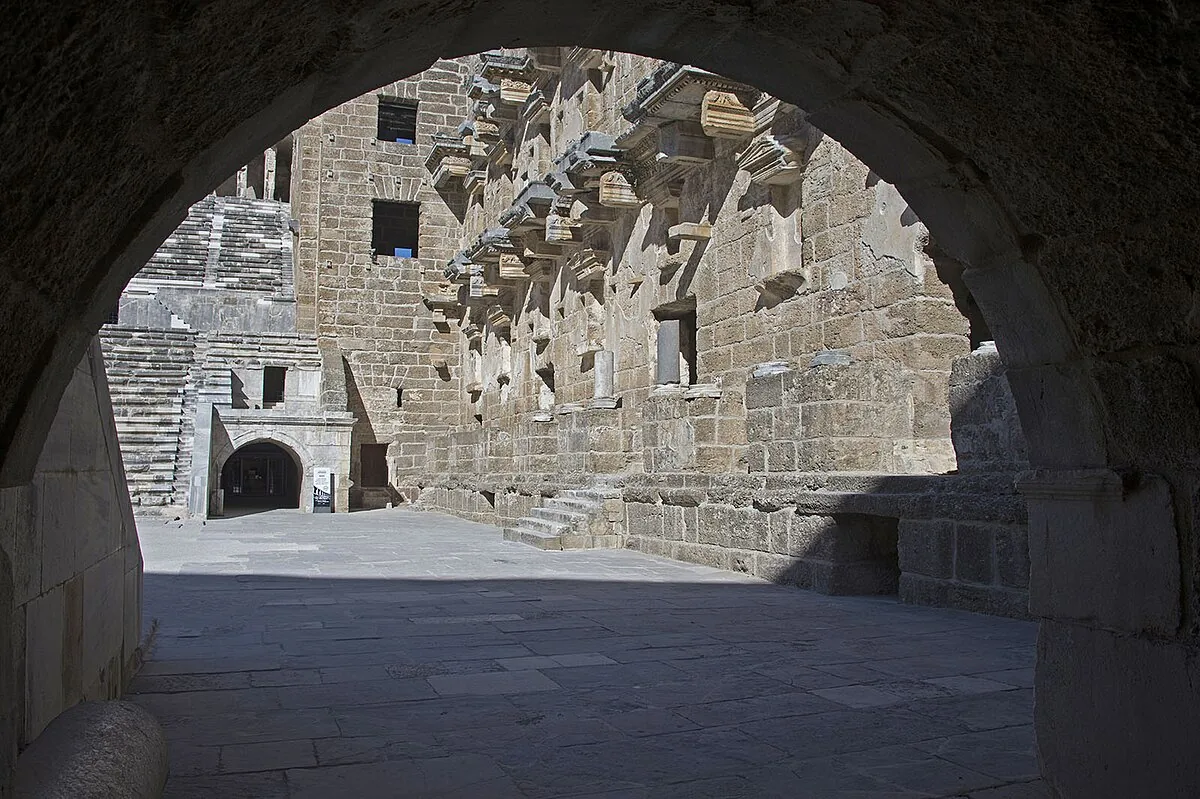
Aspendos Theatre, Turkey
of Marcus Aurelius, 160
Architect Zeno designed this arena during the reign of Marcus Aurelius around 160-180 AD, dedicating it to the gods and the imperial family. Local legend tells of a contest held by the King of Aspendos to find an architect who could build the city's most useful monument; Zeno won when the king heard him whispering from the stage while the king stood on the top row. The building's survival through the centuries is largely due to the Seljuk Turks, who recognized its utility and converted the stage house into a caravanserai and palace in the 13th century. This shift in function meant the structure was maintained and repaired rather than being quarried for stone. Consequently, we are left with the most complete Roman theatre in existence, having weathered nearly two thousand years of Anatolian history.
There is a dry, honeyed scent of sun-baked grass and distant citrus groves from the Pamphylian plain. The sharp, clear ring of footsteps on the stone and the occasional experiment of a fellow visitor testing the famous acoustics with a clap or a song. Through the vaulted tunnels of the diazoma, the sudden drop in temperature and the rough, cool texture of the massive masonry. The way the late afternoon sun illuminates the intricate niches where statues of deities once looked down upon the audience. The scale is monumental, yet the semicircular design creates a strange sense of intimacy. At the very top, the vastness of the surrounding valley makes the theatre feel like a deliberate anchor in an ever-changing landscape.
Aspendos lies approximately 45 kilometers
Aspendos lies approximately 45 kilometers east of Antalya, making it a straightforward drive along the main coastal highway. People typically use the town of Serik as their final landmark before turning toward the archaeological site. Regional buses run frequently from Antalya's main terminal to Serik, where local minibuses take over for the final leg. Arriving shortly after the gates open allows you to experience the stage in total silence before the tour groups arrive.
“Aspendos lies approximately 45 kilometers east of Antalya, making it a straightforward drive along the main coastal highway.”
The Experience
There is a surge of theatrical energy as you stand in the center of the orchestra, looking up at the towering tiers of seats that seem to wrap around you like a stone embrace. The hum of a bird's wings flapping high in the rafters is surprisingly audible, highlighting the sonic perfection of Zeno's design. What grabs you is the intricate friezes of Dionysus, the god of theatre, still visible despite centuries of erosion. The piece that lingers is the view from the gallery, where the symmetry of the architecture creates a visual harmony that feels both ancient and strikingly modern. It is easy to imagine the roar of a Roman crowd vibrating through the very seat you are occupying.
Why It Matters
Aspendos represents the zenith of Roman theatrical architecture. It is the only place on earth where the original stage house remains at its full height, providing a complete picture of the Roman aesthetic. Culturally, it serves as a bridge between the ancient world and modern performance, still hosting opera and ballet festivals under the stars.
Why Visit
Aspendos is not a ruin; it is a functioning building. While other sites require a vivid imagination to reconstruct, Aspendos gives you the ceiling, the walls, and the floor. It is the only place where you can truly understand the acoustic power that Roman audiences enjoyed.
Insider Tips
- 1
Climb to the very top gallery behind the columns for the best view of the architectural symmetry and the surrounding aqueduct ruins.
- 2
Check the local schedule for evening performances; hearing an unamplified orchestra in this space is a transformative experience.
- 3
Bring a small cushion if you plan to stay for a performance, as the original Roman limestone is less than forgiving after an hour.
- 4
Explore the nearby Roman aqueduct, which features rare inverted siphons and is just a five-minute drive from the theatre gate.
- 5
Arrive at 8:00 AM to catch the low sun hitting the facade; the light brings out textures in the stone that disappear in the midday glare.