“Nature is slowly swallowing five hundred homes and two cathedrals that were abandoned in a single week during one of the most drastic demographic shifts in modern history.”
About Kayaköy
Levissi was known for its skilled artisans, particularly its stone masons and carpenters, whose handiwork is still visible in the sturdy shells of the buildings. The town functioned as a regional center with schools, pharmacies, and even a local newspaper. Following the departure of the Greeks, the town was further damaged by a 1957 earthquake, which collapsed many of the remaining roofs. In recent years, it has been preserved as a 'Museum Village,' preventing the modern redevelopment that has transformed much of the nearby coastline into high-density resorts.
What Kayaköy actually is
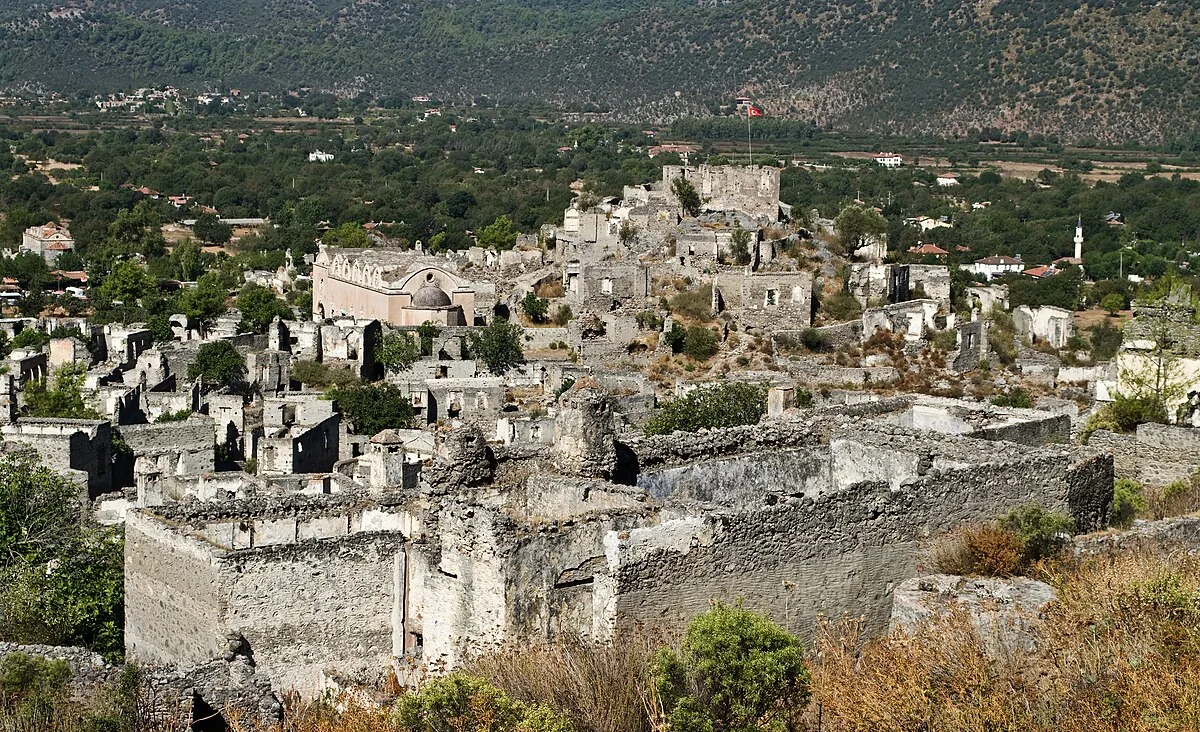
On a hillside near the turquoise coast of Fethiye, hundreds of roofless stone houses stand in a silent, orderly march toward the valley floor. Kayaköy, once the thriving Greek town of Levissi, is a skeletal city that has been uninhabited since the 1923 population exchange. Unlike the ancient ruins of Ephesus or Troy, this site feels uncomfortably recent, a place where the echoes of daily life seem to linger in the empty doorframes and the crumbling hearths. The grey stone of the dwellings blends into the rugged landscape, creating a haunting monochrome landscape that contrasts sharply with the vibrant green of the surrounding pines. It is a monument to the fragility of community and the blunt, often tragic realities of 20th-century nationalism.
On a hillside near the turquoise coast of Fethiye, hundreds of roofless stone houses stand in a silent, orderly march toward the valley floor.
Origins
Levissi was founded in the 18th century on the site of the ancient city of Carmylessus, eventually growing into a prosperous town of nearly ten thousand people. It was a place of coexistence where Greek Orthodox Christians and Ottoman Muslims lived in close proximity, sharing the valley's resources. The end came in 1923 with the Treaty of Lausanne, which mandated a forced population exchange between Greece and the new Republic of Turkey. The Greek residents were sent to the outskirts of Athens, while Muslim arrivals from Greece found the steep, hillside houses of Kayaköy unsuitable for their agricultural lifestyle. They chose to settle in the valley below, leaving the mountain town to the slow, relentless erosion of the wind and the sun.
The air is dry and carries the scent of wild rosemary and the faint, resinous smell of pine needles. The rhythmic clanging of goat bells from the valley and the dry rustle of lizards darting across the sun-bleached stones. Along the narrow, winding paths, The uneven texture of the rough-hewn rock and the heat radiating from the roofless walls. Immediately, the faded blue paint still clinging to the interior of some houses, a ghostly reminder of the families who once occupied them. The light at midday is harsh and unforgiving, highlighting the jagged edges of the ruins, but it softens into a melancholic gold at dusk. Inside the deserted Upper Church, the silence is so profound it is like a physical presence.
Kayaköy is located about eight
Kayaköy is located about eight kilometers south of Fethiye. The most common way to reach it is by taking a local dolmuş (minibus) from the Fethiye city center, a journey that winds through a beautiful pine-covered pass. For those staying in the resort town of Ölüdeniz, a well-marked hiking trail leads over the mountain directly to the ruins. This six-kilometer trek offers spectacular views of the Mediterranean before descending into the silent streets of the ghost village.
Kayaköy is located about eight kilometers south of Fethiye.
The Experience
Something strange sense of trespass walking into the empty shells of private bedrooms and kitchens. You catch of the wind through the glassless windows creates a low, whistling music that follows you up the hillside. First, the small cisterns outside each house, a record of the ingenious water management required for a mountain town with no natural springs. Just about everyone stay near the bottom of the hill, but the real atmosphere is found at the very top, near the small chapel that overlooks the sea. The contrast between the lively restaurants at the village entrance and the deathly quiet of the upper ruins is the thing that stays with you longest.
Why It Matters
Kayaköy serves as a powerful, tangible reminder of the human cost of political borders. It is a site of memory for both the Greek and Turkish peoples, representing a lost era of Mediterranean multiculturalism. Culturally, it inspired Louis de Bernières’ famous novel Birds Without Wings, which captures the town's tragic transition from a vibrant home to a silent ruin.
Why Visit
Kayaköy offers a type of historical immersion that polished museums cannot provide. It isn't a place of emperors and battles, but of cobblers, teachers, and shopkeepers. It is the only place in Turkey where you can walk through the recent past and feel the exact moment when a community's heart stopped beating.
✦ Insider Tips
- 1
Follow the path all the way to the top of the hill to reach the small 'High Chapel' for a panoramic view that stretches all the way to Cold Water Bay.
- 2
Eat at one of the 'gozleme' stands at the base of the ruins; the women make these traditional savory pancakes on outdoor griddles using local herbs.
- 3
Wear shoes with a serious grip, as the paths are made of loose, jagged stones that are notoriously difficult to navigate in sandals.
- 4
Visit in the late afternoon to see the sun set through the empty windows of the Lower Church, creating a play of light that is hauntingly beautiful.
- 5
Look for the intricate pebble mosaic floors in the courtyards of the larger houses, a hallmark of Greek Aegean architecture.