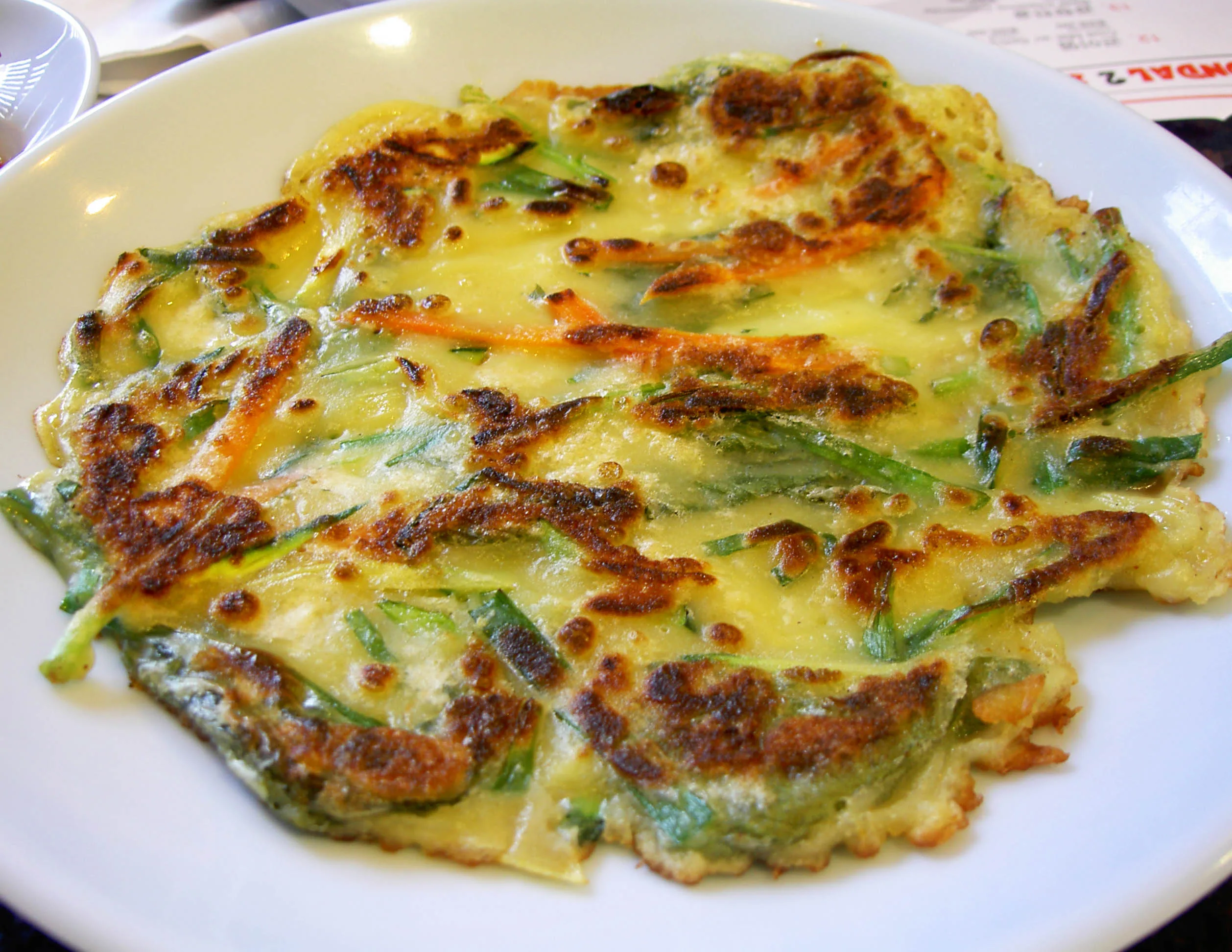
Busan's seafood pancake: squid, prawn and clam packed into a spring onion batter and crisped on cast-iron. Koreans say rain makes them crave it, the sizzle sounds the same.
About Haemul Pajeon
Busan's seafood pancake and Korea's greatest rainy-day food: a thick, crisp-edged batter of flour and egg packed with spring onion, squid, prawn and clam, pressed flat on a cast-iron pan and cooked until the base is golden and the seafood caramelises into the crust; dipped in a soy-vinegar sauce; the sound of rain, Koreans say, makes them crave pajeon.
The Seafood Pancake
Haemul pajeon is Korea's great savoury pancake: a batter of flour and egg packed with spring onion and seafood, squid, prawn and clam, pressed flat on a hot pan and cooked until the base is golden and the seafood caramelises into the crust. It is thick enough to be a meal yet crisp at the edges. The spring onion and seafood are the stars, the batter merely the binder.
“The spring onion and seafood are the stars, the batter merely the binder.”
The Batter and Pan
The trick is a hot cast-iron pan and a not-too-thick batter, so the pancake sets crisp rather than turning doughy. Plenty of oil at the edges crisps the rim, while the centre stays tender around the seafood. Pressing it flat ensures the seafood cooks into the crust rather than steaming on top.
The Rain
Koreans have a well-known association between rainy days and pajeon, often saying the patter of rain sounds like batter sizzling in the pan. Whatever the reason, a rainy afternoon is the classic time to crave it. The link is a genuine and widely shared piece of food culture.
Anju Culture
Pajeon belongs to anju, the tradition of food eaten with drink, and its natural partner is makgeolli, the milky rice wine. It is brought to the table hot and cut with scissors, the Korean way, then dipped in a soy-and-vinegar sauce. Shared over drinks, it is as much a social ritual as a dish.
What to Expect
The pajeon arrives at the table still in the pan, the base dark gold and the spring onions visible through the egg. The diner cuts it with scissors, a traditional Korean method, and dips it in soy-vinegar sauce.
Why Try It
Haemul pajeon is the dish that most clearly expresses Korean anju culture, food designed to be eaten with drinks, specifically makgeolli (milky rice wine).
Insider Tips
- Eat it with makgeolli (rice wine), the combination is the Korean standard.
- Cut with scissors at the table, not with a knife, the Korean method is faster and neater.
- Gwangjang Market in Seoul has accessible pajeon stalls alongside the tteokbokki.