The Living Desert β€” Australia
πŸ™οΈ Modern← Australia

The Living Desert

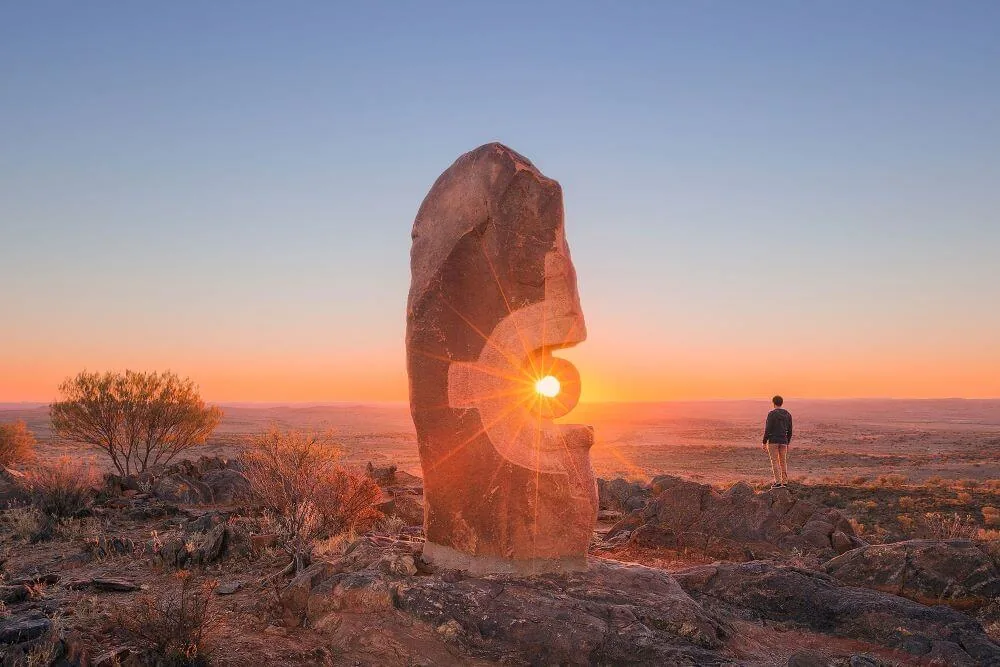
A 2,400-hectare reserve in the Barrier Ranges featuring 12 massive sandstone sculptures carved by international artists in 1993; the site overlooks the red desert plains of the New South Wales outback; hike to the sculpture ridge at sunset; the sun-bleached limestone figures turn a deep glow; the silence is absolute; offering a 360-degree view where the red earth meets a horizon that feels infinitely distant.

LocationAustraliaTypeattraction🌀 Visit during the spring months of September and October when the desert wildflowers like the Sturt's Desert Pea are in bloom and the daytime temperatures are mild enough for the long walking trails.Search on Map

Twelve internationally carved sandstone giants stand on a ridge in the Barrier Ranges, waiting for the precisely timed moment when the outback sun turns their golden bodies into glowing embers.

About The Living Desert

The reserve began as a conservation dream in 1992, spearheaded by local councillor John Simons to protect the fragile desert ecology from overgrazing and feral pests. In 1993, the site gained its iconic artistic status during the Broken Hill Sculpture Symposium, an ambitious project that saw artists from Syria, Mexico, and Georgia working alongside Australian sculptors in the open desert. They labored for forty days, chiseling fifty-three tonnes of Wilcannia sandstone into twelve distinct works that now define the skyline of Sundown Hill. The flora and fauna sanctuary was established simultaneously, enclosing 180 hectares with an electric fence to reintroduce native species like the yellow-footed rock wallaby. This dual legacy of ecological preservation and global artistic exchange has transformed a once-empty hilltop into a site of deep cultural and natural pilgrimage.

High above the silver-rich plains of Broken Hill, where the red earth of the Barrier Ranges meets an impossibly wide sky, a circle of twelve sandstone monoliths stands in silent vigil. The Living Desert and Sculptures is a place where human creativity and ancient geology collide with startling force. To reach the summit of Sundown Hill, you navigate a landscape of rugged gullies and quartz-streaked ridges that look like they have been scorched by the sun since the beginning of time. The air here is thin, dry, and carries the faint, herbal scent of saltbush and bluebush. As the afternoon light begins to stretch, the golden Wilcannia sandstone of the sculptures seems to catch fire, glowing with a warmth that makes the surrounding desert feel even more vast and beautifully indifferent.

β€œHigh above the silver-rich plains of Broken Hill, where the red earth of the Barrier Ranges meets an impossibly wide sky, a circle of twelve sandstone monoliths stands in silent vigil.”

The Living Desert in Australia β€” photo 2

The Living Desert, Australia

This open-air gallery was born from a moment of international collaboration in 1993, when twelve sculptors from across the globe gathered on this hilltop for a six-week symposium. Under the guidance of Gosford artist Lawrence Beck, fifty-three tonnes of sandstone blocks were hauled from the Wilcannia region, two hundred kilometers to the east, to be transformed under the unrelenting outback sun. The artists hailed from places as diverse as Mexico, Syria, Georgia, and the Tiwi Islands, each carving a personal narrative into the rock that reflected their own heritage and their reaction to the Australian landscape. Surrounding this artistic crown is the John Simons Flora and Fauna Sanctuary, a predator-proof haven established in 1992. It serves as a vital lifeboat for the region’s native species, preserving a slice of the pre-colonial ecosystem within a fence that keeps the encroaching modern world at bay.

Standing among the sculptures at dusk, you notice the sound of the wind whistling through the precisely cut 'Angles of the Sun and Moon,' a hollow, melodic haunting that rises as the temperature drops. The light at this hour is transformative, turning the iron-rich soil from a dull ochre to a pulsing, electric crimson. You feel the grit of the ancient sandstone beneath your fingertips, a texture that feels remarkably soft despite its heavy presence. Most visitors congregate around the iconic 'Bajo el Sol Jaguar' to capture the perfect sunset silhouette, but you notice the quiet, understated grace of 'Motherhood,' where the shadows play across the stone like liquid silk. The moment that stays with you is the sudden, deep silence that falls just after the sun slips below the horizon, when the Barrier Ranges turn a bruised purple and the first stars begin to prick through the indigo canopy. You feel a profound sense of isolation, yet you are anchored to the earth by these twelve heavy, human intentions.

Leaving the wide, silver-mining streets of Broken Hill, a nine-kilometer drive north along Nine Mile Road leads you into the heart of the reserve. The transition from the industrial grit of the town to the raw beauty of the ranges is abrupt, marked by the disappearance of houses and the sudden dominance of the horizon. A winding, sealed road climbs the flank of Sundown Hill, though many choose to hike the 900-meter trail that ascends from the sanctuary car park. This slower approach allows the ears to adjust to the chatter of wattlebirds and the occasional rustle of a wallaroo in the scrub. Reaching the peak just as the day’s heat begins to lift provides the most visceral reward, as the panoramic views of the Mundi Mundi Plains reveal the true, staggering scale of the Australian interior.

β€œLeaving the wide, silver-mining streets of Broken Hill, a nine-kilometer drive north along Nine Mile Road leads you into the heart of the reserve.”

The Experience

You notice the way the sandstone retains the day's heat, radiating a gentle warmth against your palm long after the shadows have lengthened. The soundscape is a lonely, beautiful mix of the wind’s low moan through the rock apertures and the distant, metallic chime of a bellbird. You feel the stillness of the desert pressing against you, a weight that is both humbling and strangely liberating. The thing most visitors overlook is the 'Cultural Walk' within the sanctuary, where the ground is etched with the history of the Wiljakali people through interpretive story poles and ancient plant use. The moment that stays with you is looking west across the Mundi Mundi Plains, where the curve of the earth becomes visible and the world seems to stretch on into eternity.

Why It Matters

The Living Desert matters as a rare intersection of environmental activism and international contemporary art, located in one of the world's most remote mining regions. It challenges the notion that the desert is a void, instead presenting it as a vibrant, living canvas for both nature and human expression. Culturally, it links the outback to the global community through the diverse hands that shaped its stone sentinels.

Why Visit

Other desert lookouts offer views, but this one offers a conversation between the land and the spirit. You visit because the sculptures provide a human scale to the overwhelming vastness of the Australian interior, acting as a frame for the most dramatic sunsets on the continent. It is a place that demands you slow down and witness the light changing the very texture of the world.

Insider Tips

  • 1

    Arrive at the gate exactly thirty minutes before sunset to ensure you have enough light to explore the sanctuary before the sculptures begin their golden hour glow.

  • 2

    Pay the entry fee at the self-service kiosk with exact cash or a card; the rangers are rarely at the gate but the honor system is a point of local pride.

  • 3

    Walk the 2.2-kilometer Sanctuary Cultural Trail first to see the red kangaroos and rock wallaroos before they bed down for the night.

  • 4

    Look for the sculpture 'Facing the Day and the Night' by Eduardo Nasta Luna; its alignment is designed to interact specifically with the rising and setting sun.

  • 5

    Bring a powerful flashlight if you plan to stay until the end of twilight, as the rocky path back to the car park can become treacherous once the purple shadows deepen.

Free Travel Tools
Games & Discover

Featured

Conquer the World

195 nations. One dart. Build your empire.

New Game

FateLand

Three darts. The world decides your fortune, heartbreak & legacy.

FateLand
Fortune. Heartbreak. Legacy. Throw & find out.
Show on Map