“Chile's first economic miracle happened in a desert, extracted from the ground by tens of thousands of workers paid in company scrip. Humberstone was built to house them. It still stands, empty since 1960.”
About Humberstone Saltpeter Works
One of hundreds of oficinas operating during Chile's nitrate boom (1880–1930), Humberstone processed saltpeter that fertilized fields across Europe and North America. The Haber-Bosch process for synthetic ammonia made natural nitrates commercially unviable, and the entire industry collapsed within a generation. UNESCO World Heritage designation in 2005.
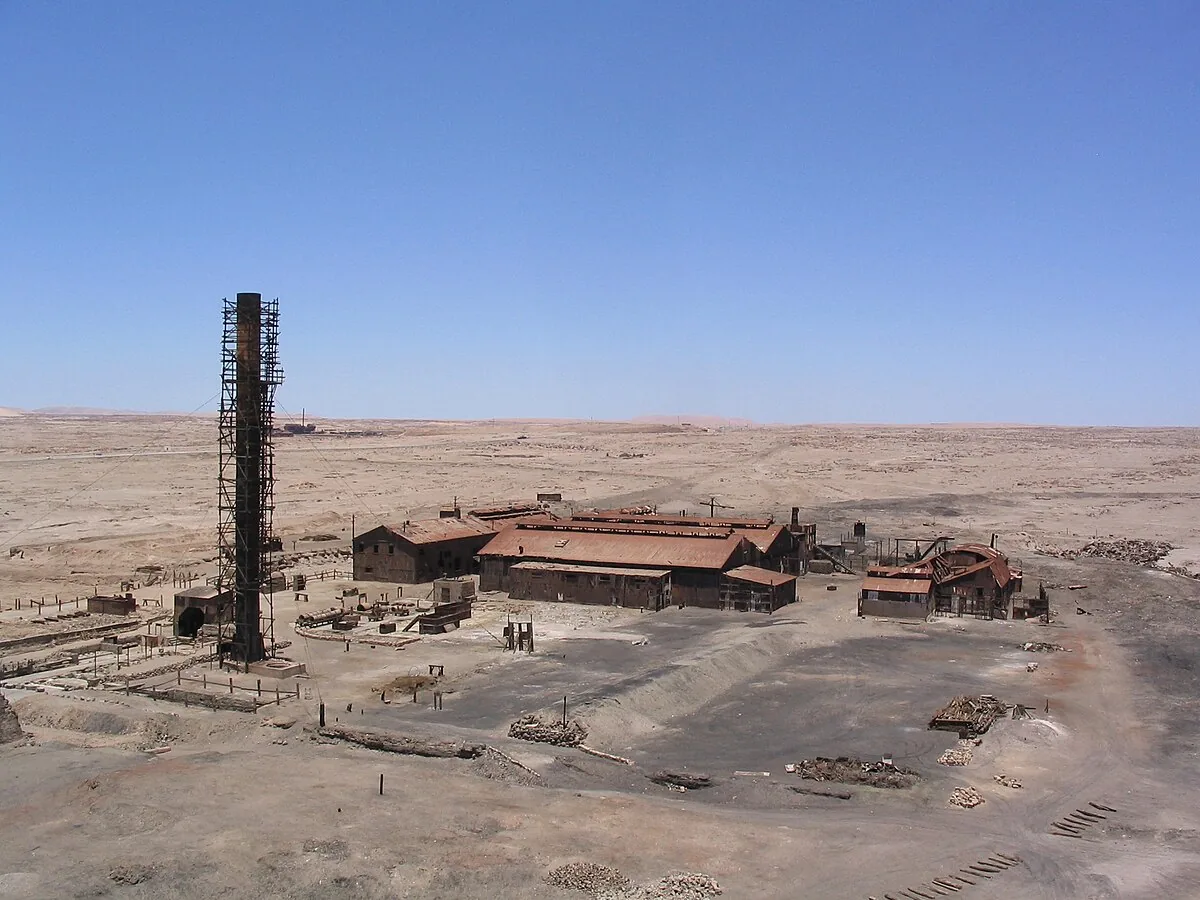
Humberstone is a ghost town in the Atacama
Desert that once processed saltpeter, the fertilizer that financed Chile's late-nineteenth-century economic boom. Now a UNESCO World Heritage Site, the abandoned company town preserves the machinery, the theatre, the church, the swimming pool, and the workers' housing from an industrial era that ended abruptly when synthetic fertilizer replaced natural nitrates in the 1930s.
Desert that once processed saltpeter, the fertilizer that financed Chile's late-nineteenth-century economic boom.
The Atacama Desert held the world's largest deposits of sodium nitrate, used as fertilizer and as a component of gunpowder. Between 1880 and 1930, Chilean nitrate exports generated enormous national wealth, funding public buildings, schools, and railways, and drew tens of thousands of workers from across South America and beyond. The oficinas (company towns) were entirely self-contained: workers were paid in scrip redeemable only at the company store, creating a form of economic captivity. When Fritz Haber and Carl Bosch developed synthetic ammonia production in the early twentieth century, natural nitrate demand collapsed. Humberstone closed in 1960, and by 1970 it was abandoned. It received UNESCO status it a World Heritage Site in 2005.
Walking the empty streets takes two to three hours. The theatre retains its wooden stage and seating. The swimming pool, once the center of social life, sits dry and peeling under the desert sun. The machinery buildings contain rusting processing equipment on a scale that makes the industrial operation comprehensible. The silence and the scale together produce an atmosphere that is difficult to manufacture and impossible to forget.
Humberstone is 47 kilometers east of Iquique on Route A-16. Buses and colectivos from Iquique's bus terminal serve the route; the journey takes about 40 minutes.
Humberstone is 47 kilometers east of Iquique on Route A-16.
The Experience
Two to three hours across a complete preserved ghost town, theatre, swimming pool, church, machinery halls, and workers' housing, in the specific silence of a large space that was once densely occupied.
Why It Matters
Humberstone documents both the extractive boom that shaped modern Chile and the social structure of company towns where workers lived in institutionalized dependency. Few industrial heritage sites convey the scale and human cost of a resource economy as clearly.
Why Visit
Ghost towns exist across the world, but few are this complete, this well-preserved, and this directly connected to national economic history. The UNESCO designation reflects genuine significance.
✦ Insider Tips
- 1
Bring water and sun protection, the site has no shade and temperatures regularly exceed 35°C.
- 2
The teatro is usually the most impressive interior; don't skip it.
- 3
The adjacent Santa Laura saltpeter works is another preserved oficina a few hundred meters away and is included in the same visit.