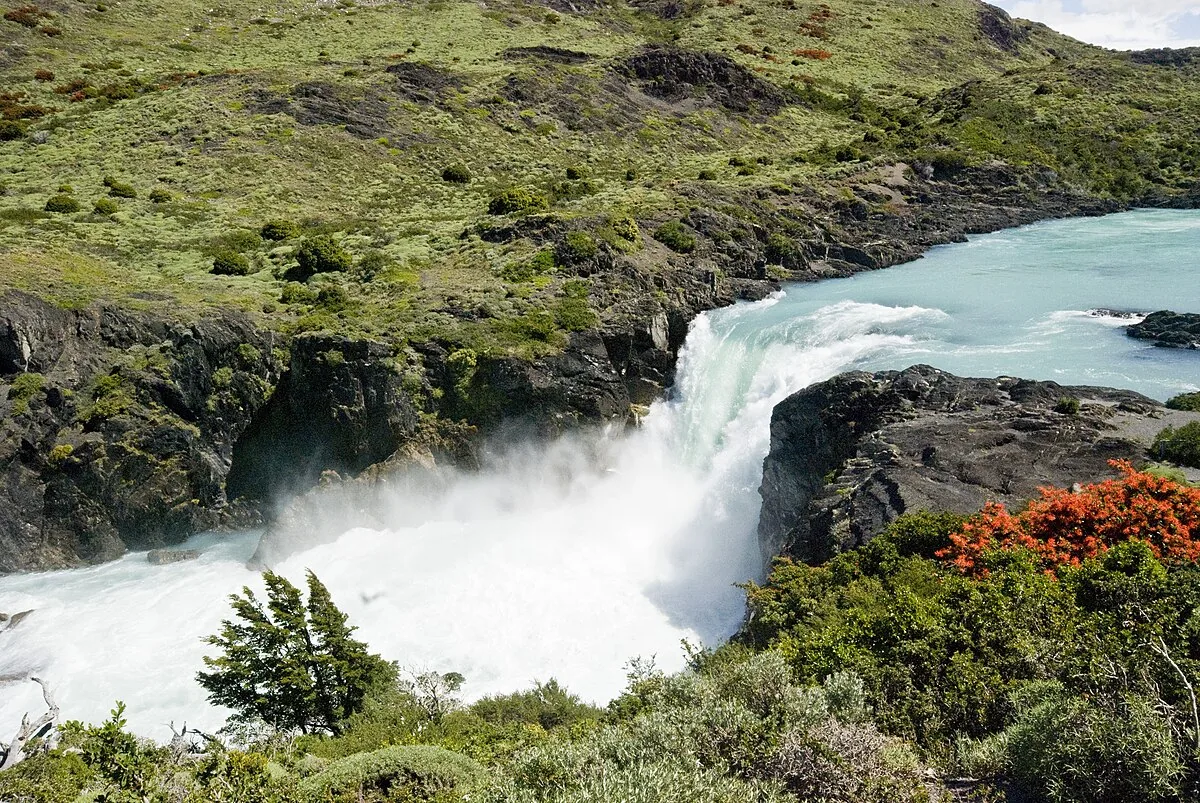
Where two glacial lakes collide, the force of Torres del Paine's meltwater compresses into a ten-meter plunge that shakes the bridge you stand on.
About Salto Grande
Shaped by glacial erosion during the last ice age, Salto Grande gained its current footpath access after Torres del Paine National Park was established in 1959 and trekking infrastructure connected the Pehoé and Grey sectors.
Salto Grande sits
Salto Grande sits at the narrowing between Lago Nordenskjöld and Lago Pehoé inside Torres del Paine National Park, where the combined outflow of glacial meltwater forces itself through a compressed channel with a force that shakes the viewing platform underfoot. The waterfall is not particularly tall, roughly ten meters, but the volume is extraordinary, and the turquoise color of the water against grey basalt creates a visual contrast that photographs struggle to reproduce accurately.
The name simply means great leap in Spanish . The waterfall has existed in its current form since glaciers shaped the Paine massif during the last ice age, carving the basins that now hold these interconnected lakes. Early estancia workers knew the spot, but it entered wider awareness only after the national park was established in 1959 and trekking routes began passing directly beside it. The suspension bridge built adjacent to the falls allowed the circuit trail to connect the Grey sector with the Pehoé sector without requiring a ferry crossing.
Standing on the bridge while wind channels through the gap is a physical experience as much as a visual one. The mist from the falls coats everything within twenty meters, and the roar of the water makes conversation difficult. Andean condors sometimes use the updrafts above the gorge, making it worth scanning the sky. The surrounding area, low scrub, exposed rock, and the steel-blue lake, has the particular austere beauty of Patagonian geography where nothing feels lush but everything feels honest.
Salto Grande is accessible from the Pehoé sector, roughly a four-kilometer round-trip walk from the Pehoé refugio. Day hikers using the park bus system can alight at the Pehoé stop and reach the falls within an hour. The path is well-marked and mostly flat, making it one of the park's more accessible major viewpoints.
The Experience
The viewing bridge places you within the spray zone, where wind and mist combine to make the falls a sensory event rather than just a scenic one. Condors occasionally circle the updrafts above the gorge.
Why It Matters
Salto Grande marks the natural boundary between two of the park's largest glacial lakes and serves as a key waypoint on both the W Trek and the full circuit.
Why Visit
Few waterfalls in South America combine accessible location, raw power, and a backdrop of this visual quality, the turquoise water against Patagonian scrub and distant granite towers is genuinely difficult to find elsewhere.
✦ Photo Gallery
Best Season
🌤 November through March offers the most stable weather and longest daylight hours. September and October bring more wind but fewer visitors.
Quick Facts
Best time to visit
November through March offers the most stable weather and longest daylight hours. September and October bring more wind but fewer visitors.
Getting there
In Torres del Paine, Chile; reach Torres del Paine first, then continue to the site.
Location
Torres del Paine, Chile
Type
attraction
Insider Tips
- 1
Wear a waterproof layer even on clear days, the spray zone extends well onto the bridge.
- 2
Arrive early or late to avoid the midday tour group concentration.
- 3
Check wind forecasts before leaving camp; sustained winds above 80 km/h can close the bridge temporarily.