“An American mining company built a city on Andean stairs at 2,200 meters, no cars, no flat ground, just staircases and a copper mine below it all. The city is empty now and a UNESCO World Heritage Site.”
About Sewell Mining Town
Built from 1905 by the Braden Copper Company to house El Teniente mine workers, Sewell peaked at 15,000 residents in the 1940s before being progressively emptied as commuter transport improved. The last residents left in the mid-1980s. UNESCO designation in 2006.
What Sewell Mining Town actually is
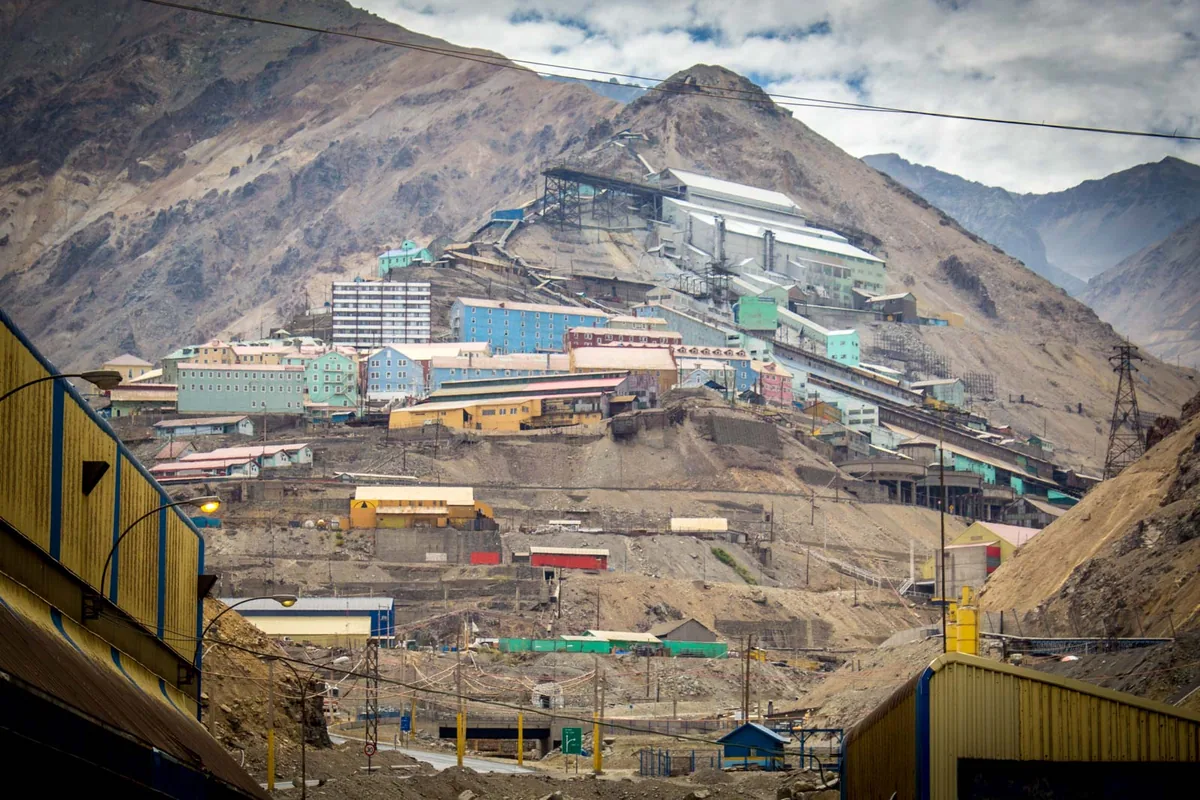
Sewell is a UNESCO World Heritage ghost town built into the Andes at 2,200 meters above sea level, 87 kilometers from Rancagua, where American mining engineers constructed a complete company city in the early twentieth century to house workers at the El Teniente copper mine, the world's largest underground copper mine. No cars were ever permitted in Sewell; the steep terrain meant everything moved on foot or by staircase, and the city's entire grid is built on stairs.
No cars were ever permitted in Sewell; the steep terrain meant everything moved on foot or by staircase, and the city's entire grid is built on stairs.
nationalized as Codelco, 1971
The Braden Copper Company (later acquired by Anaconda and then nationalized as Codelco in 1971) began building Sewell in 1905 to support El Teniente. At its peak in the 1940s, the town housed 15,000 people: miners, engineers, doctors, teachers, and their families. The company controlled everything, housing, stores, schools, hospital, recreation, and the social hierarchy was rigidly organized by nationality, with American engineers living separately from Chilean workers. When improved transport links allowed workers to commute from Rancagua in the 1970s and 1980s, Sewell was progressively emptied. The last residents left in the mid-1980s. It received UNESCO status it a World Heritage Site in 2006.
Visiting Sewell Mining Town
Access is by train or bus from Rancagua, followed by a guided tour of the preserved buildings, the famous staircase system, and the mountain setting above the snowline. The red and yellow painted buildings against the grey-green Andean terrain are visually striking in a way that photographs don't quite convey. The mine itself remains active, Sewell sits above a still-functioning industrial operation.
Guided tours depart from Rancagua, 87 kilometers south of Santiago. Independent access is not permitted; visits must be arranged through authorized tour operators.
Guided tours depart from Rancagua, 87 kilometers south of Santiago.
The Experience
A guided tour through a complete mountain company town, red and yellow buildings, an urban grid built entirely on staircases, and a 2,200-meter setting above the snowline, with the world's largest underground copper mine still operating below.
Why It Matters
Sewell documents the specific form of corporate paternalism that shaped Latin American mining communities, and the staircase-only urban form is architecturally unique, a city designed around a terrain that made everything else impossible.
Why Visit
Industrial heritage of this quality, at this scale, in a mountain setting of this drama, is almost entirely unique to Sewell. The UNESCO designation reflects a site that genuinely has no close equivalent.
✦ Insider Tips
- 1
Book tours through authorized Rancagua operators well in advance, capacity is managed and groups are limited.
- 2
Dress for weather 10°C cooler than Rancagua, the altitude difference is significant.
- 3
The train journey from Rancagua to Sewell is part of the experience; choose the train option if available.