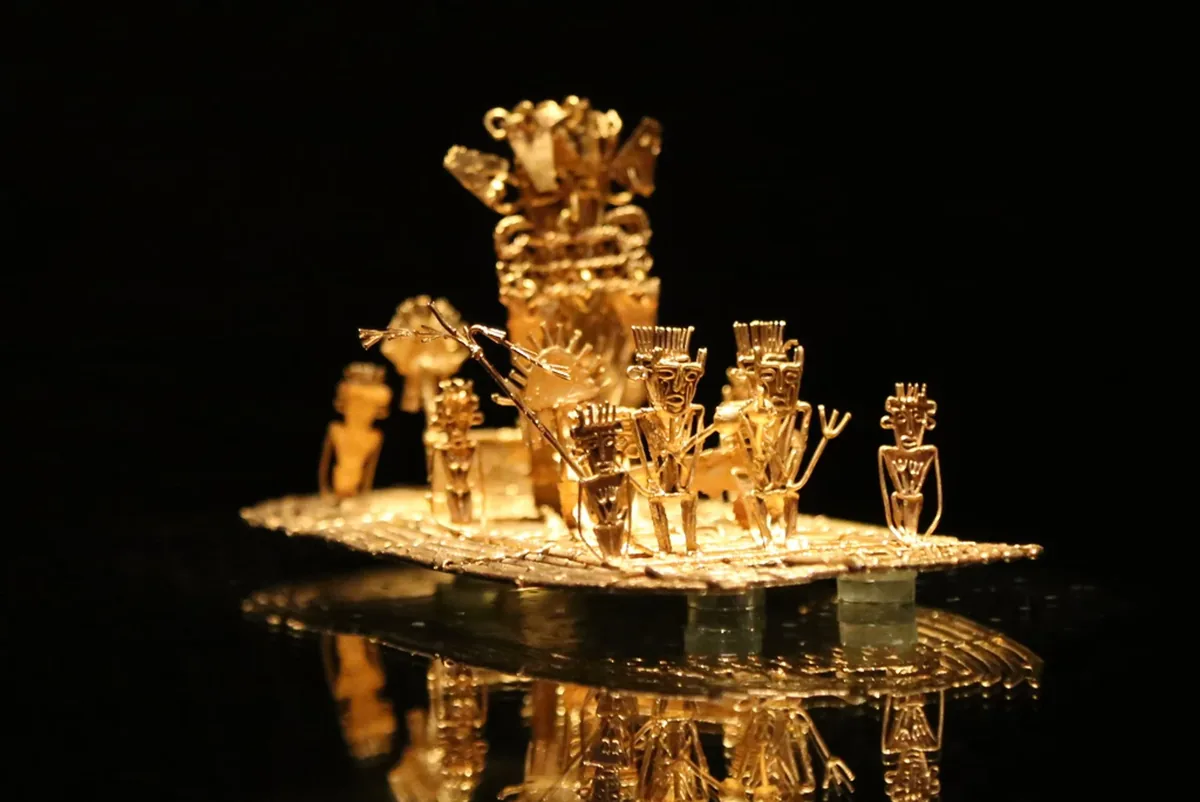
“The El Dorado legend came from here, from a ceremony involving a gold-covered chief casting offerings from a raft into a mountain lake. The gold raft he rode is in this museum. It is 11 centimeters long.”
About Museo del Oro
The Banco de la República began collecting pre-Columbian gold in 1939 to prevent export and melting. The collection grew to 55,000 pieces representing twelve distinct indigenous goldworking traditions. The current building opened 2008.
Museo del Oro in short
The Gold Museum in Bogotá holds the largest collection of pre-Columbian gold artifacts in the world, 55,000 pieces spanning multiple indigenous cultures from across what is now Colombia, Ecuador, and Panama, accumulated over centuries before Spanish conquest. The museum is the most visited in Colombia and the primary institution through which the country presents its pre-Hispanic identity to itself and to the world.
The museum is the most visited in Colombia and the primary institution through which the country presents its pre-Hispanic identity to itself and to the world.
collecting gold objects, 1939
The Banco de la República began collecting gold objects in 1939 to prevent their export and melting. The collection grew over the following decades as the bank purchased pieces from private collections and negotiated acquisitions from communities and dealers. The objects represent not a single culture but a dozen, Muisca, Zenú, Tairona, Quimbaya, Calima, Nariño, and others, each with distinct goldworking traditions, iconographic systems, and ritual uses for metal objects. The most famous single piece, the Muisca Raft, is an 11-centimeter gold votive figure depicting a cacique surrounded by attendants on a raft, the physical object most closely associated with the El Dorado legend, which described a ceremony in which a gold-covered chief floated on a mountain lake and cast offerings into the water.
Visiting Museo del Oro
The museum was redesigned and reopened in 2008 in a building in the La Candelaria historic center. The permanent collection is arranged thematically, the social function of gold, goldworking technique, specific cultural traditions, rather than chronologically, which allows comparison across cultures. The final room, the Offering Room, is entered in darkness and then dramatically lit to reveal cases of gold objects surrounding the visitor on all sides, a theatrical presentation that is genuinely effective. The Muisca Raft is displayed in a case that allows 360-degree viewing.
The Museo del Oro is in the La
Candelaria historic center of Bogotá, on Calle 16 at Carrera 6. Metro and TransMilenio connections to La Candelaria; alternatively a short taxi from most Bogotá neighborhoods.
Candelaria historic center of Bogotá, on Calle 16 at Carrera 6.
The Experience
Thematic displays of 55,000 gold objects across twelve pre-Columbian cultures, culminating in the Offering Room, entered in darkness and lit to reveal surrounding cases of gold, where the Muisca Raft is the central object.
Why It Matters
The Museo del Oro is both the world's largest pre-Columbian gold collection and the primary institution through which Colombia articulates its pre-Hispanic cultural identity, a museum that frames national self-understanding as well as historical documentation.
Why Visit
The scale and quality of the collection is genuinely exceptional, the variety across twelve goldworking traditions demonstrates a diversity of pre-Columbian artistic achievement that most visitors have no prior framework for. The Offering Room presentation is one of the better museum theatrical moments in Latin America.
✦ Insider Tips
- 1
Allow three hours minimum, moving quickly through the collection produces a blur rather than an understanding.
- 2
The Muisca Raft is in a display case on the upper level; find it specifically rather than happening upon it.
- 3
The museum is free on Sundays, arrive early to avoid weekend crowds.