Four nine-meter white figures stand in Esbjerg's tidal flats, gazing across the North Sea toward England, rising from mudflats at low tide, standing in shallow water at high.
About Men at Sea
Svend Wiig Hansen's Men at Sea was commissioned in 1995 for Esbjerg's centenary. The port city's identity has long been tied to the North Sea, fishing, ferries, and oil industry, and the sculpture was intended to embody that relationship.
About Men at Sea
Mennesket ved Havet, Men at Sea, is a sculpture installation by Svend Wiig Hansen on the waterfront of Esbjerg, on Denmark's southwestern coast. Completed in 1995, it consists of four white figures, each nine meters tall, standing in the tidal flats and gazing out across the North Sea toward England. At high tide, the figures appear to stand in shallow water. At low tide, they rise from exposed mudflats. The piece changes with the tides in a way that no fixed indoor sculpture can.
“Mennesket ved Havet, Men at Sea, is a sculpture installation by Svend Wiig Hansen on the waterfront of Esbjerg, on Denmark's southwestern coast.”
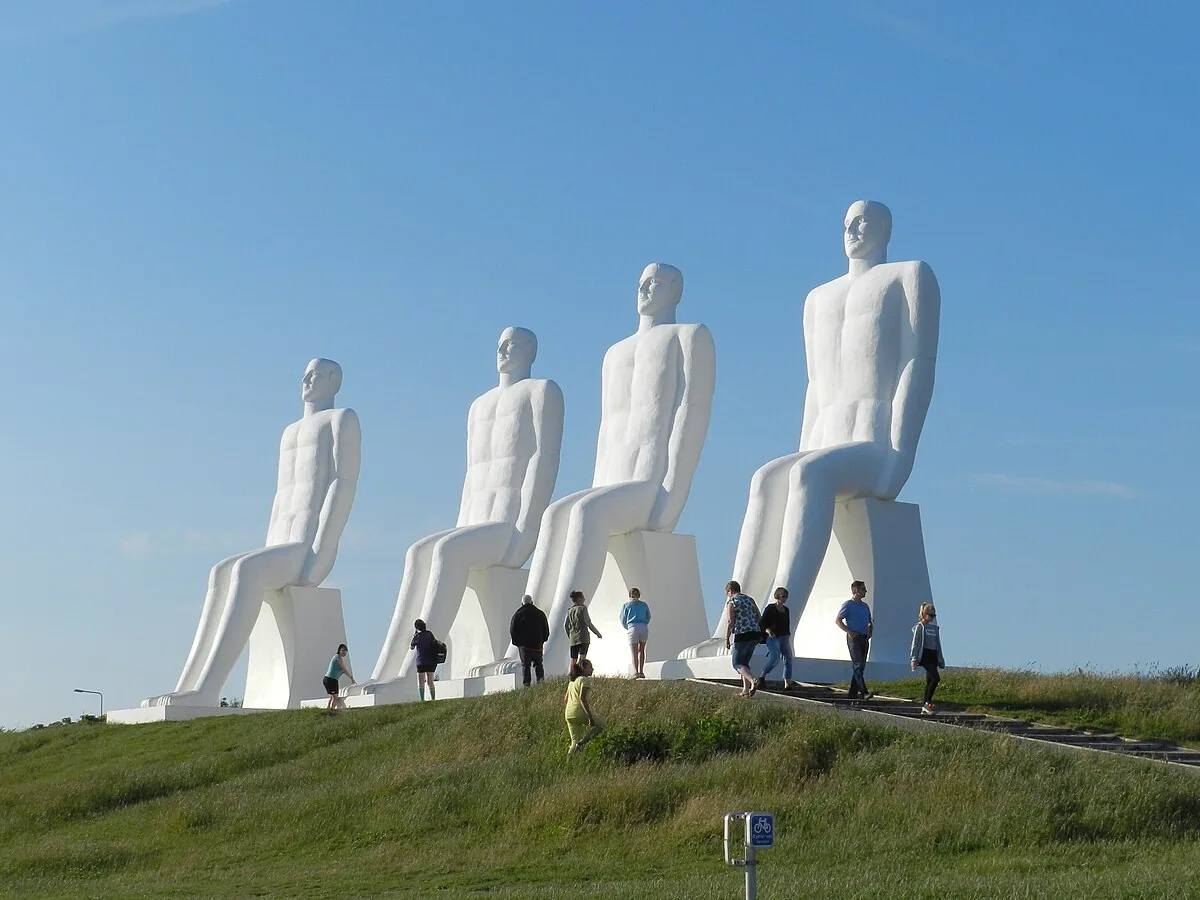
Men at Sea, Denmark
Wiig Hansen was commissioned to create the work for the hundredth anniversary of Esbjerg as a city. The port city grew in the late nineteenth century as a purpose-built harbor to serve the agricultural exports of Jutland, and its relationship with the North Sea, for fishing, ferry traffic, and later oil industry supply, has defined its character. The four figures were intended to represent the town's relationship with the sea and with England across the water. They have become one of Denmark's most photographed sculptures.
The figures stand at the edge of the Esbjerg harbor promenade, and you can walk close to the base of the installation at low tide. Their scale only becomes apparent when you're standing next to them, nine meters is substantial, and from a distance the figures read as much smaller. The North Sea context is essential: on gray days with a westerly wind, the installation has a weight that is hard to articulate. The nearby Fisheries and Maritime Museum supplements the visit with regional history.
Esbjerg is on the southwestern coast of Jutland, served by regular train service from Copenhagen (roughly three hours) and Aarhus (roughly one hour and forty minutes). The sculpture is a short walk from the city center.
“Esbjerg is on the southwestern coast of Jutland, served by regular train service from Copenhagen (roughly three hours) and Aarhus (roughly one hour and forty minutes).”
The Experience
Approach the figures on foot at low tide to understand their scale, observe how the tidal cycle changes their visual character completely, and visit the nearby Fisheries and Maritime Museum for regional context.
Why It Matters
One of Denmark's most recognized public sculptures and a site-specific work that depends on its coastal environment, the North Sea tide is as much a part of the piece as the figures themselves.
Why Visit
The installation's relationship with tidal change gives it a quality that photographs don't capture. Arriving at low tide, then returning at high tide, produces two entirely different experiences from the same sculpture.
Insider Tips
- 1
Check the local tide tables before visiting, the difference between low and high tide is the difference between mudflats and standing water.
- 2
The sculpture reads at a completely different scale from close up than from photos. Walk to the base.
- 3
Gray, overcast days often produce the most affecting atmosphere. Clear summer days are beautiful but the piece can feel lighter than intended.