“Denmark's oldest town has been continuously inhabited for over thirteen centuries, and its medieval street plan is largely unchanged.”
About Ribe Old Town
Ribe began as a Viking-age trading post around 700 CE, grew into a major North Sea port, and became an important ecclesiastical center in southern Jutland. It escaped major fires and industrialization, preserving its medieval layout almost intact.
What Ribe Old Town actually is
Ribe is Denmark's oldest town, and that title comes with genuine weight. Founded around 700 CE as a Viking-age trading post on the Ribe River, it has been continuously inhabited for thirteen centuries, longer than most European cities that get considerably more attention. The medieval street plan remains essentially unchanged. Walking the same routes that merchants, bishops, and pilgrims walked a thousand years ago.
Ribe is Denmark's oldest town, and that title comes with genuine weight.
The town grew rapidly because of its position at the mouth of a tidal river leading to the North Sea. Ships from England, the Rhineland, and the Baltic unloaded goods at Ribe's quays throughout the early medieval period. A cathedral was begun here in the twelfth century, and the town became a significant ecclesiastical center for southern Jutland. Unlike many Danish towns, Ribe was never burned or significantly rebuilt by industrialization. It stayed small, and in doing so, preserved itself almost by accident.
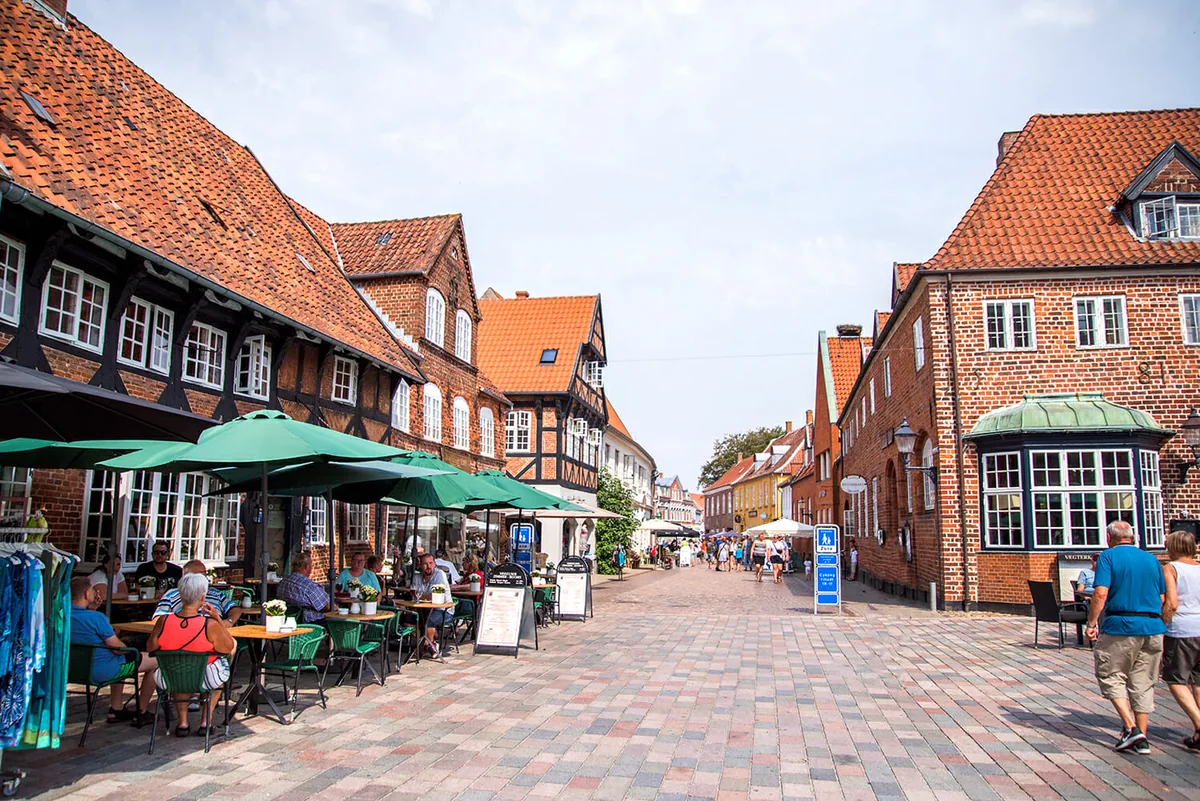
The cathedral, Ribe Domkirke, dominates the skyline and rewards a full visit. Its mix of Romanesque and Gothic architecture reflects seven centuries of construction and modification. Climb the tower for a view of the flat marshland stretching toward the Wadden Sea. The surrounding lanes are filled with half-timbered houses, some dating to the sixteenth century. The Viking Museum Ribe presents archaeological finds from the early trading settlement in clear, informative displays. Each summer evening, the Ribe Night Watchman leads a lantern tour through the old streets, theatrical but genuinely informative about local history.
Ribe sits on the southwestern edge of Jutland, roughly forty-five minutes south of Esbjerg by car. Train connections run from Esbjerg with a change at Bramming. The town center is fully walkable once you arrive.
Ribe sits on the southwestern edge of Jutland, roughly forty-five minutes south of Esbjerg by car.
The Experience
Walk lanes of half-timbered houses, visit the Romanesque-Gothic cathedral, explore Viking-era archaeological finds at the local museum, and join the traditional evening Night Watchman tour through the old streets.
Why It Matters
Ribe is the oldest continuously inhabited town in Denmark and one of Scandinavia's best-preserved medieval urban environments.
Why Visit
Few places in northern Europe offer this density of genuine medieval streetscape without crowds or commercialization. Ribe is the real thing, quiet, intact, and historically coherent.
✦ Insider Tips
- 1
Buy a combined ticket for the cathedral and tower, the tower view over the flat marshlands is worth the climb.
- 2
The Night Watchman tour runs at 8pm in summer from the main square. It's more interesting than it sounds.
- 3
Book accommodation early in July, the town fills up during the summer festival season.
- 4
The Wadden Sea National Park visitor center is a twenty-minute drive and pairs well with a Ribe visit.