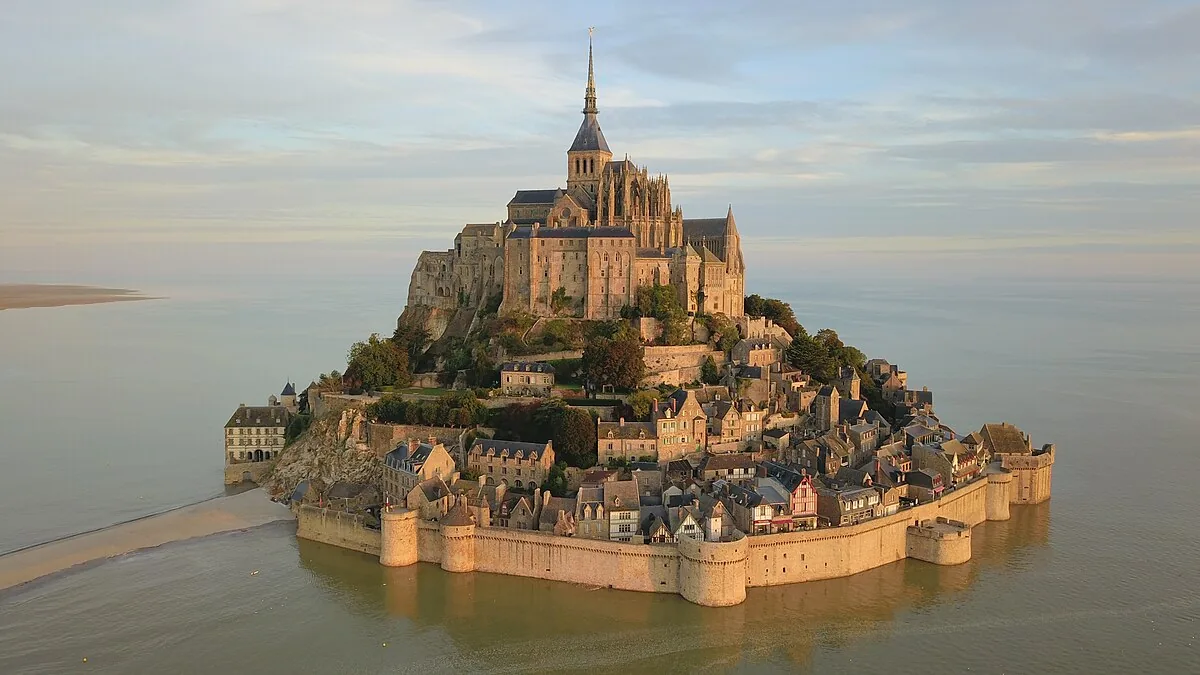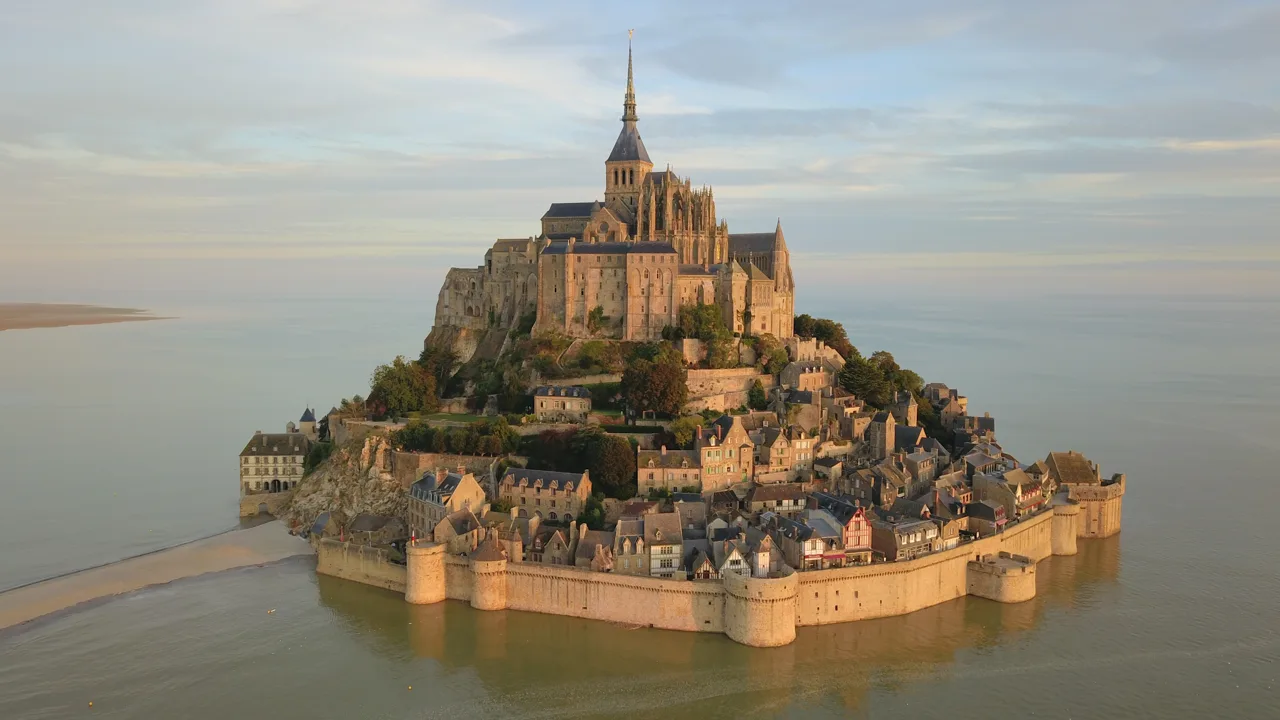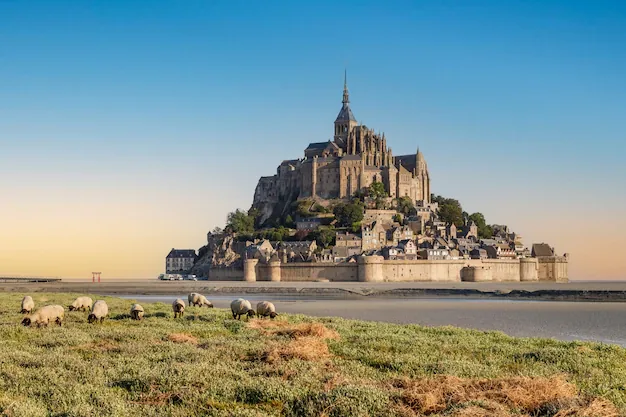
They started building an abbey on a pointed rock in the year 708 and never really stopped, adding floors vertically for a thousand years because there was nowhere else to go.
About Abbaye du Mont-Saint-Michel
Bishop Aubert founded an oratory on the rock in 708. Benedictine monks began major construction in the 10th century. The 13th-century La Merveille is the architectural high point. The abbey served as a prison after the Revolution and was restored in the 19th century. Benedictine monks returned in 1966. The site has been a UNESCO World Heritage listing since 1979.
In brief
Mont-Saint-Michel is a tidal island off the Normandy coast, crowned by a Benedictine abbey that has been a site of pilgrimage, military defence and architectural ambition since the 8th century. The abbey sits at the pinnacle of a granite outcrop that rises 80 metres above the bay, connected to the mainland by a modern bridge that allows the tides to flow freely around it.
A Thousand Years of Building Upward
The story begins in 708, when Bishop Aubert of Avranches reportedly built a small oratory on the rock after a vision of the Archangel Michael. The Benedictines arrived in the 10th century and began the project of building a major abbey on what is essentially a pointed rock. The engineering challenge was solved by constructing a series of crypts and supporting structures on the steep slopes to create level platforms, culminating in the church and the complex known as La Merveille, the Marvel, a 13th-century Gothic masterpiece of refectory, cloister and knights' hall stacked vertically on the north face. The abbey has was a fortress, a prison during the French Revolution, and a monastery again since 1966. The bay around it experiences some of Europe's most extreme tidal shifts, up to 14 metres, and at high tide the island appears to float on the water.
The Experience
You cross the bridge from the mainland and climb through the village of narrow streets and medieval houses to the abbey at the summit. The final staircase leads to the church, and the cloister of La Merveille offers views out over the bay. The tidal flats below change character with every tide cycle. At high tide, the island is surrounded by water; at low tide, you can walk on the exposed sand, guided by professionals, as quicksand is a real hazard.
Why It Matters
Mont-Saint-Michel is one of the most remarkable architectural achievements in Europe, a vertical monastery constructed over a thousand years on a tidal rock. It is among the most visited sites in France and a UNESCO World Heritage Site.
Why Visit
A Benedictine abbey built vertically over a thousand years on a tidal island, one of the most extraordinary architectural sites in Europe.
✦ Photo Gallery
Best Season
🌤 Late spring and early autumn are least crowded. Check tide tables: a spring high tide with the island surrounded by water is spectacular.
Quick Facts
Entry
Free to enter the village; the abbey costs around 13 EUR.
Opening hours
The abbey is open daily, roughly 9:30am to 6pm, with seasonal and night-visit variation.
Time needed
About half a day.
Best time to visit
Late spring and early autumn are least crowded. Check tide tables: a spring high tide with the island surrounded by water is spectacular.
Getting there
On a tidal islet off Normandy; reached by car or train to nearby towns then a shuttle across the causeway, as cars park on the mainland.
Location
Mont Saint-Michel, France
Type
attraction
Insider Tips
- 1
Check tide tables before visiting for the best experience.
- 2
Arrive early to beat the crowds on the narrow village streets.
- 3
Do not walk on the tidal flats without a licensed guide.
- 4
Stay overnight on the island to see it after the day visitors leave.