The largest concentration of Renaissance civil architecture in France outside Paris was built by Italian banking families whose credit financed the French Crown, and the traboules, covered passageways through city blocks, were used by silk workers and later by Resistance fighters during the occupation.
About Vieux Lyon
Lyon's fifteenth and sixteenth-century prosperity came from the silk trade and Italian banking families who made the city France's financial capital. The traboules' practical origin as silk-carrier routes became a wartime utility during the Second World War Resistance; the Renaissance townhouses they connect remain the most complete such concentration in France.
What Vieux Lyon actually is
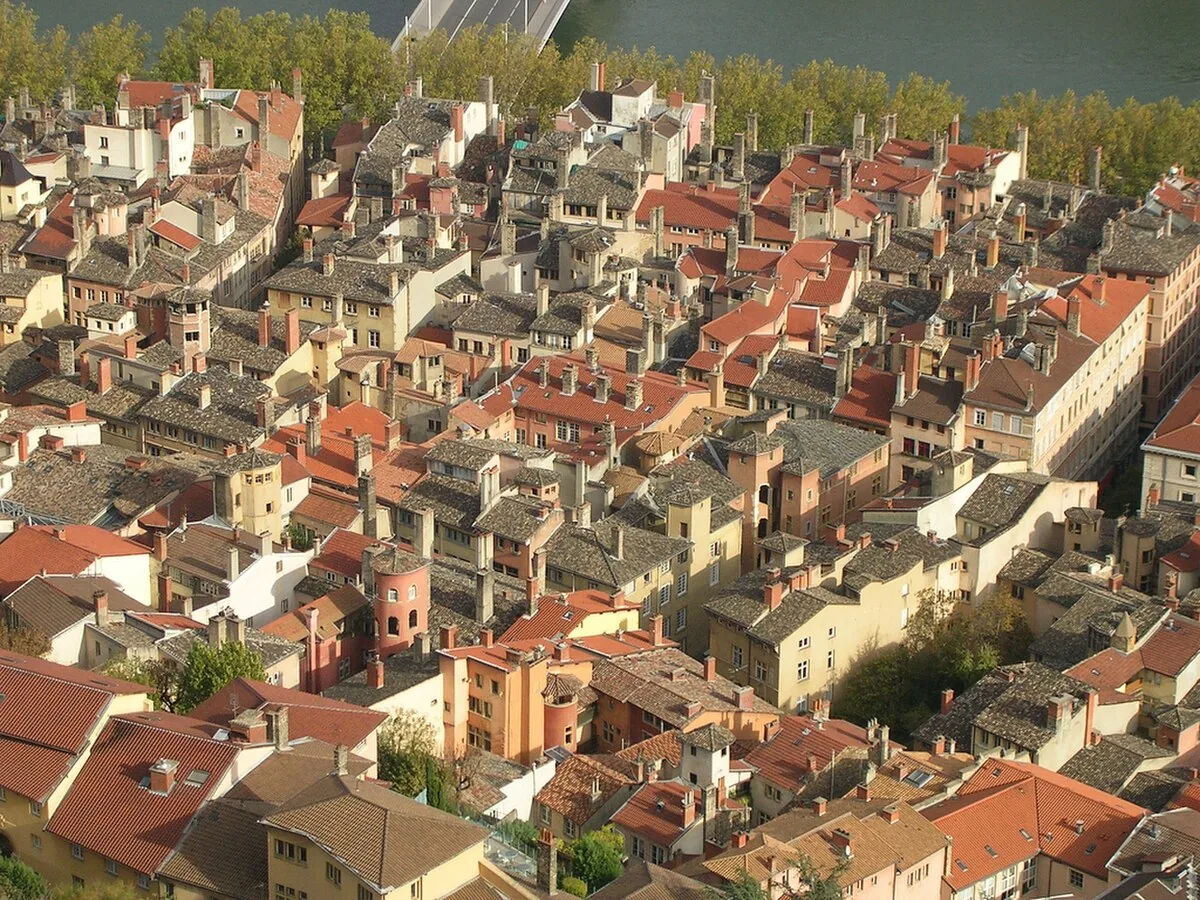
Vieux Lyon is the medieval and Renaissance old town of Lyon, on the right bank of the Saône, covering three distinct neighborhoods, Saint-Jean, Saint-Paul, and Saint-Georges, in a UNESCO World Heritage zone of approximately 30 hectares. The district contains the largest concentration of Renaissance civil architecture in France after Paris, built during the period when Lyon was the financial capital of the country and home to the Italian banking families whose wealth funded the French Crown. The traboules, covered passageways cutting through the interior of city blocks, connecting streets through courtyards and stairwells, are the distinctive urban element that makes Vieux Lyon navigable in ways that conventional street grids are not.
Lyon's Renaissance prosperity was built on silk and banking. The city was the center of the French silk trade from the fifteenth century, employing thousands of weavers in the Croix-Rousse neighborhood above the old town; simultaneously, Italian merchant families, the Guadagni, the Gondi, the Gadagne, established banking houses in Lyon that became the primary source of credit for the French monarchy. The wealth generated by these activities financed the construction of the Renaissance townhouses visible in Vieux Lyon today, with their characteristic stone spiral staircases in open courtyards. The traboules, whose word derives from the Latin 'trans ambulare' (to pass through), were originally practical routes for silk workers carrying goods to market; they were later used by Resistance fighters during the Second World War occupation.
The traboules are the primary urban experience, entering a Renaissance courtyard through a heavy wooden door and climbing to the street on the other side through a covered passageway connects layers of the district in ways that the street plan doesn't suggest. The Gadagne Museum complex in a Renaissance mansion covers Lyon's urban history and a puppet museum dedicated to Guignol, Lyon's contribution to European puppet theater. The Cathédrale Saint-Jean at the district's south end has an astronomical clock from the fourteenth century that shows the date, the position of the sun and moon, and the feast days of saints for the following 150 years. The Lyon bouchon restaurants, traditional bistros serving the city's most characteristic dishes, are at their most authentic in Vieux Lyon.
Vieux Lyon has its own Metro station on line D (Vieux-Lyon, Cathédrale Saint-Jean). Lyon is two hours from Paris by TGV. The Fourvière hill and Roman amphitheatres above Vieux Lyon are accessible by funicular from the Vieux-Lyon Metro station.
The Experience
Navigate the traboules through Renaissance courtyards connecting streets on different sides of city blocks, visit the Gadagne Museum in a Renaissance mansion for Lyon's urban history and the Guignol puppet collection, read the fourteenth-century astronomical clock at Saint-Jean cathedral, and eat at a Lyon bouchon restaurant.
Why It Matters
A UNESCO World Heritage Site containing the largest collection of Renaissance civil architecture in France, the physical record of Lyon's role as France's financial and silk-trade capital in the fifteenth and sixteenth centuries.
Why Visit
The traboules are genuinely unusual as an urban experience, moving through the interior of city blocks via Renaissance courtyards and covered passageways produces a spatial understanding of the district that walking the streets alone doesn't give. The Lyon bouchon restaurant tradition, in its most authentic Vieux Lyon form, is one of France's strongest regional food cultures.
✦ Photo Gallery
Best Season
🌤 Year-round. Lyon's Fête des Lumières in December illuminates the entire city with artistic light installations, one of Europe's largest light festivals. Spring and autumn offer the most comfortable street-walking temperatures.
Quick Facts
Best time to visit
Year-round. Lyon's Fête des Lumières in December illuminates the entire city with artistic light installations, one of Europe's largest light festivals. Spring and autumn offer the most comfortable street-walking temperatures.
Getting there
In Lyon, France; reach Lyon first, then continue to the site.
Location
Lyon, France
Type
attraction
Coordinates
45.7622°, 4.8267°
Insider Tips
- 1
The tourist office provides a traboule map indicating which are publicly accessible, not all are open to visitors.
- 2
The bouchon restaurant lunch menu (typically two courses for a fixed price) is the most authentic and economical entry point to Lyon's food culture.
- 3
The Fourvière Roman amphitheatres above the old town are reached by funicular from the Metro station, include them for the elevated view over Lyon.
- 4
The fourteenth-century astronomical clock in Saint-Jean cathedral activates at noon, 2pm, 3pm, and 4pm, time your visit to see the automata mechanism.