Two million blocks of volcanic stone were carved into a massive three-dimensional mandala without a single ounce of cement, only to be swallowed by a jungle for eight centuries.
About Borobudur Temple
Constructed during the peak of the Sailendra dynasty’s influence in the 8th and 9th centuries, Borobudur was designed as a physical map of the path to Nirvana. The architects used andesite stone quarried from nearby rivers, carving over 500 Buddha statues to inhabit the various levels. By the year 1000, however, the site began its long descent into obscurity, likely due to a combination of shifting trade routes and catastrophic volcanic activity from the surrounding peaks. When the British administrator Thomas Stamford Raffles heard whispers of a 'buried mountain of carvings' in 1814, he launched an expedition that would bring Borobudur back to global consciousness. The subsequent century saw the temple suffer from looting and well-intentioned but damaging repairs. It wasn't until 1973 that a definitive, international effort succeeded in stabilizing the hill upon which the temple sits, ensuring that the stone galleries would no longer slide into the earth during the monsoon season.
What Borobudur Temple actually is
Rising from the emerald heart of Central Java, this gargantuan stone lotus bud remained buried under layers of volcanic ash and jungle growth for nearly a thousand years. Borobudur is the largest Buddhist monument on earth, a mountain of grey andesite carved with such obsessive detail that it functions as a three-dimensional library of enlightenment. The temple complex is built without a drop of mortar, its two million stone blocks held together by ingenious interlocking joints that have survived earthquakes and the slow creep of time. As the morning mist clings to the surrounding Menoreh Hills, the silhouette of the central stupa pierces the haze, creating a scene that feels less like a ruin and more like a celestial vessel that has just touched down in the tropics. On all sides, There is a scent of damp moss and frangipani, heavy with the tropical humidity that makes the stone feel almost alive under your palms.
“Rising from the emerald heart of Central Java, this gargantuan stone lotus bud remained buried under layers of volcanic ash and jungle growth for nearly a thousand years.”
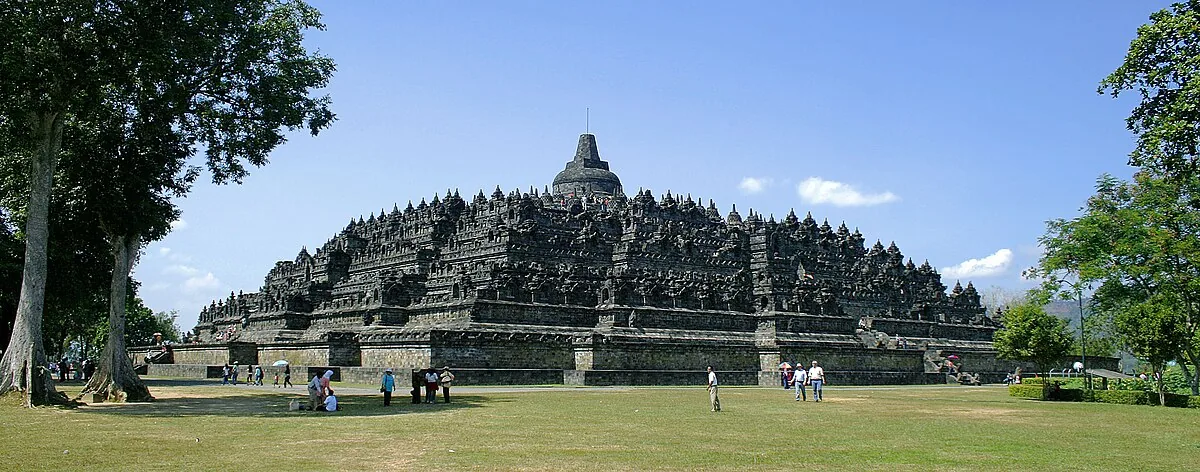
Borobudur Temple, Indonesia
this cosmic project, 750
Sailendra Dynasty architects began this cosmic project around 750 AD, likely taking nearly a century to complete a structure that mirrors the Buddhist conception of the universe. For reasons still debated by historians, the temple was abandoned in the 14th century as the center of Javanese power shifted eastward and Islam became the dominant faith. Volcanic eruptions from nearby Mount Merapi eventually choked the galleries with ash, allowing the jungle to reclaim the site until Sir Thomas Stamford Raffles 'rediscovered' it in 1814. Raffles sent two hundred men to hack away the vegetation, revealing the staggering narrative of over 2,600 relief panels. A massive UNESCO-led restoration in the 1970s involved dismantling the entire structure to install modern drainage, essentially solving the thousand-year-old problem of tropical rain eroding the foundation.
Magelang is the closest gateway, but most
Magelang is the closest gateway, but most travelers journey from Yogyakarta, roughly forty kilometers to the south. Hiring a private driver for the pre-dawn trek is the local standard, allowing you to bypass the chaotic bus schedules and arrive before the first light breaks over the volcano. The drive takes about an hour, winding through rice paddies and small kampungs where the smell of woodsmoke marks the beginning of the Javanese day. For the adventurous, cycling from Yogyakarta provides a slow-motion immersion into the landscape, though the final incline toward the temple park requires a respectable level of stamina.
Visiting Borobudur Temple
Ascending the temple is designed to be a physical prayer, moving from the base levels depicting worldly desires to the circular upper terraces representing formlessness. What you catch first is the rough, pitted texture of the volcanic rock, which stays cool even as the Java sun begins to bake the valley. Along the circumambulation path, the sheer density of the carvings becomes overwhelming; you see elephants, musicians, and celestial dancers emerging from the stone in high relief. Sound-wise is a mix of distant calls to prayer from local villages and the soft scuff of feet on the stone corridors. Reaching the upper circular platforms, the architectural language changes from dense storytelling to an open, serene forest of seventy-two perforated stupas. Each of these bell-shaped cages contains a seated Buddha, peering out through diamond-shaped lattice at the sprawling palm forests below. There is a sudden, airy liberation as the view opens up 360 degrees, revealing the smoke-plumed peak of Merapi on the horizon. The bit that stays with you is the touch of the stone stupas at dawn, when the rock is still cold and the world below is a sea of white clouds.
The Experience
What catches you first is the scent of the morning air, a crisp, herbal fragrance that only exists before the tropical heat truly takes hold. As you walk the lower corridors, the walls are so close and the carvings so intricate that you feel a sense of immersion in a stone-bound storybook. Audible: the rhythmic 'click' of the special sandals required to protect the ancient steps, a sound that replaces the usual rubber-soled thud of modern tourism. Reaching the top, the sense of enclosure vanishes, replaced by a vast, silent panorama of the Kedu Plain. The moss growing in the crevices of the stupas, a bright green velvet against the somber grey rock. The light at this altitude has a golden, liquid quality that softens the harsh edges of the volcanic stone, making the Buddhas appear as if they are meditating in a dream.
Why It Matters
Borobudur represents the absolute pinnacle of Buddhist art and architecture in the Southern Hemisphere, a bridge between the Indian origins of the faith and its unique Javanese evolution. It matters because it is a survived archive of 9th-century life, depicting everything from royal court rituals to the flora and fauna of ancient Indonesia. Humanly, it works as a monument to the endurance of belief, surviving ash, earthquakes, and time itself.
Why Visit
Visit Borobudur because it offers a rare opportunity to literally walk through a philosophy. While other temples are places to look at, Borobudur is a place to move through, where the architecture physically guides your body and mind toward a state of calm. It is the only place on earth where you can watch the sunrise from the top of a stone lotus while volcanoes smolder in the distance.
Insider Tips
- 1
Arrive at the gate the moment it opens to reach the upper terraces before the heat makes the stone steps radiate a punishing warmth.
- 2
Look closely at the relief panels on the hidden base level; they depict a gritty, earthly reality that was later covered up to strengthen the temple’s foundation.
- 3
Bring a small flashlight even for day visits to appreciate the depth of the carvings in the shaded lower galleries where the sun rarely hits directly.
- 4
Wear the provided 'Upanat' sandals throughout your visit, as they are specifically designed to reduce the friction that erodes the soft volcanic stone.
- 5
Hire a local guide specifically for the lower levels; without a storyteller, the 2,600 panels become a beautiful but silent blur of characters.