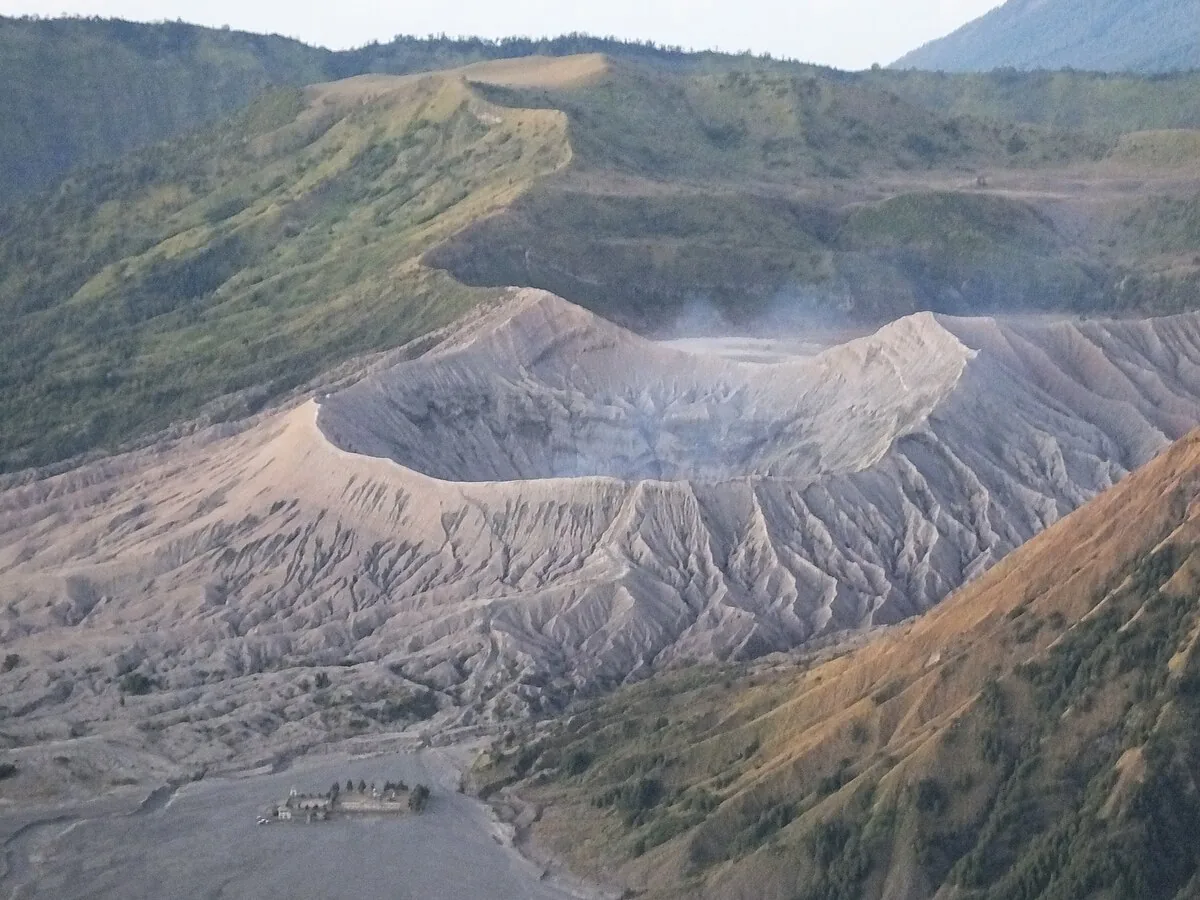
A silent desert of grey ash sits inside a collapsed mountain, where every year a local community hurls livestock and fruit into a smoking abyss to appease an ancient god.
About Mount Bromo
The Tengger massif was once a single massive peak that collapsed into itself thousands of years ago, leaving behind the circular wasteland we see today. Since the 15th century, the Tenggerese people have maintained a unique Hindu-Buddhist enclave here, surviving in the rugged highlands as the Majapahit Empire crumbled below. In 1919, the region was officially declared a national monument by the Dutch colonial government, though its spiritual significance remained entirely in the hands of the local priests. The volcano’s activity has frequently reshaped the landscape, with significant eruptions in 2004, 2010, and 2011 showering the surrounding villages in ash and closing the park for months. Despite the geological danger, the symbiotic relationship between the mountain and its people remains unbroken, with the annual Yadnya Kasada ceremony drawing thousands to the crater's edge to offer sacrifices to the fire.
What Mount Bromo actually is
Night usually breaks first over the Sea of Sand, a vast caldera of volcanic ash that feels more like a lunar landscape than a corner of East Java. Mount Bromo sits at the heart of this desolation, its crater venting a constant, white plume of sulfurous steam against a sky that transitions from indigo to a bruised orange at dawn. Unlike the lush, terraced rice paddies that define the rest of the island, the Bromo Tengger Semeru National Park is a place of raw, elemental power where the earth still breathes with a heavy, rhythmic sigh. At 2,329 meters is biting and thin, carrying the unmistakable scent of matches and cold minerals. At the top of the rim of the crater, you look down into a swirling abyss of volcanic gas, while behind you, the jagged peaks of the Tengger massif rise like the teeth of a saw. This is not just a mountain; it is a living altar in the middle of a desert made of dust.
The back story
Ancient eruptions created the ten-kilometer-wide Tengger caldera, a geological amphitheater where smaller volcanoes like Bromo eventually emerged. The mountain takes its name from Brahma, the Hindu creator god, and has remained a sacred site for the Tenggerese people for centuries. According to local lore, a childless royal couple once begged the mountain gods for help and were granted twenty-five children on the condition that the last child be sacrificed back to the crater. This legend birthed the Yadnya Kasada festival, which has survived the Islamization of Java to remain a vibrant annual tradition. During the 15th century, Hindu refugees from the Majapahit Empire sought sanctuary in these high-altitude villages, establishing an isolated culture that continues to guard the volcano today. While modern volcanologists monitor the crater with sensors, the local priests still read the mountain through the color of its smoke and the tremors beneath their feet.
The biting chill first, a damp cold that seeps through layers of wool as you wait for the sun to crest over the Penanjakan viewpoint. What is audible of the caldera is a low, industrial roar, a mechanical hum produced by the pressure of the earth’s interior escaping through the vent. The walk across the Sea of Sand, the grey dust kicks up in fine clouds that coat your boots and muffle the sound of the small, sturdy horses that ferry travelers to the base of the stairs. There is a vibration in the concrete steps climbing the final 253 rungs to the crater rim, where the wind suddenly whips across the narrow ledge. Visitors generally overlook the tiny, temporary shrines tucked into the volcanic rock, where locals leave flowers and rice even on ordinary Tuesdays. Sound-wise is the crunch of volcanic cinders underfoot, a sharp, brittle sound that emphasizes the fragility of the path. The moment that stays with you is the silence of the descent, when the sun is high enough to reveal the true scale of the desert you just crossed. Probolinggo is the primary hub for those arriving by train or bus from Surabaya or Malang. From there, a fleet of brightly colored minibuses winds up the steep mountain roads to the village of Cemoro Lawang, the final outpost of civilization perched on the very edge of the caldera. People typically arrive in the dead of night, transferring to four-wheel-drive jeeps that are the only vehicles capable of navigating the shifting sands of the basin floor. The drive from Surabaya’s Juanda International Airport takes roughly four hours, providing a dramatic shift from the humid urban sprawl to the high-altitude, temperate climate of the national park.
The Experience
You feel the fine volcanic grit in your teeth and hair long before you reach the summit, a reminder that the mountain is constantly shedding its skin. The light at 5:00 AM has a strange, translucent quality, making the white steam of the crater glow like a neon sign against the dark silhouette of the nearby Batok volcano. What you catch first is the smell of horse sweat and sulfur, a pungent combination that defines the trek across the basin. From somewhere comes the deep, rhythmic thud of the earth’s pulse, a sound that feels more like a feeling in your chest than a noise in your ears. Visitors generally are so focused on the sunrise that they miss the intricate patterns the wind carves into the ash dunes below, a natural art gallery that vanishes with every heavy rain. The experience is one of profound isolation, even in the company of other travelers, as the sheer scale of the caldera makes everything human feel temporary.
Why It Matters
Mount Bromo matters as one of the few places where the geological violence of the Pacific Ring of Fire is in constant, visible dialogue with human faith. It is a cultural fortress for the Tenggerese Hindus, whose traditions provide a living link to Java's pre-Islamic past. Environmentally, the park preserves a rare alpine ecosystem within the tropics, where frost is common and the landscape is governed by fire.
Why Visit
Visit Bromo because it is the only place in the world where you can stand on the edge of a roaring volcanic vent without being a professional mountaineer. It offers a cinematic, otherworldly beauty that makes the most famous peaks in Europe look tame. You come for the sunrise, but you stay because the feeling of standing on the rim of the world is genuinely transformative.
✦ Photo Gallery
Best Season
🌤 Dry season, from June to August offers the most reliable weather for clear sunrises and ensures the Sea of Sand doesn't turn into a muddy, impassable bog.
Quick Facts
Best time to visit
Dry season, from June to August offers the most reliable weather for clear sunrises and ensures the Sea of Sand doesn't turn into a muddy, impassable bog.
Getting there
In Probolinggo, Indonesia; reach Probolinggo first, then continue to the site.
Location
Probolinggo, Indonesia
Type
attraction
Coordinates
-7.9417°, 112.9500°
Insider Tips
- 1
Skip the crowded main viewpoint at Penanjakan 1 and hike twenty minutes further up the trail to 'King Kong Hill' for a better angle with fewer selfie sticks.
- 2
Bring a high-quality N95 mask or a thick buff; the sulfur fumes at the crater rim can be overwhelmingly acidic and irritating to the lungs on windy days.
- 3
Walk the trail back to Cemoro Lawang after sunrise instead of taking the jeep to see the wildflowers and alpine vegetables growing in the volcanic soil.
- 4
Check the local lunar calendar for the Yadnya Kasada festival date; witnessing the midnight trek to the crater is a spiritual experience unlike any other in Indonesia.