Blue flames lick the darkness of a volcanic pit where men carry eighty-kilogram loads of yellow stone through clouds of acid, all while the world’s largest vat of sulfuric poison sleeps below.
About Ijen Crater
The Ijen caldera formed during a series of massive eruptions thousands of years ago, creating a natural amphitheater ten kilometers wide. Its famous acidic lake is a result of rainwater mixing with volcanic gases, primarily sulfur dioxide and hydrogen chloride, which creates a low pH environment that supports no life. Since the mid-twentieth century, the mountain has been home to a community of sulfur miners who have turned the volcano’s destructive gases into a livelihood. These laborers became globally famous after being featured in several documentaries, which transformed the remote site into a destination for travelers seeking a glimpse of their grueling reality. Despite the dangers of eruptions and gas bursts, the mining continues alongside the tourism, creating a unique socio-economic landscape where hikers in high-tech gear share the same narrow paths as men in rubber boots carrying heavy bamboo poles. The site remains a geological anomaly, as very few volcanoes on earth produce the specific concentration of gases necessary to create the blue fire phenomenon.
Deep within the easternmost corner of Java , a turquoise lake of concentrated acid sits inside a mountain that bleeds electric blue fire into the midnight air. Ijen Crater, or Kawah Ijen, offers a landscape so visceral and alien that it challenges your very perception of the natural world. The high-altitude air here is thin and frequently sharp with the acrid sting of sulfur, requiring a gas mask to navigate the swirling white fumes that rise from the depths. Far below the jagged rim, a lake of surreal beauty shimmers with an opaque, milky green hue, its waters so acidic they can dissolve metal. This volcanic caldera is a workplace for some of the world's hardiest laborers, creating a scene of profound human grit set against a backdrop of geological violence. To stand on the edge of the crater at three in the morning is to witness the earth’s rawest alchemy, where liquid minerals solidify into canary-yellow rocks under the gaze of the stars.
“Deep within the easternmost corner of Java , a turquoise lake of concentrated acid sits inside a mountain that bleeds electric blue fire into the midnight air.”
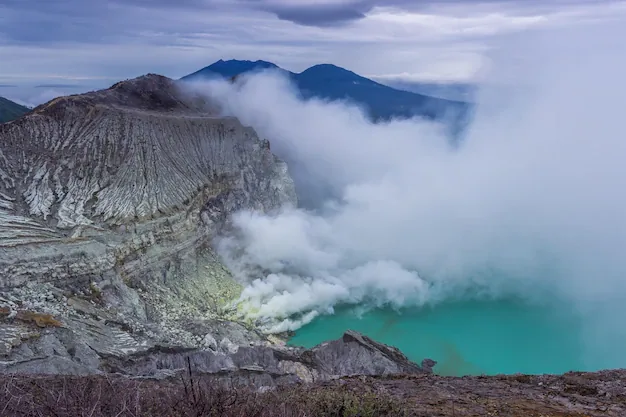
Ijen Crater, Indonesia
The Ijen complex consists of several volcanic cones , but the Great Ijen remains the site of the world's largest highly acidic crater lake. For decades, the local economy has revolved around the sulfur vents located at the lake’s edge, where volcanic gases are channeled through ceramic pipes to condense into molten red liquid. Once it cools and hardens into bright yellow stone, miners break the slabs by hand and carry them out of the crater in bamboo baskets. These men navigate the treacherous, steep paths while bearing loads that often exceed eighty kilograms, evidence of an industry that has remained virtually unchanged by technology for over half a century. While tourism has introduced a new revenue stream to the region, the rhythm of the mountain is still dictated by the cooling speed of the sulfur and the shifting winds that blow the toxic clouds across the trail. It remains one of the few places on earth where you can watch the geological process of mineral formation in real-time while witnessing the extreme physical endurance of the human spirit.
The weight of the silence first , broken only by the rhythmic crunch of volcanic sand under your boots as you ascend the three-kilometer trail in total darkness. The smell of sulfur arrives in waves, a pungent, egg-like scent that grows more intense approaching the rim. The descent into the crater, seeing the famous blue fire, a spectral glow caused by the combustion of sulfuric gases at temperatures exceeding six hundred degrees. A mark of the heat of the vents against your face even through a mask, while the cold mountain wind nips at your neck. The light of dawn reveals the true color of the lake, a startling turquoise that seems far too bright for the charred, grey walls of the caldera. Sound-wise is the clink of iron bars against stone as miners work near the fumaroles, their silhouettes ghost-like in the thick vapor. Those who come overlook the intricate patterns in the cooling sulfur, which look like frozen waterfalls of liquid gold. The piece that stays with you is passing a miner on the narrow ridge, hearing his steady breathing as he balances a load of stone that would crush an average man.
Banyuwangi is the nearest base
Banyuwangi is the nearest base, a town that sits across the narrow strait from Bali and marks the end of the Javanese railway line. Most journeys begin in the dead of night, with four-wheel-drive vehicles ferrying travelers up the steep, winding slopes of the Ijen highlands to the Paltuding base camp. From there, the only way forward is on foot, a steep hike that demands a moderate level of fitness and a steady nerve for the descent into the crater bowl. Ferries from Gilimanuk in West Bali run twenty-four hours a day, making it entirely possible to leave a beach resort at midnight and stand on a volcano before the sun rises.
“Banyuwangi is the nearest base, a town that sits across the narrow strait from Bali and marks the end of the Javanese railway line.”
The Experience
Immediately there is the biting cold of the pre-dawn air as it hits the sweat on your forehead, a sharp contrast to the heat of the volcanic vents below. The surface of the ground shifts from packed forest earth to loose, ash-grey gravel that slides under your weight during the steep descent into the pit. From somewhere comes the hiss of pressurized gas escaping the ceramic pipes, a sound like a leaking steam engine that never stops. First, the vibrant yellow of the sulfur slabs, a color so bright it looks artificial against the monochromatic grey of the crater walls. The light during the 'blue hour', just before the sun peaks, turns the acidic lake into a glowing, translucent jewel. Those visiting miss the small, carved sulfur animals that miners sell as souvenirs; they are fragile pieces of the mountain itself. The most visceral sensation is the relief of removing your gas mask at the summit, where the air suddenly feels like the cleanest thing you have ever tasted.
Why It Matters
Ijen Crater matters as a global extreme, housing the most acidic large body of water on the planet and one of the only places where sulfuric fire is visible to the naked eye. It is a cultural monument to the resilience of the Javanese working class and a geological marvel that provides scientists with a unique laboratory for studying volcanic gases. Humanly, it forces a confrontation with the raw, uncomfortable reality of manual labor in the modern world.
Why Visit
Visit Ijen because it is the only place on the planet where you can witness the earth's interior burning with a blue flame. It offers a sensory overload that no other Indonesian volcano can match, combining the beauty of a turquoise lake with a story of human endurance. You come for the fire, but the sight of the sun rising over the acid-steeped caldera will change your perspective on nature’s power forever.
Insider Tips
- 1
Rent a high-quality industrial gas mask with a proper filter at the base camp; a simple cloth mask is entirely useless against the concentrated sulfuric fumes.
- 2
Step off the trail and give way to the sulfur miners every single time; they always have the right of way and are carrying immensely heavy loads.
- 3
Look for the small, temporary camp halfway up the trail where you can share a hot tea with the miners during their short breaks from the ascent.
- 4
Check the wind direction at the rim before descending; if the fumes are blowing heavily toward the path, wait for a shift to avoid being caught in a white-out.