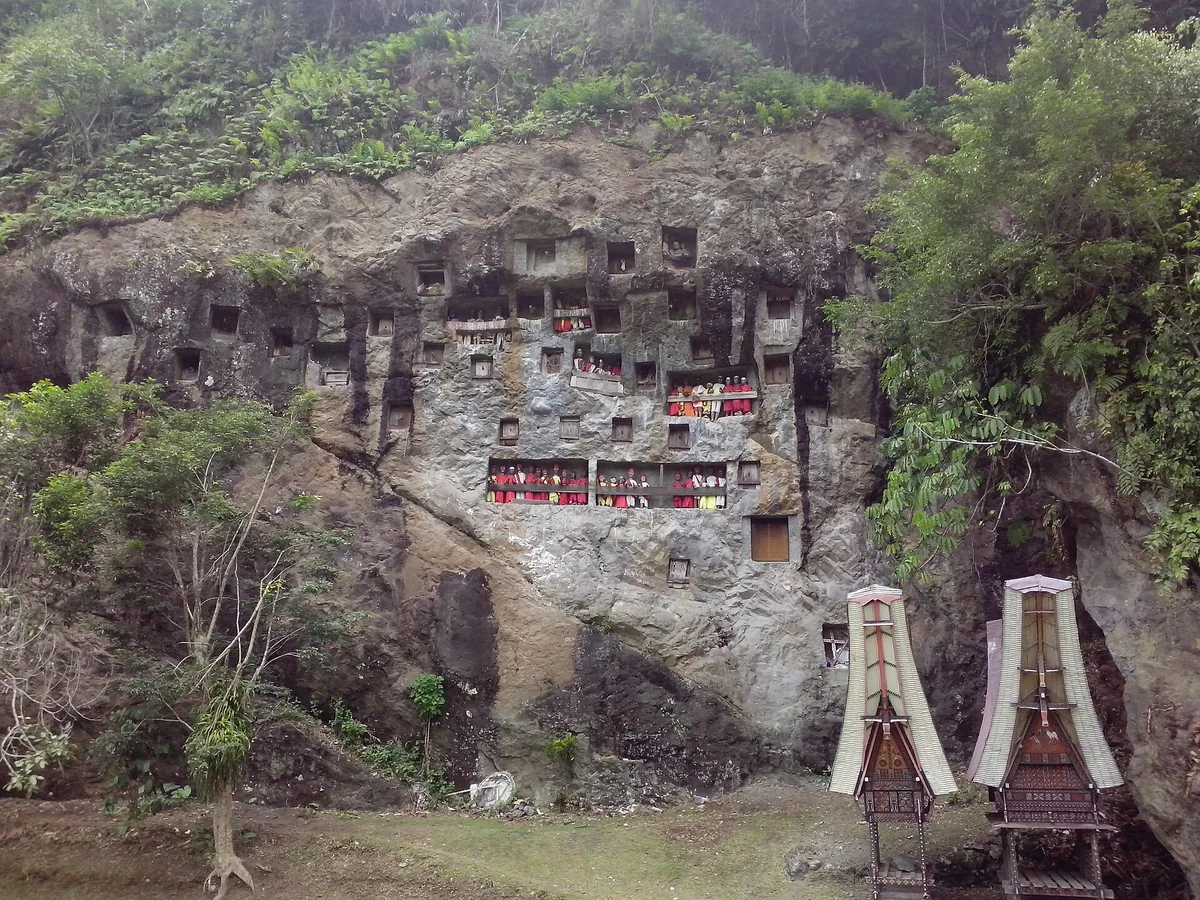
“Dozens of wooden ancestors stand on stone balconies carved into a vertical cliff, watching over the living with unblinking eyes as the scent of sacrificial buffalo smoke drifts through the valley.”
About Lemo Burial Cliffs
Aristocratic families in the Tana Toraja regency began hollowing out the Lemo cliffs roughly five hundred years ago, seeking a way to protect their dead from the elements and outsiders. Unlike the cave burials found elsewhere in the region, Lemo was designed specifically for the elite, where the height of one’s tomb directly reflected their social standing in life. The craft of the Tau-tau carver became a sacred profession, requiring specific rituals and offerings before a single cut was made into the jackfruit wood. In the 1970s, as global travel reached the Sulawesi highlands, Lemo became a focal point for international interest in Torajan culture. This influx of attention led to a dark period of theft, where many ancient Tau-tau were stolen and sold to overseas collectors, forcing families to move the originals to more secure locations or replace them with modern replicas. Despite these challenges, the site remains an active cemetery. New niches are still being carved into the rock today, ensuring that the ancient lineage of the cliff-dwellers continues to grow as long as the limestone wall holds.
Lemo Burial Cliffs
Rows of wooden figures gaze out from a sheer limestone wall, their unblinking eyes watching the wind ripple through the rice paddies below. Lemo is the most iconic window into the Toraja people’s complex relationship with the afterlife, located in the misty highlands of South Sulawesi. The cliff face is honeycombed with hand-chiseled niches, each a resting place for the dead who have been hoisted up the rock to be closer to the heavens. These Tau-tau statues, carved from jackfruit wood and dressed in vibrant cloth, represent the ancestors guarding the living from their balcony in the sky. The setting here feels thick and cool, smelling of drying grain and woodsmoke from nearby tongkonan houses. The barrier between the earthly and the spiritual feels as thin as the mountain mist, turning a vertical wall into a living genealogy of a proud highland culture.
Rows of wooden figures gaze out from a sheer limestone wall, their unblinking eyes watching the wind ripple through the rice paddies below.
Torajan cosmology dictates that the soul must travel to Puya, the land of spirits, but this journey only begins after a grand funeral feast involving the sacrifice of water buffalo. Lemo has been a site of aristocratic interment since the 16th century, chosen for its solid, unyielding rock that protects the tombs from grave robbers. Carving a single niche can take several months of grueling work, with specialized masons hanging from bamboo scaffolding to hammer away at the limestone. The Tau-tau statues were traditionally reserved for the nobility, serving as a physical vessel for the spirit to inhabit while it watches over its descendants. During the colonial era, Dutch missionaries attempted to curb these elaborate death rituals, but the Toraja successfully wove their ancestral beliefs into a unique Christian-Animist mix that persists today. Each statue is meticulously maintained, with families climbing the cliffs every few years to replace the clothing of their departed relatives in a ceremony of enduring devotion.
The eerie sensation of being watched by dozens of wooden eyes, some carved with startled expressions and others with a deep, haunting serenity. In your ears of the site is surprisingly lively; The distant lowing of buffalo and the rhythmic thud of women pounding rice in the valley. Tracing the base of the cliff, The weathered texture of the older statues, their wood bleached silver by centuries of sun, while newer additions stand out in bright orange and deep crimson. There is a dampness of the limestone under your fingertips looking up at the soaring heights where the coffins are tucked away. Most visitors stay at the designated viewing platform, but wandering further along the trail reveals the small workshops where the scent of fresh wood shavings fills the air as carvers shape the next generation of Tau-tau. The moment that stays with you is the stillness of the afternoon light hitting the cliff, when the shadows of the ancestors stretch across the green fields like long, protective fingers.
Reaching the Toraja highlands requires
Reaching the Toraja highlands requires a commitment to a nine-hour drive north from Makassar, climbing through winding mountain passes that offer glimpses of the shimmering coast and dense rainforest. Lemo is located just south of Rantepao, the region’s main hub, making it an easy excursion by hired car or local bemo. Many travelers prefer to rent a scooter in town, allowing for a slower approach through the narrow village roads where the traditional boat-shaped roofs of the tongkonan houses dominate the skyline. The entrance to the site is marked by a small path that cuts through the rice fields, providing a grand reveal of the burial wall as the palms part to show the limestone face rising abruptly from the mud.
Lemo is located just south of Rantepao, the region’s main hub, making it an easy excursion by hired car or local bemo.
The Experience
Right away, the vibrant colors of the newer statues’ clothing, bright yellows and deep reds, contrasting with the ancient, grey-white of the limestone. The place is often filled with the sound of wind whistling through the small square openings of the tombs, creating a low, melodic hum that feels like a collective whisper from the past. The clink of a carver's chisel if a new niche is being prepared, a sharp, metallic sound that echoes off the cliff face. You come across a sense of profound verticality, your neck straining to see the highest balconies where the most powerful ancestors reside. Almost all visitors miss the small, discarded bits of old coffins that occasionally fall from the heights, silvered by age and placed among the ferns at the cliff's base. The experience is not one of mourning, but of a busy, crowded community of the dead who refuse to be forgotten by the valley below.
Why It Matters
Lemo is the spiritual heart of Torajan identity, representing one of the few places on earth where a Neolithic death culture has survived into the digital age. It matters because it challenges the Western notion of burial as a final, hidden act, instead turning death into a public, vertical monument of remembrance. Culturally, it is a masterpiece of sculpture and engineering, achieved without modern tools on a treacherous limestone canvas.
Why Visit
Visit Lemo because it is the only place where you can stand at the intersection of life and death and feel entirely at peace. While other sites in Toraja offer caves or hanging coffins, Lemo gives you the Tau-tau, the wooden soul-vessels that make the ancestors feel present. You come for the spectacle of the cliff, but you stay for the realization that here, the dead never truly leave their families.
✦ Insider Tips
- 1
Hire a local Torajan guide to explain the specific family lineages of the statues; without their stories, the figures remain mere wood rather than individuals.
- 2
Walk the trail that leads behind the main cliff to see the 'hidden' side of the rock where older, less-visited tombs are tucked away in the shadows.
- 3
Bring a pair of binoculars to appreciate the intricate details of the Tau-tau carvings and the traditional textiles they wear high on the cliff face.
- 4
Avoid visiting during the midday sun when the limestone glare is harshest; the late afternoon light provides the best depth for seeing the niches.
- 5
Be respectful and ask permission if you encounter a family performing the 'Ma'nene' ritual of cleaning the tombs, as this is an intensely private and sacred time.