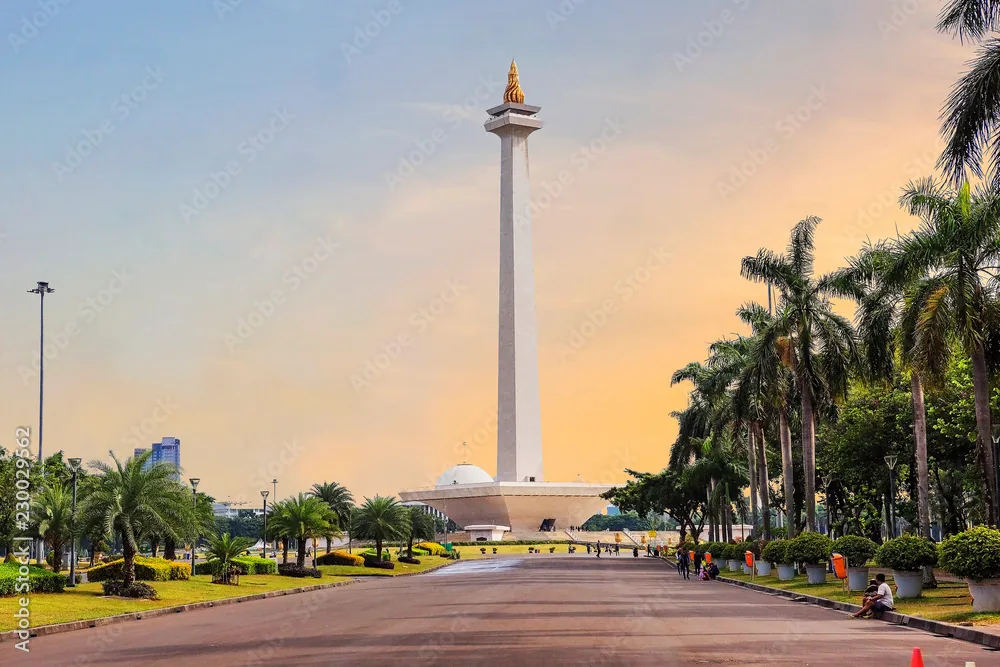
Fifty kilograms of pure gold leaf shimmer atop a white marble obelisk, crowning a monument that was built to look like a giant kitchen tool used for grinding spices.
About Monas (National Monument)
President Sukarno, a man of grand gestures and deep symbolism, sought a landmark that could rival the Eiffel Tower in stature and the pyramids in longevity. He rejected several initial designs until architects Soedarsono and Frederich Silaban proposed a structure based on the 'Lingga and Yoni,' traditional Hindu-Buddhist symbols representing creation and fertility. The monument’s construction, which began in August 1961, was a slow and deliberate process that utilized the finest Indonesian materials to ensure its permanence. During the transition of power to President Suharto, the work continued as a rare point of continuity in a changing political landscape. Today, it remains the most potent symbol of Jakarta, standing exactly 132 meters tall to dominate the skyline of the city's central administrative district. The golden flame was originally leafed with thirty-five kilograms of gold, though an additional fifteen kilograms was added during the monument's silver anniversary to ensure its brilliance would never fade.
Standing tall against the haze of Jakarta’s restless skyline, a white obelisk capped with a shimmering golden flame is the unwavering heartbeat of the Indonesian Republic. Merdeka Square stretches out around it, a vast expanse of green like a deep breath in a city that rarely pauses. Monas, or the National Monument, captures the defiant spirit of a nation that fought through centuries of colonial shadow to claim its own light. The Italian marble of the structure feels cool to the touch even in the sweltering heat of midday, reflecting a blinding glare that forces you to squint. Every inch of the monument was designed to evoke the tools of the common person, the mortar and pestle, elevated to a scale that feels celestial. The scent of street food from nearby vendors, particularly the smoky aroma of satay and the sweet fragrance of jasmine tea, drifts across the plaza, anchoring this grand symbol in the everyday life of the people who call this city home.
President Sukarno envisioned this monument in the 1950s
President Sukarno envisioned this monument in the 1950s as a grand architectural statement that would be visible from every corner of the capital. Construction began in 1961, guided by the philosophy of Lingga and Yoni, ancient symbols representing the harmony of masculine and feminine energy. The project was an immense undertaking that spanned fourteen years, surviving political upheaval and economic shifts until its eventual opening in 1975. In the base of the monument, the National History Museum houses forty-eight dioramas that trace the archipelago’s journey from prehistoric times through the glory of the Majapahit Empire to the bloody struggle for independence. The flame at the summit, covered in fifty kilograms of gold leaf, was intended to burn eternally, a physical manifestation of the undying passion for freedom that Sukarno believed defined the Indonesian character.
Visiting Monas (National Monument)
The weight of history the moment you descend into the subterranean museum, where the air is cool and the light is dim. The dioramas offer a silent, frozen theater of the past, but the real energy is found in the Hall of Independence, where the original text of the Proclamation is kept. The muffled voices of schoolchildren echoing off the marble walls, their excitement creating a high-pitched hum that bounces around the cavernous space. Waiting for the elevator to the observation deck, There is a sense of anticipation that is rewarded the second the doors open at 115 meters. Jakarta opens up below you as a sprawling, chaotic range of terracotta roofs and glass towers, dissected by the grey ribbons of the toll roads. What you catch first is the way the skyscrapers of the central business district look like glass miniatures from this height, while the vast Merdeka Square provides a rare geometric order. The element that stays with you is looking up at the base of the flame at sunset, when the real sky turns a deep violet that makes the gilded bronze appear to flicker.
Navigating to the heart of Central
Navigating to the heart of Central Jakarta is most efficiently done via the TransJakarta busway, which has a dedicated stop right at the Monas entrance. The station connects directly to the underground tunnel that leads you onto the monument grounds, sparing you from the harrowing experience of crossing the multi-lane traffic of the square. If you are staying near the Sudirman district, the modern MRT line takes you as far as Bundaran HI, from where a short taxi or a vigorous twenty-minute walk brings the obelisk into view. Most locals suggest arriving via the northern entrance, where the greenery is thicker and the path toward the monument offers the most dramatic, unobstructed perspective of the golden flame.
The Experience
The sharp contrast between the hushed, ceremonial air of the Proclamation Room and the exuberant chaos of the families picnicking on the grass outside. Audibly, the of the city is a distant, oceanic thrum that only reaches you once you stand on the top observation deck, where the wind whistles through the railings. A mark of the vibration of the elevator as it makes the vertical journey, a small metal box climbing through a spine of solid stone. The majority rush to the top, but you should notice the intricate reliefs around the monument’s base, which tell the story of the Indonesian people in a rough-hewn stone narrative. The call to prayer from the nearby Istiqlal Mosque drifting across the square, a hauntingly beautiful sound that lends a spiritual gravity to the plaza. The experience is one of perspective, where you can literally see the layers of Jakarta’s growth, from the old colonial buildings of the north to the gleaming spires of the south.
Why It Matters
Monas matters because it is the ideological anchor of the world's fourth most populous nation, acting as a compass for Indonesian identity. It is a place where the abstract concept of 'independence' becomes physical, built on a scale that forces the observer to acknowledge the collective effort required to build a republic from seventeen thousand islands. It serves as both a site of solemn national remembrance and the city’s most vital public park.
Why Visit
Visit Monas because it is the only place where you can see the sheer, impossible scale of Jakarta in one 360-degree sweep. While other landmarks offer beauty, this one offers the narrative of a nation's birth. You come to stand under the gold flame, but you leave understanding the fierce pride that keeps this city moving forward despite every challenge.
✦ Photo Gallery
Best Season
🌤 The months of June and July offer the clearest skies, providing the best visibility from the observation deck before the heavy rains of the monsoon season begin to blur the horizon.
Quick Facts
Best time to visit
The months of June and July offer the clearest skies, providing the best visibility from the observation deck before the heavy rains of the monsoon season begin to blur the horizon.
Getting there
In Jakarta, Indonesia; reach Jakarta first, then continue to the site.
Location
Jakarta, Indonesia
Type
attraction
Insider Tips
- 1
Arrive before 8:00 AM to secure a spot for the limited elevator tickets to the top, as they often sell out to school groups by mid-morning.
- 2
Visit on a Sunday morning during Jakarta's Car-Free Day to experience the square at its most vibrant, filled with runners, cyclists, and local performers.
- 3
Look for the bronze statue of Diponegoro, a national hero on horseback, located near the northern entrance of the park for a classic photo opportunity.
- 4
Bring a hat and plenty of water, as the walk from the park gates to the monument base offers almost no shade under the intense equatorial sun.