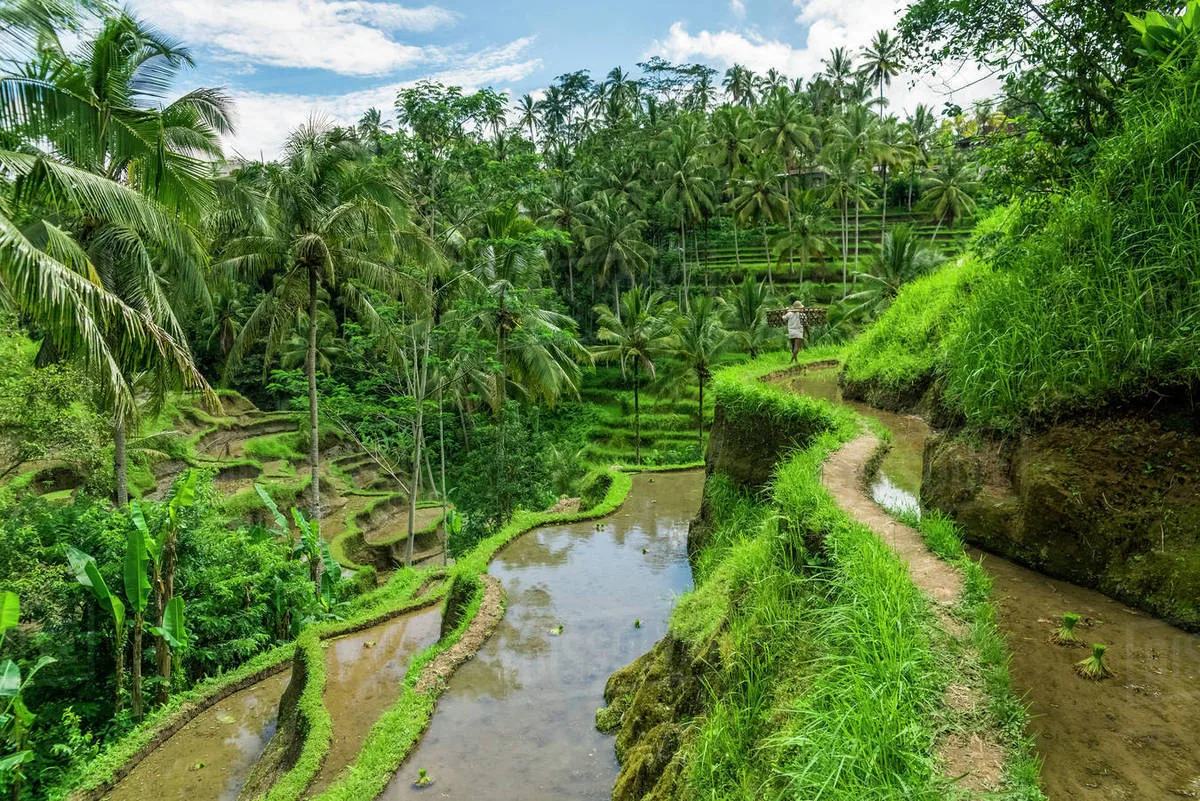
Farmers here have spent a thousand years carving the hills into a giant green stairway to ensure that water always flows downhill according to the laws of a mountain god.
About Tegallalang Rice Terrace
The terraces are a physical manifestation of Subak, a traditional Javanese and Balinese irrigation cooperative that dates back to at least the 9th century. Developed by local farmers who lacked modern machinery, the system relied on an intimate understanding of the landscape’s hydraulics and a social structure built on absolute cooperation. Each level of the terrace is designed to overflow into the one below, a process managed by a series of water temples and democratic farmer assemblies. Throughout the 20th century, Tegallalang survived the introduction of 'Green Revolution' rice varieties that threatened the traditional cycle, with the community eventually returning to the heritage methods that maintain the soil’s health. Today, the site exists in a delicate state of transition where the income from curious travelers often exceeds that of the rice harvest itself. Yet, the religious and social importance of the water management remains unchanged, as the local Subak members still meet in the village temple to decide the exact day when the sluices will be opened for the next planting season.
Emerald ribbons of silt and sprout drape over the undulating curves of the valley north of Ubud, creating a landscape that looks more like a topographical sculpture than a working farm. Tegallalang Rice Terrace represents the triumph of communal labor over rugged volcanic geography. These vertical gardens descend into a deep ravine where the humidity pools, feeding a lushness so intense it feels as though the air itself is tinted green. The terraces follow the natural contours of the land, carved by hand over centuries to ensure that not a single drop of water is wasted. While many come for the iconic photograph, the true soul of the place reveals itself in the intricate network of bamboo pipes and narrow stone sluices that keep this ancient system breathing. This is a living monument to a philosophy that views nature, humanity, and the divine as a single, inseparable loop.
Rishi Markandeya, a revered holy man, reportedly
Rishi Markandeya, a revered holy man, reportedly brought the subak irrigation system to Bali in the eighth century, transforming the island's steep, unruly terrain into a productive paradise. This cooperative water management system is governed by village priests and the rhythms of the water temples, ensuring that every farmer in the valley receives an equitable share of the mountain runoff. Tegallalang was sculpted over generations of backbreaking toil, with families carving the steps out of the hillside using only basic iron tools. In 2012, UNESCO recognized this specific method of terrace farming as a World Heritage site, acknowledging that the beauty of the valley is merely a byproduct of a highly sophisticated social and spiritual contract. Despite the pressures of modern tourism, the farmers here still plant the heritage local rice varieties, maintaining the same agricultural cycle that their ancestors practiced over a thousand years ago.
The specific, earthy smell of wet clay and young rice shoots as you descend the narrow, often slippery steps into the heart of the ravine. The clatter of the valley is a constant, rhythmic trickle of water falling from one level to the next, punctuated by the occasional clatter of bamboo bird-scarers. You get a temperature drop as you reach the bottom of the gorge, where the sun struggles to penetrate the dense canopy of coconut palms and giant ferns. Crossing the small bridges at the base, seeing the farmers balanced on narrow ridges, their sun-bronzed skin a sharp contrast to the neon-green of the seedlings. The light in the late afternoon is particularly evocative, catching the standing water in the empty paddies and turning them into mirrors that reflect the drifting tropical clouds. Almost all visitors overlook the small shrines tucked into the corners of the terraces, but these are the places where the daily offerings of flowers and incense are placed to appease the spirits of the fields.
Reaching the terraces requires a short but scenic
Reaching the terraces requires a short but scenic twenty-minute drive north from the center of Ubud, navigating the winding roads that lead toward the Kintamani highlands. Many visitors prefer the freedom of a scooter, though the traffic on the main road can be daunting for the uninitiated. Hiring a local driver remains the most relaxed option, allowing you to watch the woodcarving villages of Peliaton and Tegallalang pass by before the valley suddenly opens up on your right. For those seeking a quieter approach, a morning bicycle ride through the backroads of the surrounding villages provides a slower, more intimate introduction to the agricultural life of the region.
The Experience
The humidity thickening as you walk deeper into the valley, a heavy, fragrant dampness that smells of moss and tropical earth. The surface of the path under your feet changes from hard-packed soil to the soft, giving mud of the paddy walls, requiring a careful, deliberate gait. Audible: the rustle of the wind through the long blades of rice, a sound like dry silk rubbing together, which almost drowns out the chatter of the crowds above. The tiny, iridescent dragonflies that hover over the stagnant water, their wings flashing gold in the dabs of sunlight. The most vivid moment occurs when you look back from the opposite side of the ravine; the people on the far ridges look like ants on a massive, green emerald. It is a place that feels simultaneously like a vast landscape and a fragile, hand-tended garden.
Why It Matters
Tegallalang matters because it is one of the few places where an ancient, sustainable agricultural system remains perfectly functional in the 21st century. It is the visual heart of the Subak system, demonstrating how spiritual belief can be translated into sophisticated engineering. Culturally, it represents the Balinese concept of Tri Hita Karana, the harmony between the spirit world, the human world, and nature.
Why Visit
Visit Tegallalang because it is the most visceral proof that humans can improve a landscape rather than just exploit it. While other viewpoints offer a static look at nature, here you are walking through a living machine of water and grain. You come for the vibrant greens of the valley, but you stay because the ingenuity of the stone and bamboo irrigation system is more impressive than any photo.
✦ Photo Gallery
Best Season
🌤 April and May are the most spectacular months, as the rainy season has ended but the rice is at its tallest and most vivid green before the harvest begins.
Quick Facts
Best time to visit
April and May are the most spectacular months, as the rainy season has ended but the rice is at its tallest and most vivid green before the harvest begins.
Getting there
In Ubud, Indonesia; reach Ubud first, then continue to the site.
Location
Ubud, Indonesia
Type
attraction
Insider Tips
- 1
Cross to the far side of the ravine and hike up the opposite ridge to find the quietest paths where the tourist crowds rarely venture.
- 2
Look for the 'Tali Air' or the small bamboo pipes at the edge of the terraces to see the physical genius of the thousand-year-old irrigation system up close.
- 3
Arrive before 7:30 AM to catch the morning light filtering through the coconut palms without having to share the view with hundreds of others.
- 4
Carry small change to leave in the donation boxes located at the makeshift gates throughout the terraces; this money goes directly to the farmers who maintain the paths.
- 5
Visit the local woodcarving shops in the village above the terraces, as this area is the historical center for Bali's ornate ornamental carving.