“Five thousand years ago, stone-age engineers built a light-tight chamber so precise that it only allows a single beam of winter sun to touch its floor for seventeen minutes a year.”
About Brú na Bóinne
Neolithic farmers began shaping this landscape over five centuries before the Great Pyramid of Giza was even a blueprint. They spent decades hauling white quartz from Wicklow and grey granite cobbles from Dundalk Bay to encase the ceremonial mounds of Newgrange, Knowth, and Dowth. Following the decline of the builders, the site took on new lives, serving as a prestigious burial ground for the Iron Age elite and later as a monastic grange for the Cistercian monks of Mellifont Abbey. It was the Cistercians who gave the area its modern name, 'the dwelling on the Boyne.' The site’s true rediscovery began in 1699 when a local landowner looking for road stones accidentally opened the entrance to Newgrange, sparking three centuries of archaeological fascination that continues to rewrite our understanding of early European society.
What Brú na Bóinne is
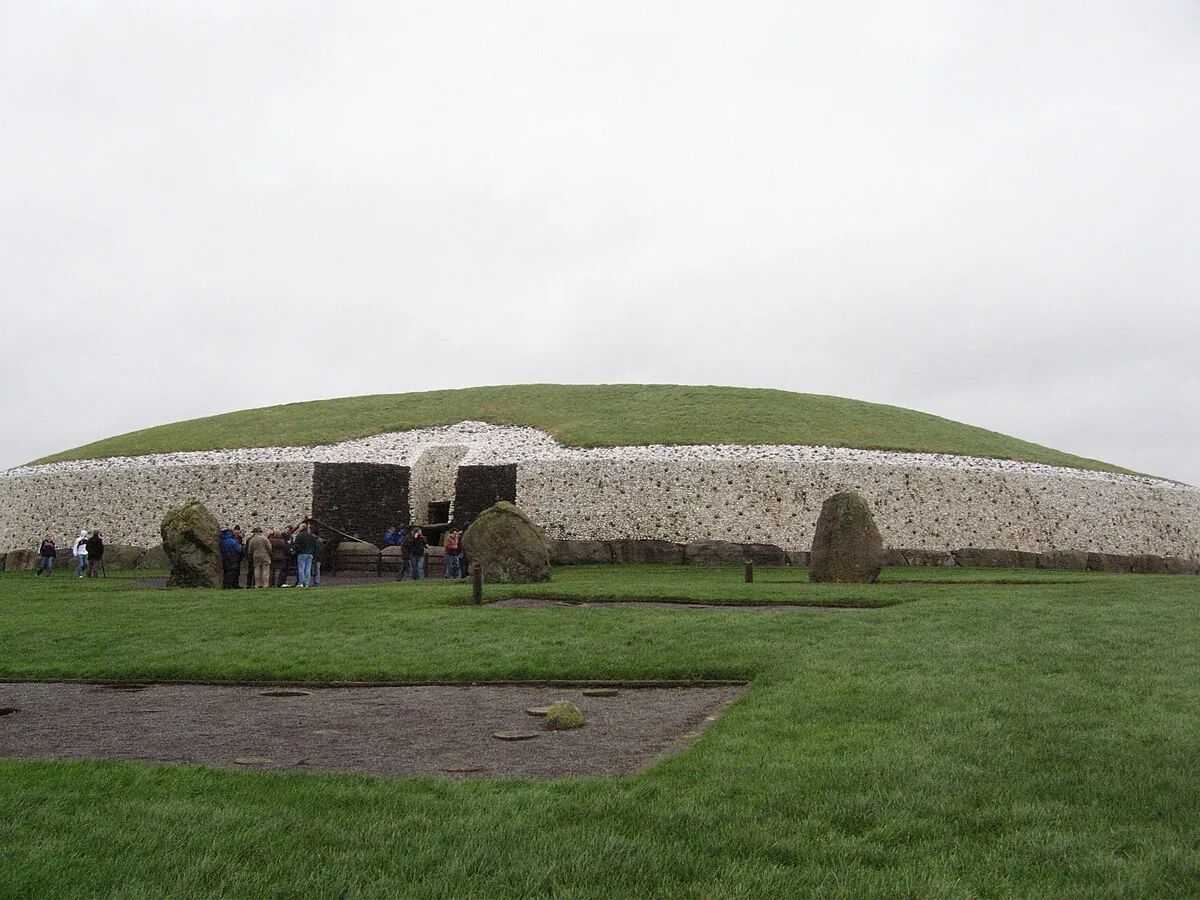
Deep within a sweeping bend of the River Boyne, three massive stone mounds rise from the soft green landscape like the slumbering giants of an earlier world. Brú na Bóinne represents a pinnacle of Neolithic engineering, a ritual landscape that was already ancient when the first stones were dragged to Stonehenge or the pyramids rose at Giza. The site is anchored by Newgrange, Knowth, and Dowth, each a complex passage tomb encircled by mysterious kerbstones etched with spirals and solar wheels. Air in the Boyne Valley feels thick with the passage of five millennia. Here the barrier between the celestial and the terrestrial was intentionally blurred by architects who understood the movement of the stars as well as they understood the weight of quartz and granite.
Deep within a sweeping bend of the River Boyne, three massive stone mounds rise from the soft green landscape like the slumbering giants of an earlier world.
Construction began, 3200
Construction began around 3200 BCE, an era when the farming communities of the Boyne Valley possessed the social cohesion and astronomical knowledge to move thousands of tons of stone from as far away as the Mourne Mountains. Newgrange remained a focal point of local lore for centuries, eventually becoming a grass-covered hill believed by later Celts to be the home of the Tuatha Dé Danann. For thousands of years, the secrets of the inner chamber remained sealed until Professor Michael J. O'Kelly began excavations in the 1960s. He famously confirmed the alignment of the 'roof box' at Newgrange, proving that the Neolithic builders had perfectly calculated the sun’s position during the winter solstice. Knowth, while less famous than its neighbor, reveals a different narrative through its two opposing passages and the largest collection of megalithic art in Western Europe, reflecting a culture obsessed with cyclical time and the interplay of light and shadow.
The experience
Walking through the narrow, nineteen-meter passage of Newgrange involves a literal descent into the cold, silent dark of the Earth. The rough, damp texture of the structural orthostats pressing in from the sides, their surfaces cold to the touch even in the height of summer. Within, the space the cruciform chamber is perfectly still, smelling of wet earth and ancient stone. When the artificial light is extinguished during the tour, the darkness is absolute, making the subsequent simulation of the solstice sunrise feel like a profound spiritual event. Outside, the white quartz facade of the mound reflects the Irish sun with a brilliance that can be seen for miles. First, the intricate megalithic carvings on Kerbstone 52, where the triple spiral motif seems to twist and dance under the shifting clouds. The experience is one of profound perspective, forcing you to reckon with a human intelligence that functioned with terrifying precision long before the invention of the wheel. Accessing this archaeological heartland requires a journey into County Meath, roughly fifty kilometers north of Dublin. Those visiting take the train or bus to Drogheda, then connect to the dedicated shuttle service that runs to the Brú na Bóinne Visitor Centre. Access to the monuments themselves is strictly controlled and only possible via official guided tours departing from this central hub. A pedestrian bridge crosses the Boyne, leading you from the modern exhibits into the protected agricultural landscape where the mounds sit. Because the site is a delicate UNESCO World Heritage area, private cars cannot drive directly to the tombs, ensuring the horizon remains as uncluttered as it was five thousand years ago.
The Experience
The silence inside the chamber of Newgrange is heavy, a dense absence of sound that makes the drip of a single water droplet echo like a hammer. Something like a strange sense of compression as you navigate the narrow stone corridor, your shoulders nearly brushing the ancient supports. Looking at the corbelled roof, you notice that the dry-stone layers are still perfectly waterproof after five millennia, born from a craftsmanship that has outlasted every empire. Outside, the wind whips across the Boyne flats, carrying the scent of clover and peat. What registers is the way the light catches the carved spirals on the entrance stone, making the ancient symbols seem to pulse with energy. The piece that stays with you is the walk back to the shuttle, looking back at the white mound and realizing you have just stepped out of a time machine made of rock.
The silence inside the chamber of Newgrange is heavy, a dense absence of sound that makes the drip of a single water droplet echo like a hammer.
Why It Matters
Brú na Bóinne matters as the most significant concentration of megalithic art in Europe and proof of the sophistication of prehistoric mankind. It proves that the early inhabitants of Ireland were not primitive foragers but a highly organized society capable of grand-scale architectural projects and complex astronomical calculations. It remains a foundational site for Irish identity, linking the modern nation to a deep, mysterious heritage that predates the Celts.
Why Visit
Every ancient site offers ruins, but Brú na Bóinne offers a physical encounter with the sun. You come here to stand in a room that hasn't seen a drop of rain in fifty centuries and to see carvings that were already ancient when the Roman Empire was founded. It is the only place where you can truly feel the weight of deep time pressing against the palms of your hands.
✦ Insider Tips
- 1
Enter the annual lottery at the visitor center for a chance to be inside Newgrange during the actual winter solstice; thousands apply for just a handful of spots.
- 2
Spend extra time at Knowth to see the timber circle reconstruction, which offers a rare look at the wooden ritual structures that once mirrored the stone mounds.
- 3
Look for the 'Graffiti' left by 19th-century antiquarians inside the Newgrange chamber, which is a fascinating, if unofficial, record of early tourism.
- 4
Visit the visitor center's exhibition first to understand the 'corbelling' technique, which explains how the massive stone roofs stay up without a drop of mortar.
- 5
Book your tickets at least three months in advance during the summer season, as daily entry is strictly capped to protect the interior microclimate.