Three hundred million years of river silt and Atlantic fury have carved a vertical world where the ocean doesn't just meet the land; it attempts to swallow it whole.
About Cliffs of Moher
The bedrock of these cliffs began as a prehistoric river mouth, where seasonal floods deposited layers of sand and silt that eventually hardened into the shale and sandstone we see today. Humans have used this high ground as a lookout for millennia, but it was the 19th-century MP Cornelius O’Brien who transformed the cliffs into a destination. He believed that developing the site would lift the local population out of poverty, and he spent his own fortune building the iconic observation tower and the flagstone fences. In 2011, the cliffs were designated as part of a UNESCO Global Geopark, recognizing the site not just as a scenic vista, but as a crucial record of Earth’s carboniferous period. Today, the area is a strictly protected special area of conservation, acting as a vital sanctuary for the razorbills and guillemots that have claimed these ledges since before recorded history.
Cliffs of Moher in Ireland
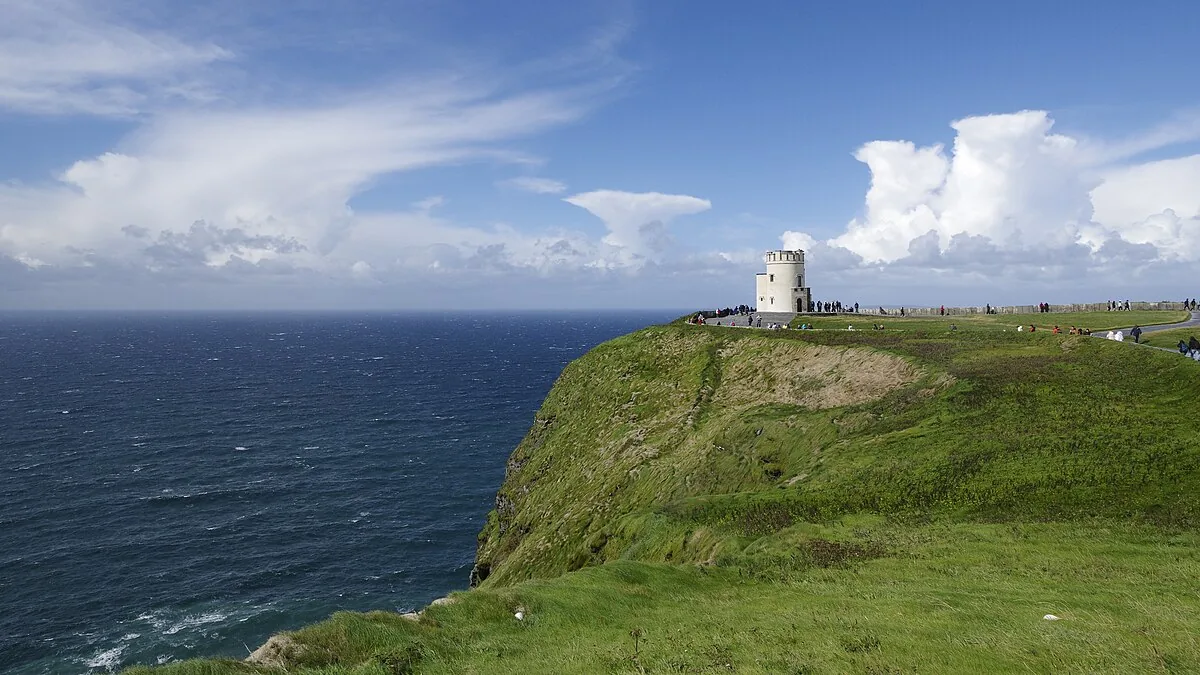
Wind here behaves like a living thing, hauling the salt and spray of the North Atlantic up sheer sandstone faces that reach two hundred meters toward a perpetually shifting sky. These shale and gritstone ramparts form the jagged western edge of County Clare, stretching for fourteen kilometers along a coastline like the abrupt conclusion of the European continent. Unlike the manicured parks of the interior, the cliffs possess a raw, unsettling scale that makes even the bravest visitor lean instinctively away from the precipice. The grass atop the plateau is flattened by the gale, a vibrant, sea-salted green that provides a sharp contrast to the slate-grey depths of the water below. Beneath the primary roar of the ocean, The frantic chatter of over thirty thousand pairs of nesting seabirds, a chaotic symphony that fills every crevice of the rock.
“Wind here behaves like a living thing, hauling the salt and spray of the North Atlantic up sheer sandstone faces that reach two hundred meters toward a perpetually shifting sky.”
Cliffs of Moher, Ireland
Geological forces spent over three hundred million years layering the mud and sand of an ancient river delta to create these massive platforms. The name itself derives from a long-vanished fortification called Mothar, a stone fort that stood on Hag’s Head until it was dismantled during the Napoleonic Wars to make way for a signal tower. Cornelius O’Brien, a local landowner and visionary, recognized the magnetic pull of the site as early as 1835. He built the eponymous stone tower that still stands today, betting that even in the nineteenth century, people would travel great distances just to stare into the abyss. During the Great Famine, he employed local laborers to build walls and paths, essentially creating the first blueprint for the sustainable tourism that sustains the region today. Modern visitors now walk atop stone flags that were once the seabed of a prehistoric world, surrounded by fossils of extinct creatures locked within the gritstone.
Standing at the edge during a high tide feels like being on the prow of a massive, unmoving ship. The standout is the way the Atlantic swells don't just hit the cliffs; they explode against them, sending plumes of white foam high into the air that catch the light in fleeting rainbows. The smell of the air is intoxicatingly clean, a mix of cold ozone and crushed grass. If you walk toward the southern end at Hag’s Head, the crowds thin out, leaving you with the solitary sound of the wind whistling through the dry-stone walls. Almost all visitors focus on the horizon, but if you look down at the ledge below O'Brien's Tower, you might spot the orange beaks of puffins tucked into the crags. As the sun begins to dip, the dark stone takes on a golden, metallic sheen, and the Aran Islands appear like shadows on the water. The sheer verticality of the landscape creates a sense of vertigo that stays in your legs long after you return to the gravel path.
Navigating to this remote stretch of Clare involves
Navigating to this remote stretch of Clare involves winding through the narrow, hedge-lined roads of the Burren. People typically drive from Galway or Limerick, though the most rewarding approach is via the coastal village of Doolin. From Doolin, a challenging but rewarding eight-kilometer cliff walk allows you to earn the view, approaching the main visitor center on foot as the cliffs gradually rise in height. Public buses run regularly from Ennis and Galway, dropping passengers at a modern, grass-roofed visitor center that is built directly into the hillside to minimize its impact on the skyline. For a completely different perspective, ferries depart from Doolin pier, allowing you to look up at the towering cliffs from the churning perspective of the sea.
“Navigating to this remote stretch of Clare involves winding through the narrow, hedge-lined roads of the Burren.”
The Experience
A heavy, wet mist often clings to the clifftop, obscuring everything until a sudden gust of wind tears the curtain open to reveal the drop. There is a spray of the ocean on your face even when the water is hundreds of feet below, a reflection of the power of the updrafts. Audible here is dominated by the 'crrrr-ack' of the waves hitting sea caves and the high-pitched screams of thousands of kittiwakes. The opening note is the strange, flattened geometry of the cliff edge, where the limestone has been polished smooth by millions of footsteps and centuries of rain. What truly lingers is when you look north toward Galway Bay and realize that the next stop across that vast, grey water is North America. It is a place that makes the modern world feel very new and very fragile.
Why It Matters
The Cliffs of Moher represent the primal heart of the Wild Atlantic Way and serve as a foundation of Irish folk identity. Beyond their role as a cinematic backdrop, they are a biological fortress, hosting the largest colony of nesting seabirds in Ireland. They offer a rare, accessible encounter with the raw power of plate tectonics and coastal erosion, reminding us that the geography of our world is still being aggressively reshaped every day.
Why Visit
Plenty of places offer high views, but Moher offers a physical confrontation with the Atlantic. You don't just see the cliffs; you hear the booming echoes of the caves and feel the salt-laden wind trying to push you back. It is the only place where you can stand on the very rim of Europe and feel the ancient, geological pulse of the planet beneath your boots.
Insider Tips
- 1
Park in Doolin and take the shuttle bus to the visitor center, then walk the eight kilometers back along the cliff edge for a spectacular, downhill trek away from the bus tours.
- 2
Look for the 'Liscannor Flagstones' near the path which contain fossilized worm tracks that look like delicate, squiggly etchings in the rock.
- 3
Arrive after 6:00 PM during the summer months to avoid the heavy coach traffic and experience the sunset in near-total solitude.
- 4
Bring a pair of binoculars even if you aren't a birdwatcher, as they are essential for spotting the colonies of puffins nesting on the inaccessible grassy ledges.
- 5
Check the wind forecast rather than just the rain; if gusts exceed 50kph, the upper paths are often closed for safety reasons.