“Legend says that when the King of Munster destroyed this northern fortress in 1101, he forced each of his soldiers to carry a single stone back home to ensure it could never be rebuilt.”
About Grianan of Aileach
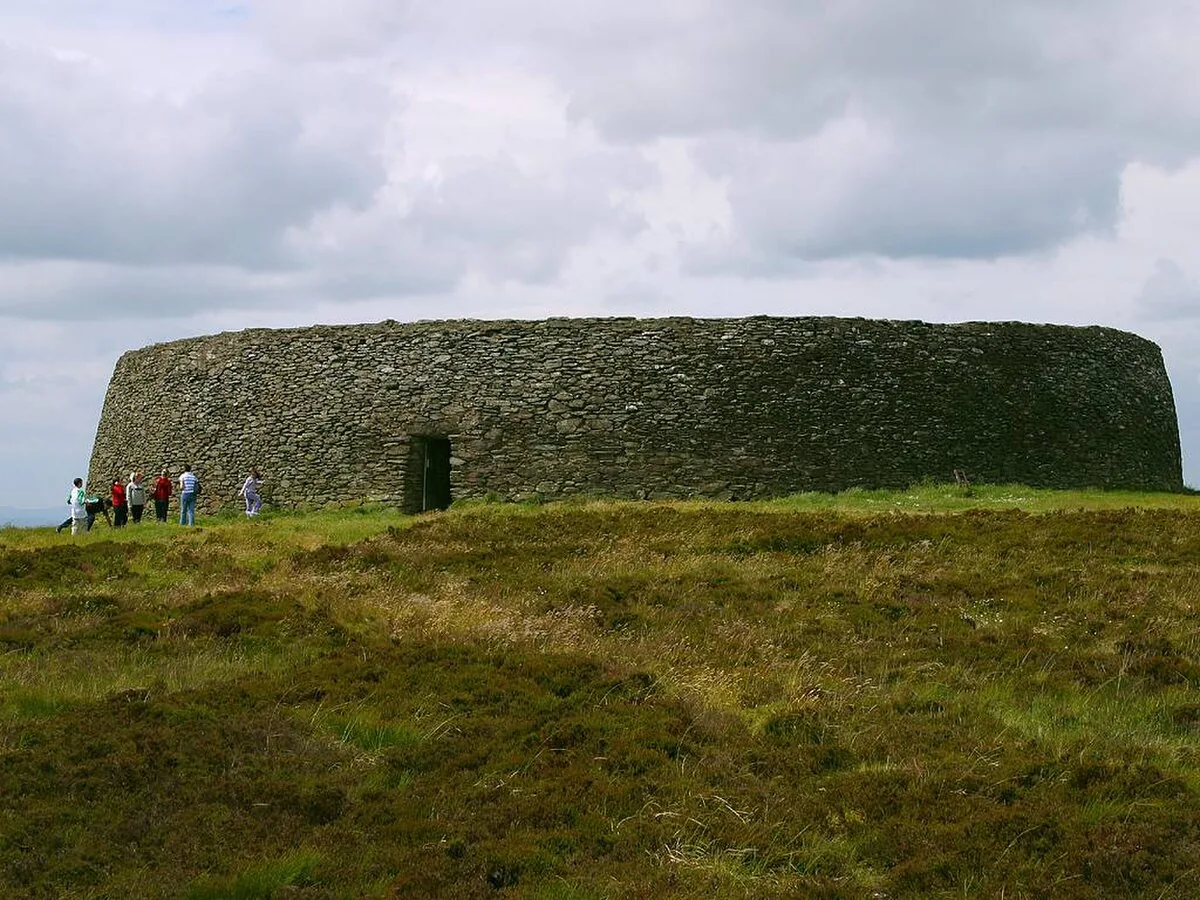
The site of Grianan of Aileach has been occupied for at least four thousand years, beginning as a Bronze Age tumulus. The stone ringfort, known as a 'cashel,' was the political and military nerve center for the kings of Aileach during the early medieval period. In the late 19th century, Walter Bernard's restoration saved the site from being a mere pile of rubble, though purists argue he may have added features like the internal terraces that weren't originally there. Despite this, the restoration maintained the original spirit of the fort, allowing visitors to appreciate the defensive engineering that made this summit impregnable for centuries.
Grianan of Aileach in short
Perched on the summit of Greenan Mountain in County Donegal, the Grianan of Aileach is a circular stone fortress like it belongs to the stars as much as the earth. From its ramparts, you can see across Lough Swilly to the west and Lough Foyle to the east, a panoramic view that encompasses three counties and two countries. The fort is a massive ring of dry-stone masonry, five meters thick and nearly twenty-five meters in diameter, sitting 250 meters above sea level. The wind here is relentless and clean, smelling of gorse and sea salt. It is a place of dizzying perspective, where the modern landscape of farmsteads and roads looks like an insignificant layer atop something far older and more powerful.
Perched on the summit of Greenan Mountain in County Donegal, the Grianan of Aileach is a circular stone fortress like it belongs to the stars as much as the earth.
The past
While the stone fort we see today was largely restored in the 1870s by a Derry doctor named Walter Bernard, its origins are buried in the mist of Irish mythology. Legend says it was built by Dagda, the god-king of the Tuatha Dé Danann, to protect the grave of his son. Historically, it was the seat of the Northern Uí Néill, the High Kings of Ireland, from the fifth to the twelfth century. It was a site of such strategic and symbolic importance that in 1101, the King of Munster, Murtagh O’Brien, marched his army north to dismantle the fort stone by stone as an act of ultimate humiliation. He supposedly ordered every soldier to take a stone from the fort back to Munster so that no one could ever rebuild the power of the northern kings.
Stepping through the narrow, lintelled entrance is like entering a stone womb. The interior is a perfect circle of green grass surrounded by terraced walls that you can climb via internal stone stairs. A rough, cool texture of the grey stone and notice the precise way the slabs are fitted together without a drop of mortar. As you reach the top of the ramparts, the world opens up in an explosion of blue and green. The silence of the high ground, punctuated only by the whistle of the wind through the stones. It is a geometric marvel; the circle is so perfect it feels intentional, a human attempt to mirror the horizon.
The fort is located about ten
The fort is located about ten minutes from Derry city and twenty minutes from Letterkenny. The road up Greenan Mountain is steep and narrow, twisting through sheep pastures until it reaches a small car park just below the summit. The final climb is a short walk on a paved path. Because of its height, the fort is often shrouded in cloud; a visit on a clear day is a completely different experience from a misty one, though the latter lends the stones a ghostly, mythological quality that feels entirely appropriate for the home of the gods.
The fort is located about ten minutes from Derry city and twenty minutes from Letterkenny.
The Experience
The wind at Grianan is a constant, vocal presence, vibrating through the cracks in the dry-stone walls. You come across a massive weight of the masonry pressing down on the earth, a stark contrast to the light, airy feeling of the wide-open views from the ramparts. It becomes clear how the lichen grows thicker on the weather side of the stones, creating patches of neon orange and silver-grey. Within the center of the circle, there is a strange acoustic effect where your own voice feels amplified and contained, a secret room at the top of the world. It is a place that makes you want to speak in whispers.
Why It Matters
Grianan of Aileach is one of only five sites mentioned in the Ptolemy map of the 2nd century AD, highlighting its ancient importance on a European scale. It is a primary landmark of the Northern Uí Néill dynasty and a masterpiece of dry-stone construction. It remains a powerful symbol of regional identity in the northwest of Ireland.
Why Visit
Visit Grianan for the best 360-degree view in Ireland. Unlike the cliffs, which look one way at the sea, this fort looks everywhere. It is a physical link to the high kings of old and a place where you can see the geography of a whole province laid out like a map at your feet.
✦ Insider Tips
- 1
Bring a heavy windbreaker even in mid-summer; the temperature at the summit is significantly lower than in the valley below.
- 2
Look for the 'St. Patrick's Well' just down the hill from the fort, which was once a place of local pilgrimage.
- 3
Check the horizon to the west on a clear day; you can see as far as the mountains of the Inishowen Peninsula.
- 4
The drive up is very narrow, so be prepared to reverse into a 'passing place' if you meet a car coming down.
- 5
Visit at sunrise if you want to see why it was named the 'Sun Palace', the orientation of the entrance catches the first light perfectly.