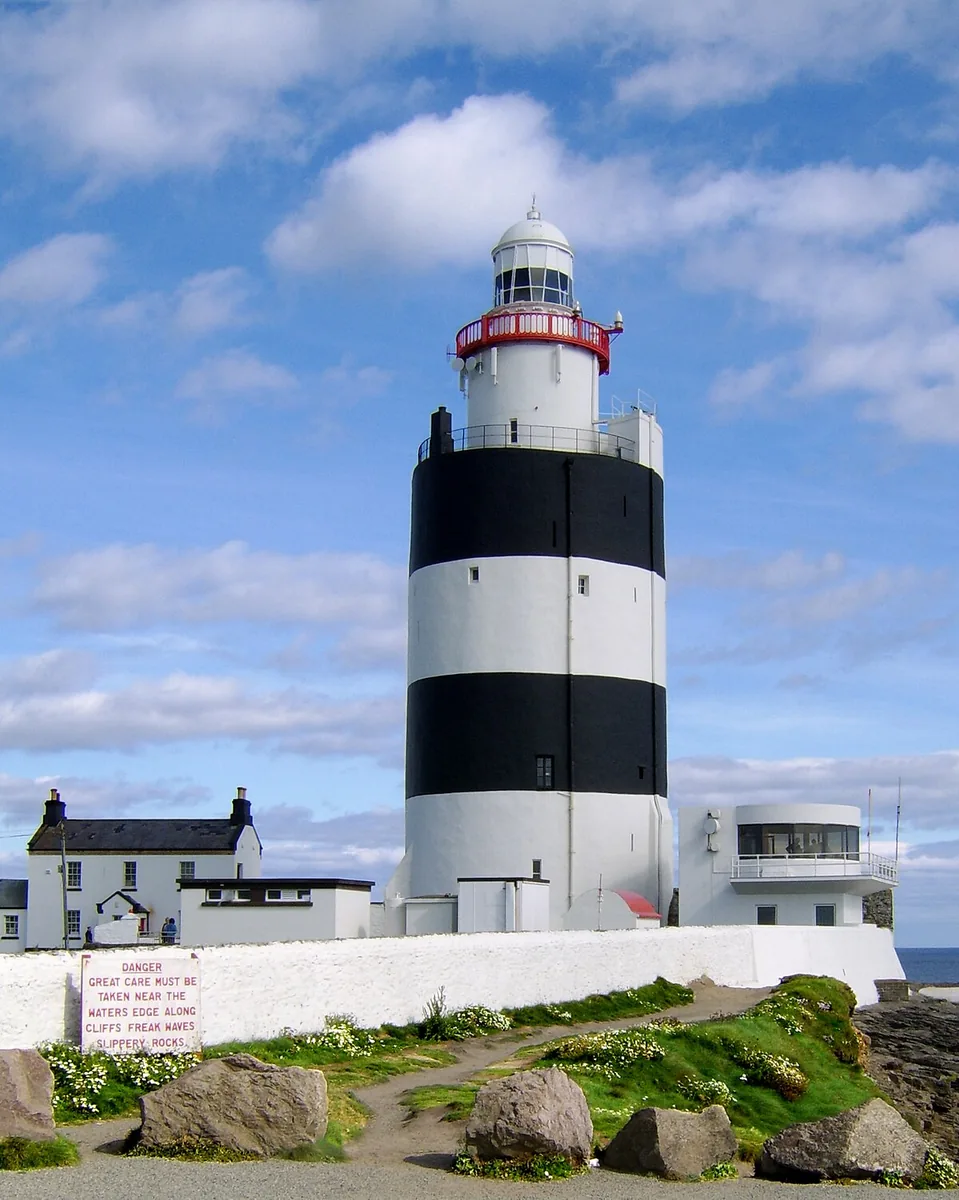
This medieval tower has been keeping a light burning for sailors since the 1200s, long before the 'New World' was even a thought on a European map.
About Hook Lighthouse
William Marshall built the tower using local limestone and lime mortar mixed with ox blood, a common medieval technique for strengthening masonry. The lighthouse was a private enterprise for centuries, funded by tolls on ships entering the harbor. During the Cromwellian era, the light was often extinguished as an act of war, leading to countless shipwrecks on the nearby rocks. In the 1800s, the tower was painted with its iconic stripes to make it more visible during the day. It remains a critical navigational aid today, using a powerful LED light that can be seen for twenty-three nautical miles.
Standing on the tip of the Hook Peninsula
Standing on the tip of the Hook Peninsula in County Wexford, this black-and-white striped tower is the oldest operational lighthouse in the world. It is a thick, stubborn pillar of limestone that has weathered eight centuries of Atlantic storms. The landscape here is flat and limestone-scarred, a stark headland where the land seems to be slowly dissolving into the Celtic Sea. The room is perpetually salted, and the sound of the foghorn, when it triggers, is a guttural roar that can be felt in the chest. Unlike modern, slender lighthouses, Hook Head has a massive, medieval girth, born from its origin as a fortress of light built by a Norman knight.
In the fifth century, a monk named Dubhán
In the fifth century, a monk named Dubhán established a beacon here, keeping a fire burning on the headland to warn sailors of the treacherous rocks. However, the structure we see today was built in the early thirteenth century by William Marshall, the Earl of Pembroke and the same man behind Kilkenny Castle. He needed a beacon to guide his ships safely into the port of Waterford. Across centuries, the light was tended by monks who lived in the tower, a tradition that continued until the mid-seventeenth century. The lighthouse was eventually automated in 1996, but its heart remains medieval; the walls at the base are up to four meters thick, designed to withstand the sheer hydraulic pressure of waves that have been known to break over the top of the lantern room.
Visiting Hook Lighthouse
Climbing the 115 stone steps of the spiral staircase is a walk through vertical time. There is the drop in temperature moving into the thickest parts of the wall and notice the smooth, hollowed-out centers of the steps where thousands of keepers have trodden before you. The tour takes you through the original medieval chambers where the monks lived and prayed. When you finally reach the balcony outside the lantern room, the perspective is dizzying. A sense of a spray of the sea on your face and see the coastline of Waterford across the estuary. The ground below is a pattern of 'blowholes' in the limestone where the sea erupts in white plumes during high tide.
The Hook Peninsula is a detour
The Hook Peninsula is a detour from the main Wexford roads, a passage through quiet villages and narrow lanes lined with wild roses. It is about a fifty-minute drive from Wexford town or a ferry ride across from Passage East in Waterford. The approach is marked by the lighthouse’s distinctive horizontal stripes, which become visible long before you reach the headland. A sense of arriving at the end of the world. The visitor center, housed in the former keepers' cottages, provides a warm contrast to the wild, exposed cliffs, offering tea and stories to those who have braved the wind.
The Experience
The interior the lighthouse is heavy with the scent of sea salt and old stone, a cool dampness that never quite leaves the walls. The opening note is the transition from the dark, narrow stairs to the brilliant, blinding light of the lantern room, where the giant Fresnel lens looks like a massive glass jewel. On the outdoor gallery, the wind is so strong it seems to strip the thoughts from your head, leaving only the sight of the crashing waves. Looking down at the limestone slabs of the headland, you feel the immense age of the place, a sentinel that has watched the world change while remaining utterly still.
Why It Matters
Hook Lighthouse is a rare surviving piece of medieval industrial technology. It is a symbol of the maritime history of the southeast and shaped by the engineering genius of the Normans. It serves as a physical record of the evolution of coastal lighting, from open coal fires to modern satellite-synched optics.
Why Visit
Visit the Hook because it is the only place where you can climb a medieval castle that is also a working lighthouse. It is functional history. The rugged beauty of the headland, with its fossils and blowholes, offers a playground for the curious that feels much more authentic than a standard museum.
✦ Photo Gallery
Best Season
🌤 October is fascinating; the weather turns stormy enough to see the sea truly battering the headland, but the lighthouse remains a safe, warm vantage point.
Quick Facts
Best time to visit
October is fascinating; the weather turns stormy enough to see the sea truly battering the headland, but the lighthouse remains a safe, warm vantage point.
Getting there
In Wexford, Ireland; reach Wexford first, then continue to the site.
What's nearby
Kilkenny Castle and Glendalough are also in the area.
Location
Wexford, Ireland
Type
attraction
Coordinates
52.1238°, -6.9293°
Insider Tips
- 1
Check the 'blowholes' on the rocks during a rising tide; the water can spout thirty feet into the air like a geyser.
- 2
The limestone around the lighthouse is packed with fossils of crinoids and brachiopods; look closely at the flat slabs near the water.
- 3
Take the ferry from Passage East to Ballyhack if you are coming from Waterford; it saves an hour of driving and offers a great view of the estuary.
- 4
The 'Keepers' Lunch' in the cafe is legendary for its seafood chowder, which is perfect for warming up after a windy climb.