“A wedding took place in the prison chapel by candlelight at midnight, followed by an execution in the courtyard at dawn, forever binding romance to revolution in the Irish consciousness.”
About Kilmainham Gaol
When it first opened at the end of the 18th century, Kilmainham was considered a model of modern incarceration. It functioned as a transit point for thousands of convicts waiting for ships to transport them to the penal colonies of Australia. During the 1840s, the prison became a tragic compressed version of the Great Hunger, with women and children filling the cells because the jail offered a guarantee of bread that the outside world could not. The political arc of the gaol reached its crescendo during the Irish War of Independence and the subsequent Civil War. Eamon de Valera, who would later become the President of Ireland, was the prison’s final political captive. He symbolically turned the key in the lock when he was released in 1924, effectively ending the building’s life as a functioning prison and beginning its journey as a national shrine.
What Kilmainham Gaol in Ireland is
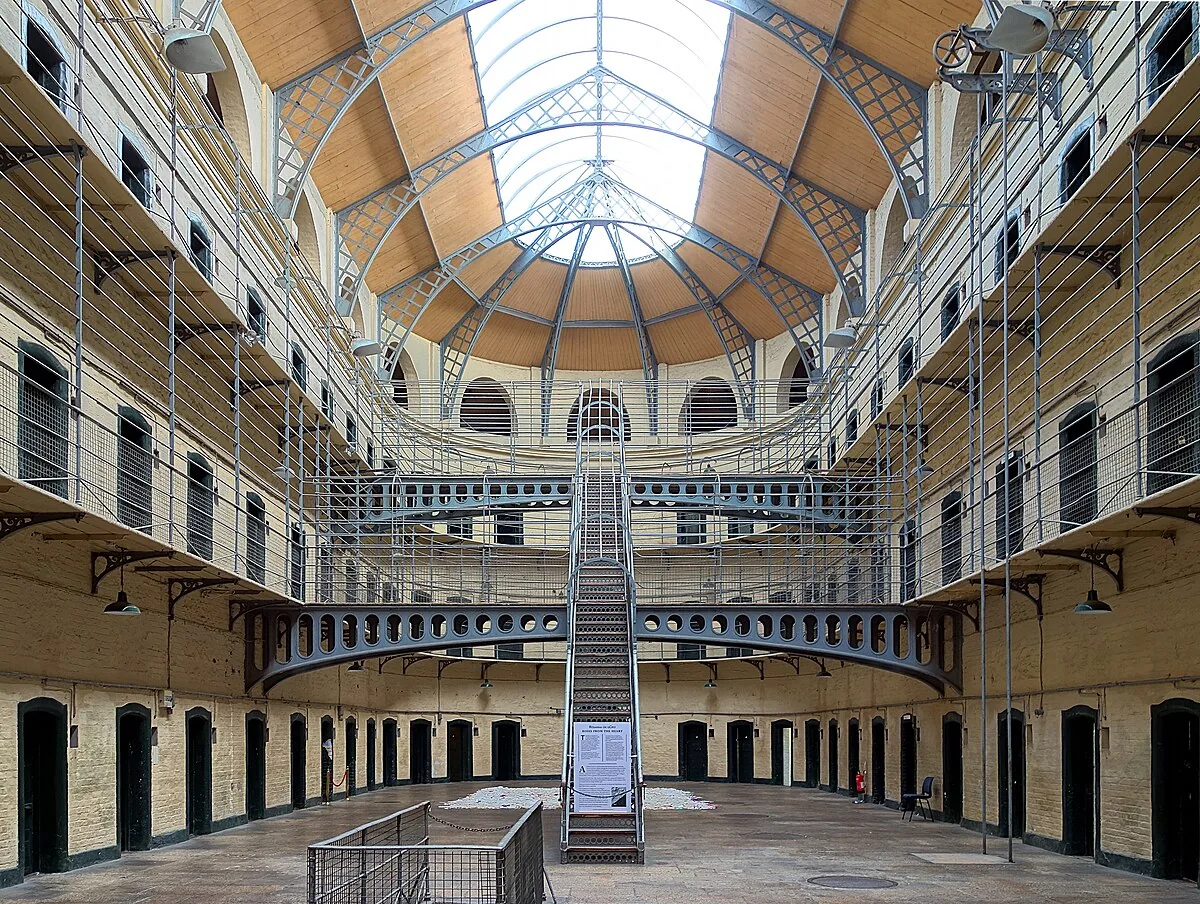
Stone walls three feet thick possess a peculiar way of holding onto the cold, even in the height of a Dublin summer. Kilmainham Gaol is a silent, limestone monument to the messy, agonizing birth of modern Ireland. This panopticon fortress was the final stop for generations of revolutionaries, common thieves, and famine-stricken children alike. Walking through the narrow threshold, the roar of city traffic is instantly replaced by a heavy, vacuum-like silence. The architecture transition from the claustrophobic darkness of the old West Wing to the soaring, skylit ironwork of the Victorian East Wing is a jarring lesson in how different eras attempted to reform, or simply break, the human spirit. Every corridor smells faintly of damp masonry and white wash, a scent that seems to have lingered since the last cell door was bolted shut in 1924.
Stone walls three feet thick possess a peculiar way of holding onto the cold, even in the height of a Dublin summer.
New Gaol opened, 1796
Dublin’s New Gaol opened in 1796 on a ridge overlooking the city, intended as a progressive alternative to the squalor of older dungeons. Reformers believed that solitude and silence would lead to penitence, but the Great Famine of the 1840s shattered these ideals as the building became dangerously overcrowded with people committing petty crimes just to secure a meal. The prison's most enduring and painful chapter began in May 1916. Following the failed Easter Rising, fourteen leaders of the rebellion were brought to the Stonebreaker's Yard and executed by firing squad. Among them was Joseph Plunkett, who married his sweetheart Grace Gifford in the prison chapel just hours before his death. These events transformed a place of shame and punishment into a sacred ground for the Irish Republic. After decades of dereliction, a volunteer restoration society saved the building from demolition in the 1960s, hand-scraping the rust from the catwalks to preserve the site for the nation.
Stepping into the East Wing creates a visceral physical reaction as the ceiling opens up into a massive, vaulted glass roof. The standout is the way the light hits the blue and cream iron railings, casting long, barred shadows across the flagstone floors. The acoustics here are haunting; every footstep and whisper travels up the central spine of the wing, making constantly watched. In the West Wing, the experience is the opposite. The weight of the squeeze of the narrow halls and see the tiny, high-set windows that offered prisoners only a square of grey Irish sky. The Stonebreaker's Yard is the moment that stays with you. From the spot where the leaders of 1916 fell, the high stone walls cut off the wind, leaving a stillness that feels heavy with the weight of the past. It is a place that demands a quiet voice and a slow pace.
Reaching this historic site requires a short journey to the western edge of Dublin's city center. Several bus routes, including the 69 and 79 from Aston Quay, drop passengers nearly at the gate. Many visitors choose to take the Luas red line to the Suir Road stop, followed by a ten-minute walk through the residential streets of Inchicore. The prison sits directly across from the Royal Hospital Kilmainham, which now houses the Irish Museum of Modern Art. Because of the building's delicate nature and immense popularity, entry is strictly restricted to guided tours. These tours often sell out weeks in advance, making early online booking the only way to ensure you aren't left standing at the outer gate.
Reaching this historic site requires a short journey to the western edge of Dublin's city center.
The Experience
Inside the cells feels static, as if the breath of the thousands who occupied them has never quite escaped. The scratching on the stone walls, initials, dates, and small crosses, carved by those who had nothing left but their names. In the Victorian Wing, the symmetry is beautiful but cold, designed so a single guard could see every door from one central point. You discover a distinct drop in temperature as you move toward the older parts of the building where sunlight never reaches. A large share of visitors find themselves staring at the small black cross in the courtyard, marking the execution spot of James Connolly, who was so badly wounded he had to be tied to a chair to face the firing squad. It is a sensory journey that moves from the clinical cold of the law to the raw emotion of national tragedy.
Why It Matters
Kilmainham Gaol matters because it is the physical ledger of Ireland’s struggle for sovereignty. It provides a rare, unvarnished look at the intersection of social history and political rebellion. Within these walls, the stories of the poorest famine victims carry as much weight as those of the high-profile revolutionaries, making it a place of profound human empathy and national reflection.
Why Visit
Dublin has many sights that celebrate the city's literary and social flair, but Kilmainham offers the grit and the backbone. You come here to understand the price paid for the independence you see celebrated elsewhere. It is a rare opportunity to stand in the exact rooms where the course of a nation's history was diverted by a few dozen people with an impossible dream.
✦ Insider Tips
- 1
Pay attention to the small details in the chapel; the original floor tiles and altar are exactly as they were on the night of the Plunkett-Gifford wedding.
- 2
Look for cell number 19 in the West Wing, where you can still see the faded remains of murals painted by Republican prisoners during the Civil War.
- 3
Combine your visit with a walk through the adjacent War Memorial Gardens at Islandbridge for a peaceful place to decompress after the heavy atmosphere of the gaol.
- 4
Ask your guide about the 'Iron Man,' a specific guard whose reputation for both cruelty and unexpected kindness has become part of the prison's oral legend.