“Local lore says the Devil spat this massive limestone crag across the plains of Tipperary after losing a tooth while biting the mountains to the north.”
About Rock of Cashel
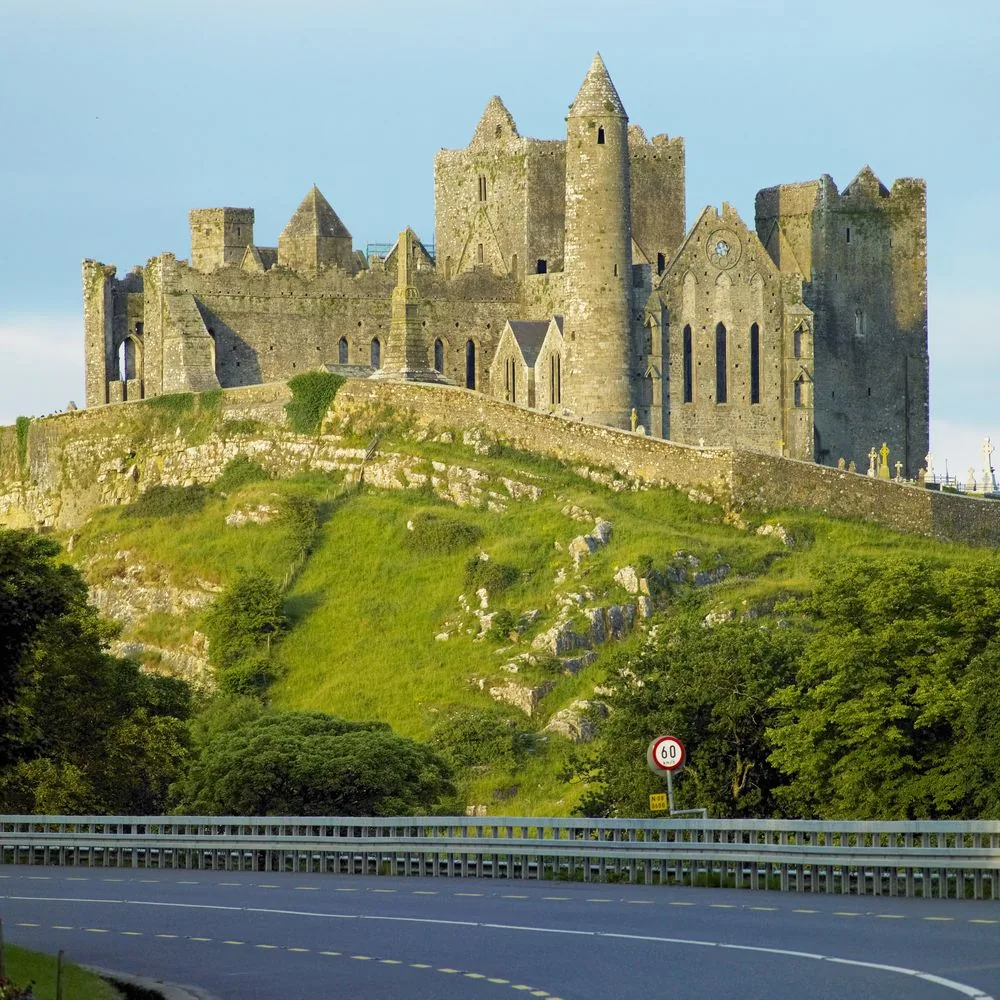
The Rock served as the fortress of the Kings of Munster for five hundred years, most notably as the base for Brian Boru, the High King who united Ireland in the eleventh century. After its donation to the Church, the site evolved into a sprawling complex of Gothic and Romanesque structures. The 12th-century Round Tower is the oldest surviving building on the Rock, a slender needle of stone that once served as a bell tower and a treasury. The massive Gothic cathedral was added in the 13th century, creating a dominant architectural presence that survived multiple sieges and the eventual abandonment of the site in the 1700s.
What Rock of Cashel actually is
Rising abruptly from the flat, fertile plains of the Golden Vale, the Rock of Cashel is a limestone outcrop crowned with a silhouette of jagged gables and round towers. It looms over the town of Cashel like a stone ship moored on a green sea. This was the seat of kings long before it was a cathedral, a place where the air feels thick with the weight of medieval power struggles. The grey limestone walls, weathered by centuries of Munster rain, house some of the most significant ecclesiastical ruins in Europe. To stand at the base of the rock is to feel small against the sheer verticality of Irish history.
Rising abruptly from the flat, fertile plains of the Golden Vale, the Rock of Cashel is a limestone outcrop crowned with a silhouette of jagged gables and round towers.
Legend claims the Rock landed here
Legend claims the Rock landed here when the devil took a bite out of the Slieve Bloom Mountains and spat it out in a fit of rage, but the human history is even more dramatic. Over the centuries, it was the traditional seat of the Kings of Munster, the Eóganachta clan. In 1101, King Muirchertach Ua Briain made the strategic decision to gift the Rock to the Church, effectively preventing his rivals from ever reclaiming the stronghold. This move transformed a fortress into a religious powerhouse. Within its walls, the Synod of Cashel in 1172 fundamentally altered the structure of the Irish Church, and later, in 1647, the site saw a bloody massacre during the Irish Confederate Wars when Cromwellian forces set fire to the cathedral with hundreds of people inside.
The ascent up the steep path
The ascent up the steep path from the car park offers a changing perspective of the circular stone walls. Inside the complex, Cormac’s Chapel is the crown jewel, a sandstone masterpiece of Romanesque architecture. The coolness of the stone and see the faint, ghostly remains of twelfth-century frescoes, the oldest in Ireland, showing saints with large, staring eyes. The wind whistles through the roofless nave of the Great Cathedral, and the grass floor feels soft underfoot. From the North Transept, you can look out over the valley toward the ruins of Hore Abbey, seeing the same pastoral landscape that the high kings gazed upon a millennium ago.
Location and access
Cashel is located in County Tipperary, easily reached via the M8 motorway connecting Dublin and Cork. The Rock is visible for miles, acting as a permanent North Star for travelers in the region. Once you park in the town, it is a short, brisk walk up the hill. The site is popular, but because it is spread across several buildings and courtyards, it rarely feels suffocating. Guided tours are highly recommended here, as the complexity of the carvings and the overlapping eras of construction are best untangled by the storytellers who know the stone by heart.
Cashel is located in County Tipperary, easily reached via the M8 motorway connecting Dublin and Cork.
The Experience
The sound of jackdaws nesting in the high stone crevices is the constant soundtrack to a visit at Cashel. You get a dampness of the sandstone in Cormac’s Chapel, where the air is kept at a constant temperature to preserve the fading pigments of medieval paint. The light in the roofless cathedral changes with the clouds, throwing long, dramatic shadows of the Celtic crosses onto the mown grass. You discover a sense of immense solidity here, a feeling that these walls have absorbed a thousand years of prayer and conflict, making the modern world below seem fleeting and fragile.
Why It Matters
The Rock of Cashel is the most impressive collection of medieval architecture in Ireland, representing the peak of Celtic-Romanesque art. It symbolizes the historical union of royal and religious authority on the island. Its survival, particularly the delicate frescoes in Cormac’s Chapel, provides an irreplaceable link to the visual world of twelfth-century Christendom.
Why Visit
While the Blarney Stone gets the crowds, Cashel offers the soul of Irish history. It is a place of raw power and intricate beauty, where you can touch the same stones that Brian Boru once walked. The view from the Rock over the Golden Vale is the definitive image of inland Ireland.
✦ Insider Tips
- 1
Walk down the hill to Hore Abbey after your visit; the view of the Rock from the abbey ruins is the best photo opportunity in the county.
- 2
The guided tour is included in the price and provides access to stories and specific carvings you will definitely miss on your own.
- 3
Spend time looking at the sarcophagus in Cormac’s Chapel; the intertwined serpent carvings are a pinnacle of Hiberno-Scandinavian style.
- 4
Check the weather and bring a jacket; even on warm days, the wind at the top of the outcrop can be surprisingly sharp.
- 5
Visit the Hall of the Vicars Choral near the entrance to see the original St. Patrick's Cross, which is kept indoors to protect it from erosion.