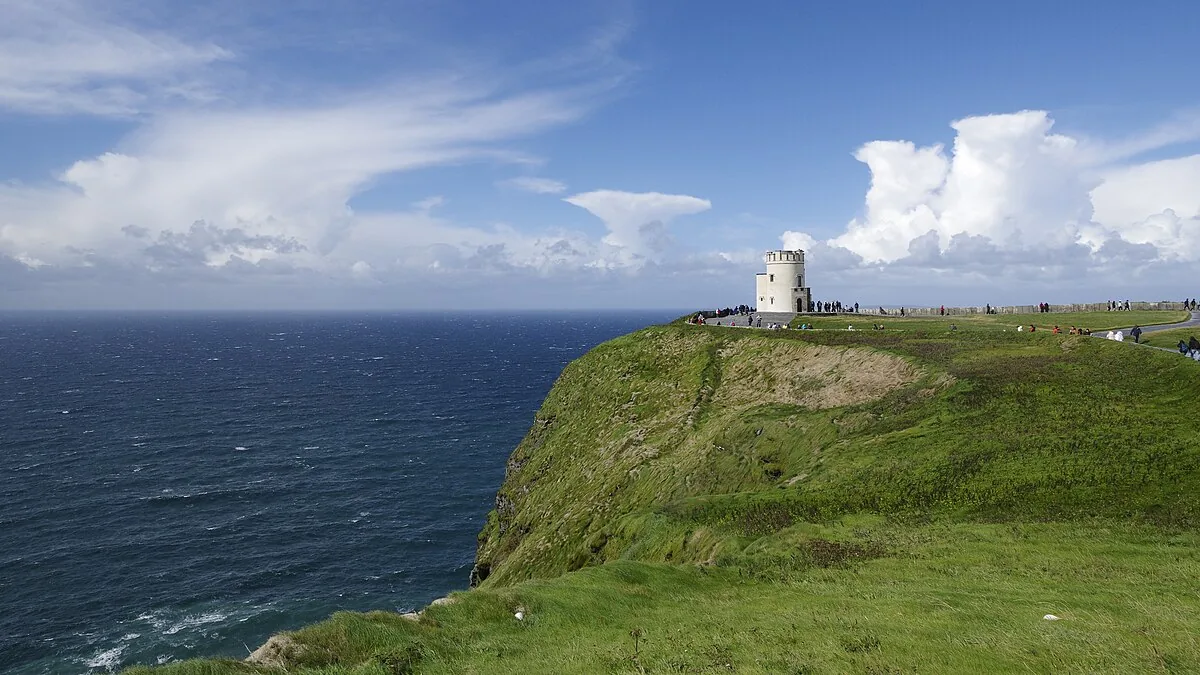
At the tip of this peninsula, you are standing closer to America than anyone else in Europe, with only the ghost-filled Blasket Islands between you and the horizon.
About Slea Head Drive
The archaeology along the drive ranges from the Iron Age Dunbeg Fort to the Gallarus Oratory, a thousand-year-old stone church that looks like an upturned boat. This region was a major filming location for 'Ryan’s Daughter' in the 1960s, an event that brought the first real tourism to the area and forever changed the local economy. The Blasket Centre at Dunquin tells the tragic and beautiful story of the islanders who lived in sight of the mainland but remained culturally distinct for centuries. Every turn of the road reveals a different layer of this history, from the pagan to the cinematic.
What Slea Head Drive in Ireland is
The Slea Head Drive is a looping ribbon of tarmac that clings to the ragged westernmost edge of the Dingle Peninsula. It is a journey where the Atlantic Ocean is a constant, shimmering character on your left and the steep, emerald slopes of Mount Eagle rise on your right. The road is famously narrow, often bordered by stone walls that feel uncomfortably close to the car door. The surroundings here is bright and clear, smelling of diesel, salt, and wild fuchsia. This is a landscape where the Irish language still thrives, and the history of the island is written in the stone 'beehive' huts and ancient forts that dot the cliffs like barnacles.
“The Slea Head Drive is a looping ribbon of tarmac that clings to the ragged westernmost edge of the Dingle Peninsula.”
Slea Head Drive, Ireland
This corner of Kerry has been inhabited
This corner of Kerry has been inhabited for over six thousand years, and the drive passes through a concentration of archaeological sites that is outstanding in Ireland. The Fahan Beehive Huts, or 'clocháin,' date back to the early medieval period and were built using a dry-stone corbelling technique that remains watertight today. The drive also circles the base of the Blasket Islands, which were inhabited until 1953. The islanders were a resilient community of storytellers and fishermen who left behind a rich literary legacy before the government evacuated them due to the extreme isolation. The road itself follows old cattle tracks and famine-era relief roads, a winding history of the struggle to live on the very edge of Europe.
The most dramatic moment comes at Slea Head
The most dramatic moment comes at Slea Head itself, where a white crucifix stands against the blue of the sea and the road turns sharply to reveal the Blasket Islands. A mark of the shift in the wind and notice how the light turns the water into shades of turquoise and deep amethyst. The drive is a mix of the engine's low gear and the constant crashing of waves against the rocks of Coumeenoole Beach. First, the small, stone-walled fields, some no bigger than a living room, climbing impossibly high up the mountainsides. It is a slow experience; You end up stopping every few hundred meters to look at a cross, a ruin, or a flock of sheep that has decided the road is a good place for a nap. The drive starts and ends in the town of Dingle. It is a circular route of about thirty miles, usually driven clockwise to ensure the best views and to avoid head-to-head encounters with tour buses on the narrowest sections. Driving it requires focus; the road is barely wide enough for two cars in many places, and the sheer drops can be intimidating. However, the slow pace is the point. Many visitors choose to cycle the route, which takes a full day but allows for a complete sensory immersion into the sounds and smells of the peninsula. Whether by car or bike, it is essential to check the fog forecast, as Slea Head can disappear in a 'sea-fret' that makes driving dangerous and erases the views entirely.
The Experience
The light on the Slea Head Drive is unlike anywhere else in Ireland; it has a crystalline quality that makes the colors of the grass and the sea appear hyper-saturated. The spray from the Atlantic if you walk down to the pier at Dunquin, where the cliffs look like giant, stacked dinner plates. First, the sudden silences when you turn into a sheltered cove, and the air becomes warm and still. The most lasting impression is the scale of the landscape versus the smallness of the human efforts to contain it, the stone walls look like lace draped over the shoulders of giants. It is a humbling and invigorating circuit.
Why It Matters
Slea Head Drive is the heart of the Gaeltacht (Irish-speaking region) and a living museum of rural Irish life. It preserves a concentration of early Christian and pre-historic monuments that are vital for understanding the island's origins. Culturally, it is the home of the 'Blasket tradition,' a unique body of literature that captured a disappearing way of life.
Why Visit
Drive this route because it is the most concentrated dose of Irish beauty available in a single afternoon. It combines archaeology, language, and geography in a way that feels organic. Unlike the Ring of Kerry, which can feel commercialized, Slea Head remains intimate and ruggedly honest.
Insider Tips
- 1
Drive clockwise; the tour buses are forced to go this way, and meeting one on a blind corner going the opposite direction is a nightmare.
- 2
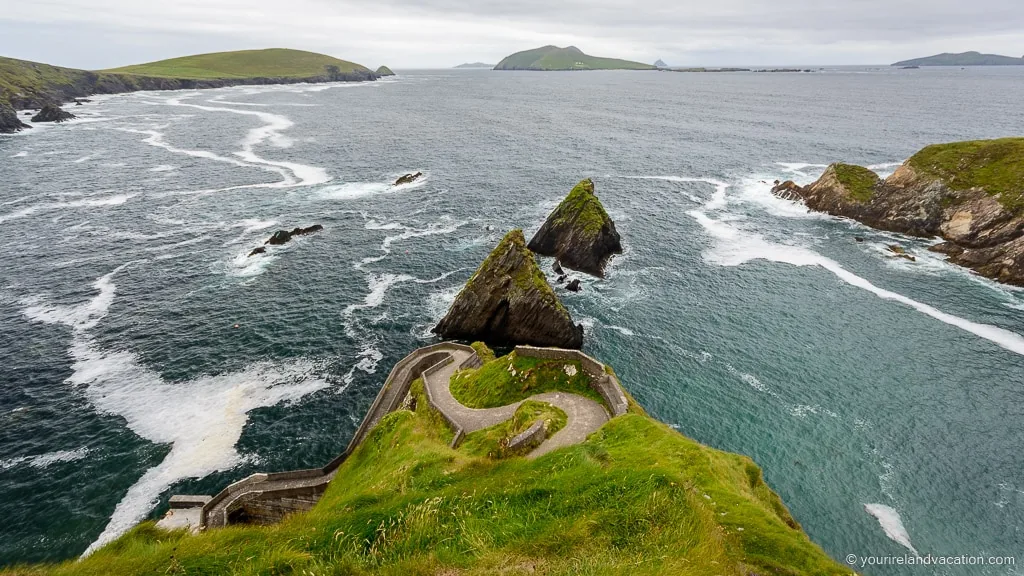
Stop at the Dunquin Pier to see the most photographed road in Ireland, a zig-zagging path that leads down to the ferry.
- 3
The 'beehive huts' are on private land and usually require a few euros in a donation box, so keep some change handy.
- 4
Eat at the small cafes in Ventry or Ballyferriter rather than waiting to get back to Dingle; the local crab sandwiches are exceptional.
- 5
The Gallarus Oratory is just off the main loop and is worth the five-minute detour to see the perfect dry-stone masonry that hasn't leaked in 1,200 years.