“A heartbroken widow walked away from seventy Indian craftsmen and a half-finished palace, leaving a Scotsman's fever dream to be slowly digested by the Malaysian jungle.”
About Kellie’s Castle
William Kellie Smith’s ambition was so great that he planned for Malaya's first private elevator, a shaft that still stands empty today. During the construction, a Spanish flu outbreak decimated his workforce, leading the surviving craftsmen to build a Hindu temple on the grounds as an offering for protection. Kellie Smith, a man of surprising religious tolerance, actually funded the temple, and his image was carved into the roof alongside the deities. His death in Portugal was a sudden end to an era of extravagant colonial building. For decades, locals believed the site was cursed or haunted by the restless spirits of those who died during the plague, which kept the building remarkably preserved from looters until its official heritage designation.
What Kellie’s Castle in Malaysia is
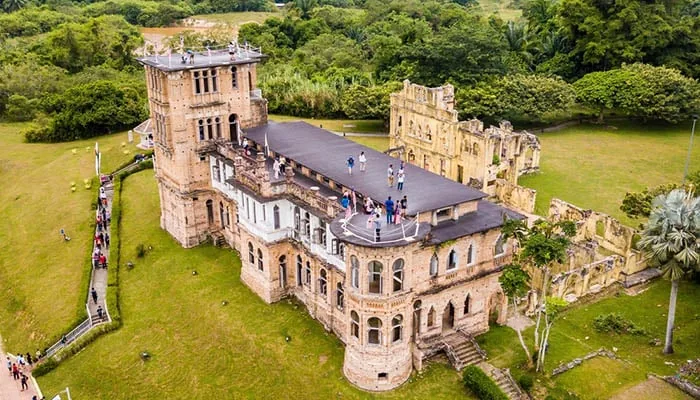
Rust-colored bricks rise in a defiant tangle of Moorish arches and Greco-Roman columns against the vibrant green backdrop of the Perak jungle. Kellie’s Castle remains a skeletal monument to a Scottish planter's grandest ambitions and his most crushing heartbreaks. The space around the estate feels thick and heavy, smelling of damp earth, tropical rot, and the dry, mineral scent of crumbling mortar. You walk through the roofless corridors where the sun casts sharp, geometric shadows across floors that were never finished. In your ears is a lonely mix of the wind whistling through empty window frames and the distant, rhythmic chirping of cicadas that have slowly reclaimed the land. Every corner reveals a staircase that leads to nowhere or a hidden room intended for a lavish life that never began.
Rust-colored bricks rise in a defiant tangle of Moorish arches and Greco-Roman columns against the vibrant green backdrop of the Perak jungle.
arrived in Malaya, 1890
William Kellie Smith arrived in Malaya in 1890 with little more than a pocketful of copper and a desire to make his fortune in rubber and tin. By the turn of the century, he had acquired vast tracts of land and a desire to build a home for his wife and son that would rival the manor houses of Europe. In 1915, he brought over seventy Tamil craftsmen from southern India to execute a design that blended the architecture of his home with the intricate masonry of the East. Disaster struck in 1926 when Kellie Smith contracted pneumonia during a trip to Lisbon and died suddenly. The project halted immediately as his grief-stricken widow sold the estate and returned to Scotland. The jungle spent the next seventy years swallowing the bricks until the Malaysian government cleared the vines to reveal this unfinished dream.
Standing in the center of the grand ballroom , The physical weight of an absence where the laughter of a thousand guests was supposed to echo. You catch the way the light catches the intricate plasterwork on the ceilings of the completed rooms, hinting at the opulence that Kellie Smith envisioned. The sound of your own footsteps on the uneven stone is the only thing breaking the silence of the morning. Something like a sudden, cool draft in the underground wine cellar, a space that feels disconnected from the tropical heat above. Immediately, the tiny, deliberate details in the brickwork, including the small statues of the Smith family tucked high up on the facade. The element that stays with you is looking out from the rooftop terrace at the Kinta Valley, realizing that the view is exactly as the Scotsman left it, save for the passage of time. The estate sits just outside the small town of Batu Gajah, about a twenty-minute drive from the city of Ipoh. Travelers usually reach the site by hiring a taxi or using a ride-sharing service from the Ipoh railway station. The road winds through former rubber plantations and quiet villages before the tall towers of the castle appear on a small hill. Arriving in the late afternoon provides the best light for photography, as the setting sun turns the red bricks into a glowing orange. Walking shoes are necessary as the stairs are steep and some of the ground remains uneven from the original excavation.
The Experience
The sense of Kellie’s Castle is one of romantic, heavy melancholy. What registers is the smell of the air, it is the scent of old dust and rainwater, a grounded perfume that anchors the site's ethereal appearance. There is a humidity pressing against the stone, making the bricks feel slightly damp to the touch even in the midday sun. The light is the true architect here, flooding through open roofs and creating a sense of being both inside and outside simultaneously. The dark, square openings of the secret tunnels that were meant to provide escape routes during times of unrest. The most evocative detail is the silence in the nursery, where a marble floor was laid for a child who would never play there. It is a place of profound, unfinished stories.
The sense of Kellie’s Castle is one of romantic, heavy melancholy.
Why It Matters
Kellie’s Castle is a unique architectural hybrid and a vital link to the colonial history of the Kinta Valley. It represents the height of the early 20th-century rubber boom and the immense human effort required to build in the tropical frontier. Historically, it is significant as one of the few examples of private, non-military colonial architecture that survived the Pacific War and the subsequent years of neglect.
Why Visit
The point is that you need to see the architecture of obsession. While Malaysia has many grand colonial buildings, none possess the raw, emotional power of this unfinished ruin. You come here to stand in the elevator shaft that never moved and to walk through the ballroom that never held a dance. It is the only place in the country where you can touch a ghost made of red brick.
✦ Insider Tips
- 1
Look for the small Hindu temple located about 500 meters from the castle to see the carving of William Kellie Smith in his colonial hat.
- 2
The secret tunnels are accessible but very narrow; bring a small flashlight to see the details of the brickwork inside.
- 3
Climb to the very top of the tower for a panoramic view that stretches all the way to the limestone hills of Ipoh.
- 4
Visit during a weekday morning to have the roofless rooms to yourself; the echoes are much more powerful when the crowds are absent.
- 5
Check the weather before driving; the outdoor nature of the site means a tropical downpour can end your visit very quickly.