“Designed with the mathematical precision of the Golden Ratio, this 16th-century stone circle has guarded the Dniester river-ford against empires for five hundred years.”
About Soroca Fortress
The fortress at Soroca was part of a larger defensive chain that included strongholds at Hotin, Tighina, and Cetatea Alba. Its construction was a response to the growing threat of the Ottoman Empire, which sought to turn the Dniester into a Turkish lake. The stone was quarried locally, a soft but resilient limestone that has weathered to a pale, bone-like color over the centuries. During the 1730s, the fortress played a key role in the Russo-Turkish wars, serving as a vital supply depot and a sanctuary for local populations. Despite being besieged numerous times, the walls never suffered a catastrophic breach. A major restoration project in the 2010s replaced the rotting wooden galleries and roofs, returning the fortress to its mid-16th-century appearance while preserving the original Genoese masonry.
What Soroca Fortress is
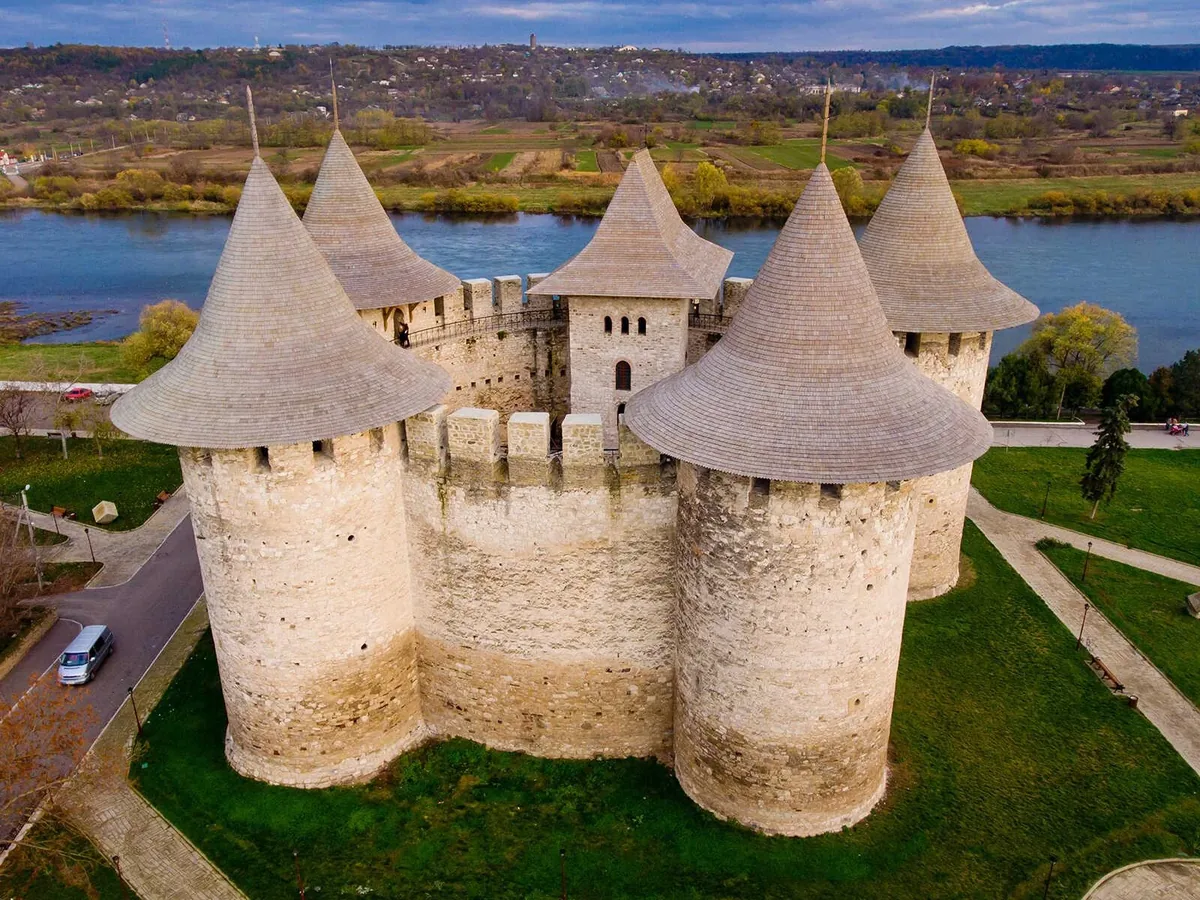
A perfect circle of chalky stone sits on the banks of the Dniester River, its five rounded towers casting long shadows toward the Ukrainian border. Soroca Fortress is a masterwork of medieval geometry, a rare surviving example of the circular fortifications that once defended the eastern frontiers of the Principality of Moldavia. The space by the river is humid and smells of fresh reeds and the iron-scent of the water. You walk through a massive oak-bound gate. Notice how the stone walls, thick enough to absorb a cannon blast, still feel cold even in the height of July. The sound is a quiet combination of the river's steady flow and the chirping of swallows that have claimed the high battlements as their own. Unlike the sprawling, irregular castles of Western Europe, this structure feels contained, focused, and mathematically deliberate.
A perfect circle of chalky stone sits on the banks of the Dniester River, its five rounded towers casting long shadows toward the Ukrainian border.
wooden fort here, 1499
Stephen the Great originally established a wooden fort here in 1499 to guard a strategic ford against Tatar incursions across the Dniester. Between 1543 and 1546, his son Petru Rares brought in Genoese master builders to replace the timber with the current stone structure. These Italian architects utilized a design based on the 'Golden Ratio,' ensuring that each of the four outer towers was equidistant from the central tower and the curtain walls. This circular layout meant there were no blind spots for defenders, making it a nightmare for besieging Ottoman or Polish forces. Throughout the 17th and 18th centuries, the fortress was the site of fierce battles, including the famous Pruth River Campaign of Peter the Great. It has survived centuries of conflict and Russian imperial expansion, standing today as the most intact medieval fortification in the country.
Climbing the narrow spiral stairs to the upper wooden galleries, The rough texture of the porous limestone against your palms. You catch the way the light filters through the narrow arrow-slits, creating sharp, geometric bars on the floor. Audible here is an airy echo where the voices of a few visitors in the courtyard below sound like ghosts from another century. The breeze pick up as you reach the battlements, offering a panoramic view of the Dniester and the vast, flat plains of Ukraine just a few hundred meters away. Right away, the intricate timber work of the restored roof, which smells faintly of pine resin and old dust. The most powerful moment is standing in the small chapel located in one of the towers, where the silence is so thick it is like a physical presence.
Location and access
Soroca is located in the northern reaches of Moldova, roughly three hours by road from Chisinau. Regular buses and private shuttles depart from the North Bus Station, following a route that passes through the heart of the country's northern agricultural belt. The fortress is situated at the river's edge, a short walk from the town center. Arriving in the late morning allows you to explore the stone galleries before the afternoon sun hits the exposed ramparts. After visiting the fort, many travelers take a taxi up to the nearby 'Gypsy Hill' to see the surreal and opulent mansions that overlook the town, providing a startling architectural contrast to the medieval austerity of the fortress.
Soroca is located in the northern reaches of Moldova, roughly three hours by road from Chisinau.
The Experience
The energy at Soroca is one of compact, defensive elegance. What registers is the smell of the river, muddy and green, mingling with the dry, chalky scent of the interior courtyard. The presence of the scale of the towers, which seem much larger from the inside than they do from the riverbank. The light in the central courtyard is bright and direct, highlighting the precision of the stone joints. The small carvings in the masonry, some made by soldiers centuries ago to pass the time during long watches. The most evocative detail is the view through the main gate toward the water, where you can easily imagine the sails of enemy ships appearing on the horizon. It is a place that feels remarkably solid and unshakeable.
Why It Matters
Soroca Fortress is a landmark of medieval military architecture and a symbol of Moldovan resistance against foreign domination. It represents the height of the Principality of Moldavia's power and its ability to attract the finest engineers from Europe. Historically, it is significant as one of the few circular fortresses in the world that has remained virtually unchanged since the Renaissance.
Why Visit
The reason to visit: you want to see a castle that feels like a piece of jewelry. While other forts are messy and sprawling, Soroca is a perfect, logical circle that you can grasp in a single look. You come here to walk the same battlements as the Moldavian knights and to gaze across a river that has been the border between worlds for a millennium. It is the only place in Moldova where Italian design and Balkan history meet so perfectly.
✦ Insider Tips
- 1
The best photo of the entire fortress is taken from the middle of the Dniester River; ask a local fisherman for a ten-minute boat ride.
- 2
Look for the small museum inside the towers that houses authentic medieval chainmail and arrowheads found during the restoration.
- 3
Check the 'Thanksgiving Candle' monument nearby after your visit; it offers a higher vantage point for viewing the fortress and the river valley.
- 4
The stairs to the upper galleries are very narrow and steep; if you are claustrophobic, stick to the impressive central courtyard.