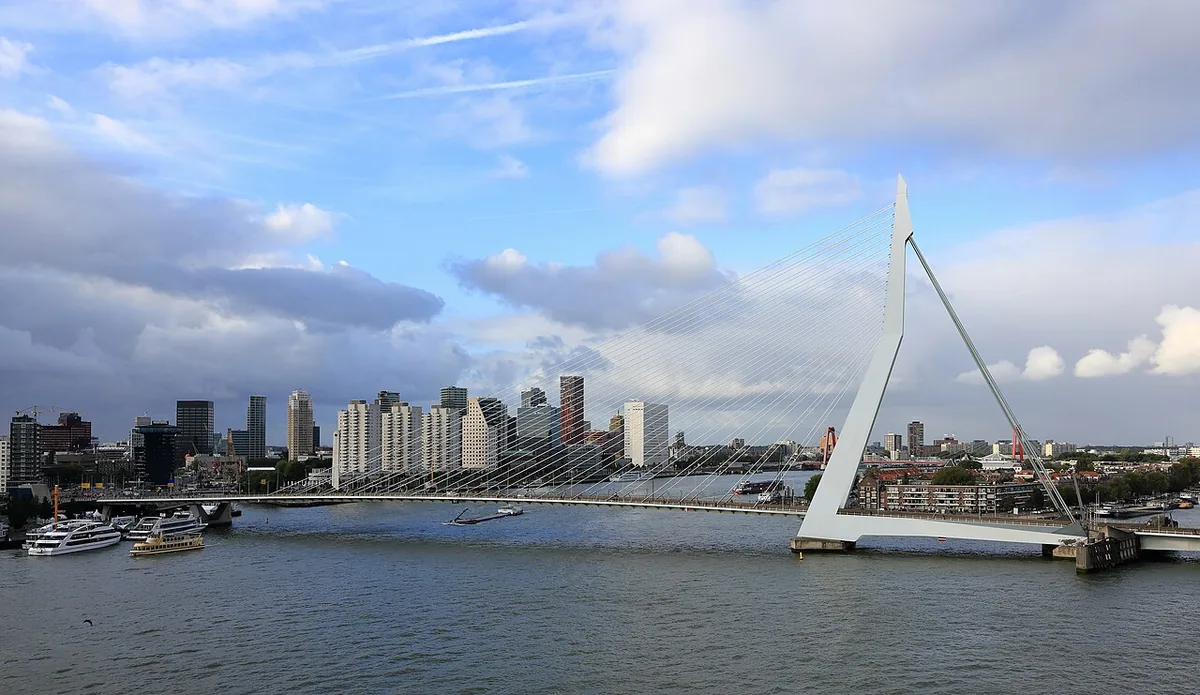
A single 139-meter pylon holds the weight of a city's maritime future, leaning back like a giant white swan poised to take flight over the Nieuwe Maas.
About Erasmusbrug
Queen Beatrix inaugurated the span in September 1996, marking the completion of a 165 million euro investment in the city's infrastructure. Ben van Berkel's design won out because it broke from the traditional symmetrical suspension models, opting instead for a bold, singular pylon. The bridge had to solve the problem of connecting the northern city center with the formerly abandoned port lands of the south, which were being transformed into 'Manhattan on the Maas.' It has since become the finish line for the Rotterdam Marathon and the setting for countless films and Red Bull Air Races, solidifying its role as the city's primary cultural stage.
What Erasmusbrug actually is
Rotterdam skyward ambition finds its most poetic expression in the massive white pylon of the Erasmusbrug. Stretching across the Nieuwe Maas river, this 802-meter cable-stayed bridge connects the historic center with the glass-and-steel Kop van Zuid district. Locals affectionately call it De Zwaan, or The Swan, a name that perfectly captures the grace of its asymmetrical silhouette. The bridge acts as a functional sculpture, a gateway for container ships that pulse through Europe's largest port and a stage for the city's cyclists who battle the harbor winds daily. Its stark white paint reflects the moody grey of the Dutch sky, turning brilliant silver when the sun finally breaks through the clouds. The structure does more than bridge water; it represents the city's refusal to be defined by its wartime destruction, serving as a pivot point for a skyline that is constantly reinventing itself.
Know before you go
Architect Ben van Berkel designed the bridge to be a centerpiece for the redevelopment of Rotterdam's old harbor basins. Completed in 1996, the project was officially opened by Queen Beatrix, signaling a new era of urban design for a city that had spent decades healing from the Blitz. The construction was not without its drama; shortly after opening, the stay cables began to vibrate violently in light rain and wind, necessitating the immediate installation of specialized dampers. The southern end features an immense bascule bridge, the largest and heaviest of its kind in Western Europe, allowing tall ships to pass into the inner docks. It was named after Desiderius Erasmus, the great Renaissance humanist born in Rotterdam, grounding this high-tech marvel in the intellectual history of the Netherlands.
Actually being there
Walking across the wooden-planked pedestrian paths, The rhythmic hum of the light rail cars and the vibrating thrum of the harbor current beneath your feet. It smells of brackish water and diesel, a mark of the city's maritime industrial heart. First you see the way the light catches the intricate network of 32 stay cables, making them look like the strings of a giant harp. What registers is the temperature drop as you reach the center, where the wind coming off the river has nothing to block its path. Simple to walk past is the dramatic perspective from the base of the pylon, where the sheer scale of the engineering becomes almost dizzying. First, the contrast between the old brick warehouses of the Veerhaven and the futuristic towers like De Rotterdam that loom on the southern bank.
The bridge is impossible to miss
The bridge is impossible to miss and easily accessible via the Leuvehaven or Wilhelminaplein tram stations. Cycling across is the most authentic way to experience it, following the dedicated lanes that flow alongside the vehicle traffic. Water taxis zip back and forth beneath the span, offering a different vantage point from the river level. If you arrive by train at Rotterdam Centraal, the walk to the bridge takes you through the heart of the city's modern shopping districts, providing a perfect introduction to the local architecture.
The Experience
You notice the vibrations from the tram tracks traveling through the soles of your shoes as the city pulses around you. You hear the wind through the cables creates a haunting, low-frequency whistle during stormy North Sea afternoons. The immense openness of the harbor, a stark contrast to the tight canal streets of Amsterdam. Most visitors miss the tiny harbor park at the northern foot, which offers the perfect angle to see the pylon align with the sun. The moment that stays with you is seeing the bridge illuminated at night, its white lines glowing against the dark river, reflecting the lights of the passing barges.
Why It Matters
Erasmusbrug is the quintessential symbol of Rotterdam's post-war identity, daring, industrial, and forward-looking. It serves as a bridge between the city's historical mercantile roots and its status as a global hub of modern architecture. Culturally, it serves as the spine of the city, hosting major festivals and national celebrations that define the modern Dutch spirit.
Why Visit
Visit the Erasmusbrug to see a city that isn't afraid to be new. While most of the Netherlands leans on its Golden Age charm, this bridge offers a hit of pure, unadulterated modernity. It is the best place to feel the true scale of the world's shipping lanes while standing in the middle of a vibrant urban center.
✦ Photo Gallery
Best Season
🌤 September is ideal, as the evening light is soft enough for photography and the city often hosts the World Port Days festival, filling the river with spectacular maritime displays.
Quick Facts
Best time to visit
September is ideal, as the evening light is soft enough for photography and the city often hosts the World Port Days festival, filling the river with spectacular maritime displays.
Getting there
In Rotterdam, Netherlands; reach Rotterdam first, then continue to the site.
What's nearby
Nieuwe Kerk, Mauritshuis and Hortus Botanicus Leiden are also in the area.
Location
Rotterdam, Netherlands
Type
attraction
Coordinates
51.9092°, 4.4867°
Insider Tips
- 1
Board a yellow water taxi at the Willemsplein for a high-speed thrill ride directly under the massive span.
- 2
Stand on the southern bank at dusk to watch the sun set behind the pylon for the most iconic skyline photo.
- 3
If you hear a bell and see the barriers drop, stay and watch; the massive bascule section rising to let a ship through is a feat of engineering.
- 4
Check the wind forecast; on a typical Dutch day, the bridge acts as a wind tunnel that can make cycling a serious workout.
- 5
Visit the Nederlands Fotomuseum on the south side immediately after crossing for a deep dive into the city's visual history.