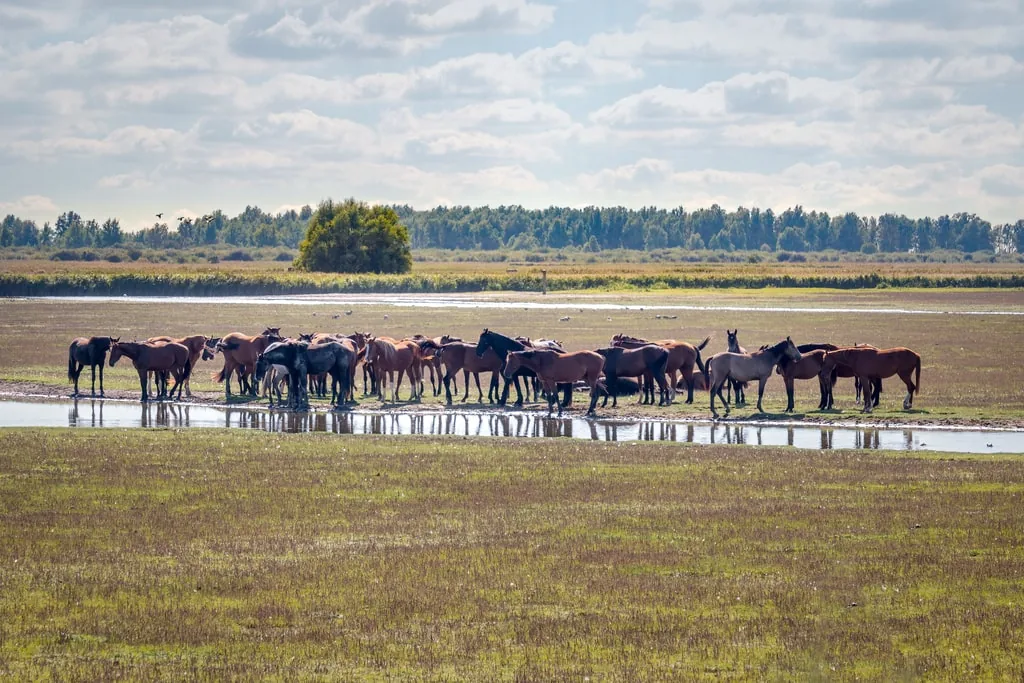
In 1969, a single dam turned a violent ocean bay into a silent lake, creating a 'new land' where white-tailed eagles now rule over a dark-sky wilderness.
About Lauwersmeer National Park
The Lauwerszee was once the primary naval approach to the city of Dokkum, the site of Saint Boniface's martyrdom. For a millennium, it was a source of both wealth and terror for the Frisians. The 1969 closure was a feat of modern engineering that used massive concrete caissons to block the tide. Almost immediately, the salt-tolerant vegetation died off, and a massive bloom of freshwater life took its place. The park has since become a major transit point for the 'intercontinental' bird migrations, hosting over 100 species at any given time. Its designation as a Dark Sky Park in 2016 marked its transition from a flood-protection project to a sanctuary of international ecological importance.
Where the provinces of Groningen and Friesland meet
Where the provinces of Groningen and Friesland meet, there is a landscape born from a sudden, artificial silence. Lauwersmeer National Park was once a turbulent bay of the Wadden Sea, but the completion of a primary sea dyke in 1969 turned it into a freshwater lake overnight. The resulting environment is a strange, wild frontier of reed beds, vast meadows, and young forests. This is a place of massive scale, where the sky feels larger than anywhere else in the Netherlands. It has become a premier destination for birdwatchers and stargazers, officially designated as one of the few Dark Sky Parks in the world. Here, nature has been left to its own devices, creating a rugged wilderness that feels distinctly different from the manicured parks of the southern provinces.
For centuries, the Lauwerszee
For centuries, the Lauwerszee was a dangerous arm of the sea, prone to devastating floods. After the great flood of 1953, the Dutch government decided that the safety of the northern provinces required the closure of the bay. In 1969, Queen Juliana presided over the closing of the final gap in the dyke. While the fishermen of Zoutkamp mourned the loss of their salt-water access, a new ecosystem began to emerge in the 'new land.' The seabed became a meadow, and the salt-water plants were replaced by freshwater reeds. In 2003, it was designated a National Park, protecting a landscape that is still very much in its infancy. It is a living laboratory for how nature responds when the sea is suddenly removed from the equation.
Walking through the Ballastplaatbos, The ground
Walking through the Ballastplaatbos, The ground is still remarkably sandy, an echo of its time as a seafloor. Around you it is filled with the cacophony of thousands of geese, a sound that is both musical and deafening during the winter months. The texture of the Konik horses' coats, these wild-looking animals roaming the plains to prevent the forest from encroaching on the open meadows. An impression of immense openness of the Ezumakeeg, where the wind seems to have no beginning or end. What most skip is the park after dark, but those who stay are rewarded with a view of the Milky Way that is impossible to find in the light-polluted cities of the west. First, the scent of wild mint and marsh grasses as the sun sets, turning the water of the lake into a sheet of silver.
Lauwersmeer is located about 30 kilometers
Lauwersmeer is located about 30 kilometers north of the city of Groningen. It is best explored by car, as the park’s various viewpoints and bird hides are spread across a wide area. There is a bus service (Line 163) from Groningen central station that goes to Lauwersoog, the main harbor at the edge of the park. Once there, renting a bicycle is the best way to navigate the 43-kilometer loop around the lake. The Activity Center Lauwersnest is the main gateway, offering information on the Dark Sky trails and the best locations for spotting white-tailed eagles, which have recently begun nesting in the area.
The Experience
See how the horizon seems to curve slightly, a trick of the immense, flat polder landscape. Audible: the wind in the reeds is a dry, whispering hiss that follows you throughout the park. There is a sense of prehistoric isolation when you encounter the herds of Scottish Highland cattle grazing near the water's edge. Most visitors miss the 'stargazing platforms' near Lauwersoog, which are designed specifically for lying down to view the constellations. What sticks with you is seeing the silhouette of a white-tailed eagle, the 'flying door', soaring over the Ezumakeeg against the backdrop of a massive, bruised-purple thunderstorm.
Why It Matters
Lauwersmeer is one of the most important wetlands in Western Europe. It is a vital link in the bird migration routes and serves as one of the very few places in the Netherlands where true darkness can still be experienced. It represents the successful 'rewilding' of a man-made landscape, showing that biodiversity can flourish even in areas shaped by heavy engineering.
Why Visit
Visit Lauwersmeer if you are a seeker of silence and space. It is the best place in the country to experience the 'Big Sky' of the north and to witness the return of megafauna like the sea eagle. It offers a wild, unpolished beauty that stands in stark contrast to the groomed parks of the Randstad.
✦ Photo Gallery
Best Season
🌤 October and November are the peak for birdwatchers, as tens of thousands of barnacle geese arrive, while winter offers the clearest, darkest nights for stargazing.
Quick Facts
Best time to visit
October and November are the peak for birdwatchers, as tens of thousands of barnacle geese arrive, while winter offers the clearest, darkest nights for stargazing.
Getting there
In Lauwersoog, Netherlands; reach Lauwersoog first, then continue to the site.
Location
Lauwersoog, Netherlands
Type
attraction
Coordinates
53.3640°, 6.2000°
Insider Tips
- 1
Bring a high-quality pair of binoculars; the distances across the Ezumakeeg are too great for the naked eye.
- 2
Check the 'Dark Sky' forecast; even a thin layer of cloud will obscure the park's main attraction after sunset.
- 3
The bird hide at Sylnoard offers the best chance to see the white-tailed eagles without disturbing them.
- 4
Try the local smoked eel in the harbor of Lauwersoog; it is a tradition that survived the closing of the sea.
- 5
Dress in layers even in summer; the wind coming off the Wadden Sea is significantly colder than the inland temperature.