Under the four towers of this 13th-century abbey lies the only Late Romanesque interior in the country, a place where the stone feels as heavy as the history it protects.
About Munsterkerk
Gerard III of Guelders didn't just want a church; he wanted a dynastic statement. Built starting in 1218, the Munsterkerk was the spiritual heart of a Cistercian abbey for noblewomen. For six hundred years, it functioned as a quiet cloister until the French Revolution forced the nuns to flee in 1797. The building fell into disrepair until Pierre Cuypers took it on as a passion project in the 1860s. Cuypers was so convinced of his vision for the church that he replaced the original 18th-century bell tower with the current twin-tower facade, a move that made him famous but also earned him the ire of preservationists who accused him of inventing a history that never existed.
What Munsterkerk actually is
Rising above the brick-lined streets of Roermond, the Munsterkerk remains a lonely, powerful sentinel of the Romanesque style in a country dominated by Gothic spires. Its four towers and distinctive octagonal lantern crown create a silhouette that feels more at home in the Rhineland than the Low Countries. This 13th-century abbey church is the only surviving example of Late Romanesque architecture in the Netherlands, characterized by thick walls, rounded arches, and a somber, grounded majesty. Unlike the airy, light-filled cathedrals of the north, the Munsterkerk feels protective and ancient. Inside, the limestone surfaces catch the dim light, guiding the eye toward the magnificent tomb of Gerard III, Count of Guelders, and his wife Margaretha of Brabant. It is a space where the weight of the stone seems to hold the silence of the centuries in place.
“Rising above the brick-lined streets of Roermond, the Munsterkerk remains a lonely, powerful sentinel of the Romanesque style in a country dominated by Gothic spires.”
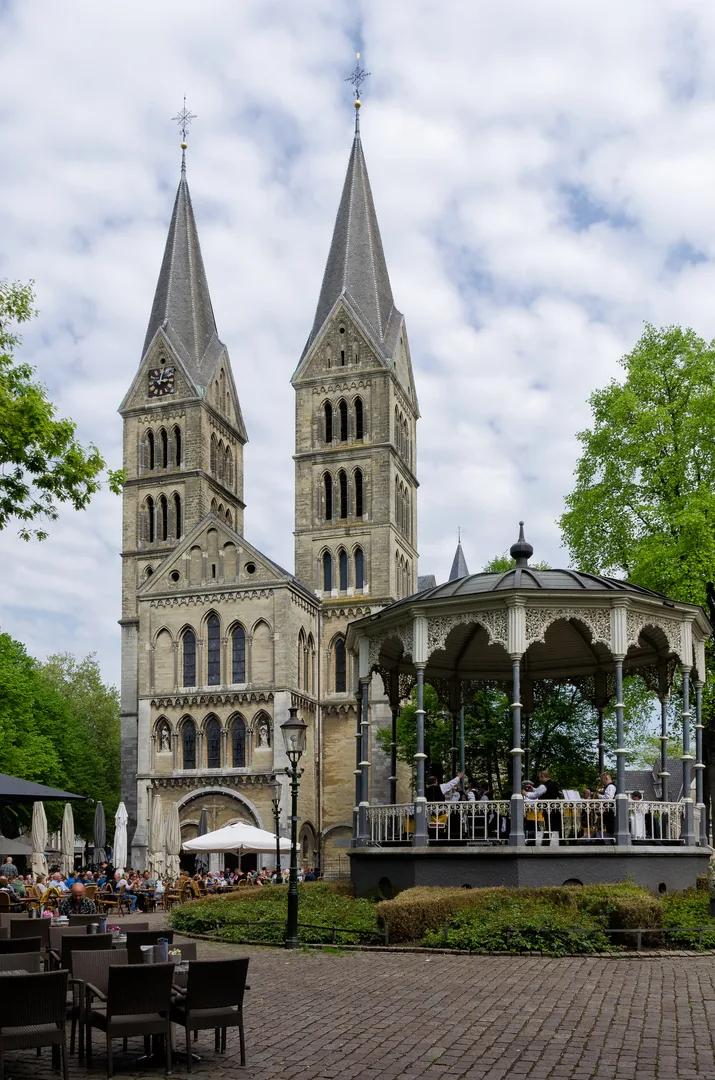
Munsterkerk, Netherlands
Founded the Munsterkerk, 1218
Count Gerard III founded the Munsterkerk in 1218 as a Cistercian nunnery, intended to serve as a final resting place for his dynasty. Construction took decades, blending the heavy Romanesque foundations with the emerging decorative flourishes of the early Gothic period. The church witnessed the turbulent shifts of power in the Limburg region, surviving the iconoclastic furies and various military sieges. However, its most controversial chapter came in the late 19th century. The famous architect Pierre Cuypers, known for the Rijksmuseum, oversaw a radical restoration that saw the removal of Baroque additions and the construction of two new towers to achieve a 'pure' Romanesque symmetry. This intervention transformed the church into the icon we see today, sparking a national debate about the ethics of architectural 'correction' that still lingers among historians.
Stepping into the nave, The temperature
Stepping into the nave, The temperature drops significantly, the cold stone acting as a thermal battery. It smells of old incense and the faint, dusty scent of pulverized lime. The immense pressure of the architecture; the low-slung arches and thick pillars create a sense of being underground even though you are at street level. The vibrant colors of the restored stained glass, which cast deep blues and blood-reds across the grey tomb of the founders. What most skip is the intricate carvings in the triforium, focusing instead on the grand altar. The thing you pick up on is the sound of your own footsteps echoing with a sharp, hollow ring against the stone floor. What stays with you is looking up into the central dome, where the geometry of the octagonal tower creates a perfect, celestial symmetry that seems to pull the heavy building toward the heavens.
Roermond is a major rail hub
Roermond is a major rail hub in the province of Limburg, easily reached by direct trains from Eindhoven or Maastricht. The Munsterkerk is located in the Munsterplein, a lively square just a ten-minute walk from the central station. For those driving, Roermond is famous for its designer outlet mall, which draws massive crowds; it is best to park in the garage near the theater and walk through the historic center to avoid the retail traffic. The square surrounding the church is filled with cafes, providing an excellent vantage point to admire the exterior towers over a local Limburgse vlaai.
“Roermond is a major rail hub in the province of Limburg, easily reached by direct trains from Eindhoven or Maastricht.”
The Experience
You notice the peculiar silence of the choir, where the transition from Romanesque to Gothic is visible in the sharpening of the arches. The light at mid-morning hits the tomb of Gerard and Margaretha, illuminating the stiff, formal carved drapery of their 13th-century effigies. There is a sense of fortress-like security within the walls, which are nearly two meters thick in places. Most visitors miss the small, carved monsters hiding in the capitals of the columns, a classic Romanesque touch meant to ward off evil. You hear the bells from the square outside filtered through the thick stone sounds muffled and distant, as if the church is operating on a different timeline.
Why It Matters
The Munsterkerk is the definitive monument of the Hohenstaufen Romanesque style in the Netherlands. It remains the only major church in the country that preserves the transition from the heavy, defensive architecture of the early Middle Ages to the soaring ambitions of the Gothic era. Culturally, it serves as the final resting place of the counts who consolidated power in the region that would become Limburg.
Why Visit
Visit this church to see a version of the Netherlands that feels almost German in its structural DNA. It offers a somber, masculine beauty that is the perfect antidote to the airy, white-washed interiors of the Protestant North. It is a masterclass in how 19th-century visionaries reshaped our understanding of the medieval past.
Insider Tips
- 1
Walk around the exterior to the east side to see the Romanesque apse, which is the most original part of the 1220 construction.
- 2
Look for the architect Pierre Cuypers’ statue nearby; he considered this church his most important restoration work.
- 3
The tomb of the Count and Countess is best viewed from the elevated gallery if access is permitted.
- 4
Check for organ recitals; the acoustics of the thick-walled nave are uniquely suited to heavy, resonant bass tones.
- 5
The surrounding Munsterplein is the best spot for 'people watching' over a coffee while observing the church's towers.