Beneath a floor of worn gravestones lies a secret world where every Dutch monarch for the last 400 years has been laid to rest in a silent royal city.
About Nieuwe Kerk
The Nieuwe Kerk is the spiritual home of the Dutch Republic. Its transformation from a Catholic basilica to a Protestant hall mirrors the country's own struggle for independence from Spain. The royal crypt is technically still the property of the royal family, and the heavy stone slab that seals it is only moved during royal funerals, most recently for Queen Juliana and Prince Bernhard in 2004. The 108-meter tower was originally built of a lighter stone that proved too fragile for the Dutch weather, leading to the use of the darker, more durable Bentheim sandstone seen today. The carillon in the tower, consisting of 48 bells, still rings out over the city every Thursday market day, a tradition that has survived since the 17th century.
Nieuwe Kerk
Rising above the central market square of Delft, the Nieuwe Kerk (New Church) is a monument to Dutch identity and royal history. Despite its name, the church dates back to the late 14th century, though it has been rebuilt multiple times following fires and explosions. The tower, a dark and imposing spire of brick and stone, is the second-highest in the Netherlands, offering views that stretch as far as Rotterdam and The Hague on a clear day. The interior is a vast, light-filled space of white-washed walls and soaring Gothic arches, a hallmark of the Dutch Protestant style that favors austerity over ornament. However, this simplicity is interrupted by the magnificent tomb of William the Silent, the founding father of the nation, which sits directly above the royal crypt where members of the House of Orange-Nassau have been laid to rest for centuries.
“Rising above the central market square of Delft, the Nieuwe Kerk (New Church) is a monument to Dutch identity and royal history.”
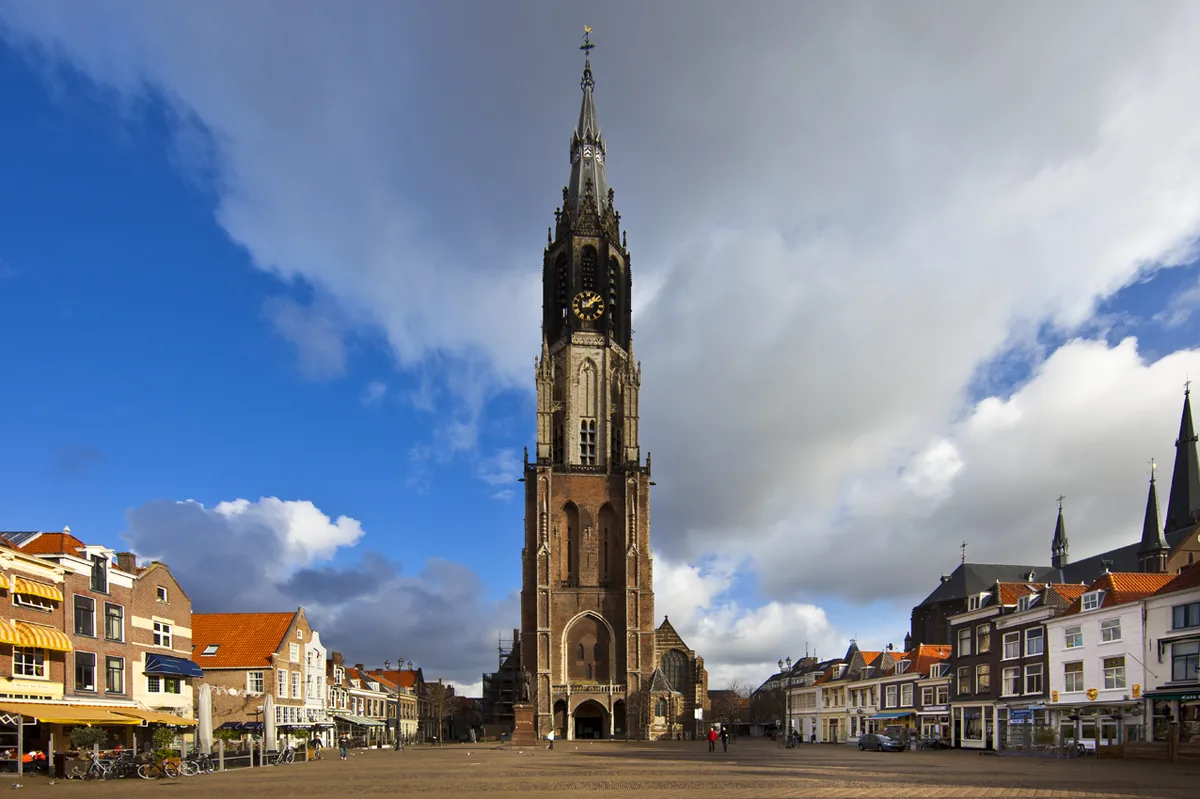
Nieuwe Kerk, Netherlands
Construction began, 1381
Construction began in 1381 after a beggar and a hermit reportedly saw a vision of a golden church on the site. It took over a century to complete the original structure, but the church’s modern history is defined by the 1584 assassination of William of Orange in nearby Delft. Because his family seat in Breda was under Spanish occupation, he was buried here, beginning the tradition of royal burials in Delft. The church suffered immensely during the Great Fire of 1536 and the devastating Delft Thunderclap, a gunpowder warehouse explosion, in 1654, which shattered the stained-glass windows. The current spire, with its distinct dark stone, was added in the 19th century after the previous one was struck by lightning. Today, it remains an active place of worship and the final destination for Dutch monarchs.
Entering the nave, The sudden shift
Entering the nave, The sudden shift from the busy cheese and souvenir market outside to the cool, echoing silence of the church. The light is exceptionally bright for a Gothic structure, pouring through tall, clear glass windows that were replaced after the 1654 explosion. The feel of the old gravestones that form the floor, their inscriptions worn smooth by centuries of footsteps. The gravity of history at the back of the choir, where the black and white marble of the royal monument stands in stark contrast to the white walls. People often miss the small plaques marking the resting places of Delft’s famous citizens, including the scientist Antoni van Leeuwenhoek. First you see the way the light catches the massive brass pipes of the 19th-century organ, which seems to vibrate even when silent.
The church is the focal point
The church is the focal point of Delft's Markt square and is a short, scenic walk from the Delft railway station. The climb up the tower requires a separate ticket and a significant amount of stamina, as the spiral staircase is narrow and steep. The church is open daily except during services or special royal events. Combining a visit with the Oude Kerk (Old Church) just a few blocks away allows you to see the full arc of the city's religious history. Delft itself is perfectly situated between The Hague and Rotterdam, making it one of the easiest and most rewarding stops on any Dutch itinerary.
“The church is the focal point of Delft's Markt square and is a short, scenic walk from the Delft railway station.”
The Experience
What draws you in is the way your own breathing becomes audible in the immense vertical space of the tower’s base. Nearby, the market vendors’ calls outside is muffled to a low hum, making the ticking of the church clock seem unusually loud. The cool draft that always seems to swirl around the royal monument, regardless of the season. Most visitors miss the intricate carvings on the choir stalls, which survived the Reformation’s iconoclasm. What sticks with you is reaching the top gallery of the tower, where the red-tiled roofs of Delft look like a Lego set, and the modern glass towers of the Randstad loom on the horizon.
Why It Matters
The Nieuwe Kerk is the national mausoleum of the Netherlands. It serves as a physical record of the House of Orange-Nassau and a symbol of Dutch resilience against fire, war, and religious upheaval. Its architecture is a textbook example of the Lower Rhenish Gothic style, adapted to the specific needs of the Dutch Protestant tradition.
Why Visit
Visit the Nieuwe Kerk to understand the soul of the Netherlands. It’s where the country’s history is literally buried. Climbing the tower provides the best panoramic view in the western Netherlands, and the sheer scale of the royal monument is a rare display of grandeur in a country otherwise known for its modesty.
Insider Tips
- 1
Buy the 'Combi-ticket' which includes the Oude Kerk; it’s cheaper and the two churches are inseparable in their history.
- 2
The climb is 376 steps; do not attempt it if you have a fear of tight spaces or heights.
- 3
Look for the 'Great Bell' at the first level of the tower; it weighs nearly 5,000 kilograms and is only rung for royal deaths.
- 4
Visit the small museum section in the back for a 3D model of the royal crypt, which you cannot visit in person.
- 5
Check the carillon schedule; hearing the bells while standing in the square is one of the most 'Delft' experiences possible.