In 1924, a furniture designer and a rebellious widow built a house with no walls, proving that the future of living was a puzzle of primary colors and sliding panels.
About Rietveld Schröderhuis
Gerrit Rietveld was a pioneer of the De Stijl movement, which sought to simplify art and design to its most basic elements. The Schröderhuis was his first and most successful attempt to apply these ideas to a full-scale dwelling. The project was deeply collaborative; Truus Schröder provided the functional requirements, while Rietveld provided the aesthetic radicalism. When it was built, the house sat at the very edge of the city, looking out over open fields, a view that Truus considered essential to the design's sense of freedom. Although the view was later destroyed by the construction of the A27 highway in the 1960s, the house remains a defiant island of modernity. It was inscribed on the UNESCO World Heritage list in 2000 as an icon of the Modern Movement in architecture.
What Rietveld Schröderhuis actually is
At the end of a quiet, unremarkable residential street in Utrecht sits a house that looks like a Mondrian painting exploded into three dimensions. The Rietveld Schröderhuis, completed in 1924, is the ultimate manifestation of De Stijl architecture, a radical rejection of everything that came before it. Built from steel, glass, and concrete in primary colors, the house was a shock to its traditional neighbors and remains a startlingly modern sight a century later. The building is a manifesto of flexibility; inside, there are almost no fixed walls, with sliding panels allowing the living space to be reconfigured according to the time of day. It is a house designed around the philosophy of 'active living,' where every window, lever, and color choice was a deliberate attempt to change the way humans inhabit space.
“At the end of a quiet, unremarkable residential street in Utrecht sits a house that looks like a Mondrian painting exploded into three dimensions.”
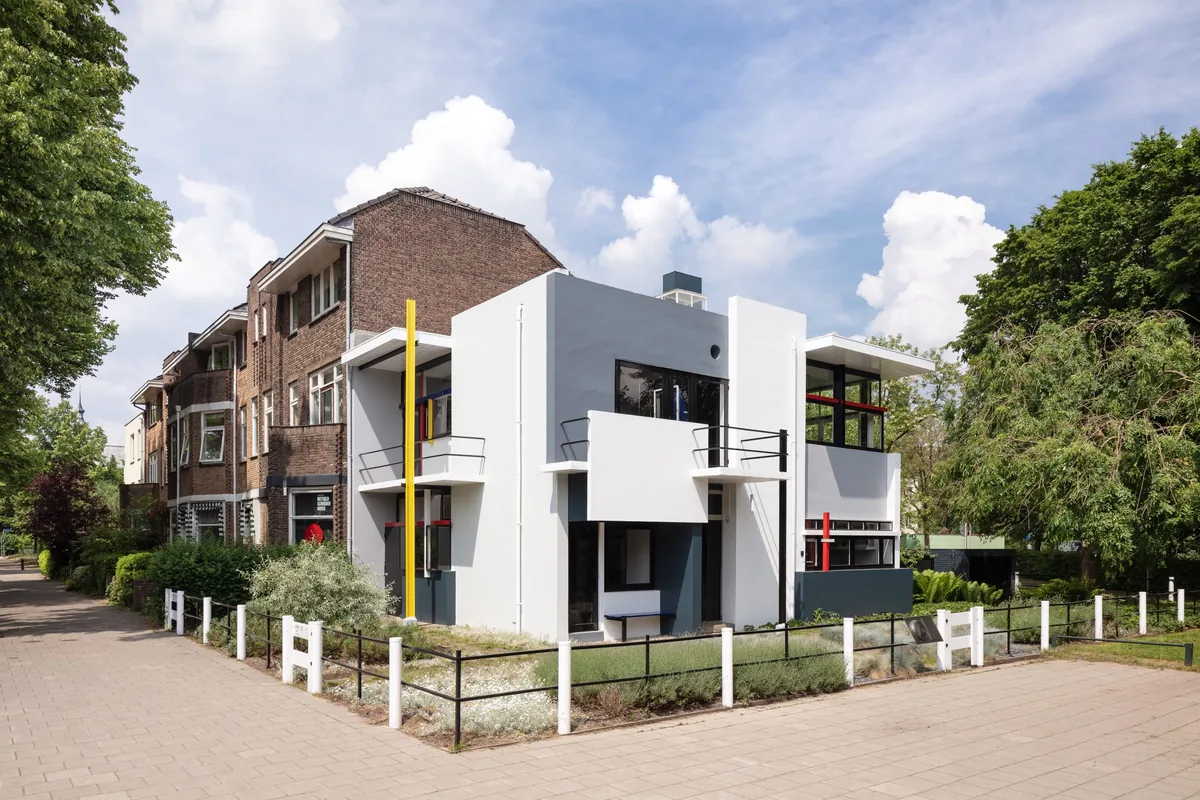
Rietveld Schröderhuis, Netherlands
Truus Schröder-Schräder, a recently widowed socialite
Truus Schröder-Schräder, a recently widowed socialite with radical ideas about living, commissioned Gerrit Rietveld, a furniture designer with no formal architectural training, to build her new home. She wanted a space that was open, light, and free from the heavy Victorian clutter of her past life. Rietveld took her vision and the principles of the De Stijl movement to their logical extreme, using only red, blue, yellow, black, and white. The house was the only building ever fully realized according to these principles. Truus lived there until her death in 1985, fiercely protecting the design even as a highway was built just meters from her front window. Today, it is a UNESCO World Heritage site and a museum that remains perfectly preserved in its 1920s state.
Stepping inside, The space feels much
Stepping inside, The space feels much smaller and more functional than it appears in photographs. The sound is curiously muted, as the house was built with experimental materials that absorb noise differently than brick and plaster. First, the texture of the painted wood, the high-gloss primary colors against the matte grey and white surfaces. A sense of mechanical ingenuity as the guide demonstrates the sliding wall panels, which transform the open-plan upper floor into individual bedrooms in seconds. Often missed is the clever 'black-out' shutters and the unique window-opening mechanisms that Rietveld designed to ensure a seamless connection between inside and out. The detail that registers is the way the light changes as the sliding walls are moved, proving that the house is less a building and more a living machine.
The house is located
The house is located on the outskirts of Utrecht, a pleasant twenty-minute walk or a quick bike ride from the city center. It is situated right next to the Utrecht University campus and a major highway overpass, a juxtaposition that only emphasizes its avant-garde nature. Because of the fragile nature of the interior and the small space, admission is strictly by pre-booked guided tour only, and group sizes are kept very small. After the tour, a visit to the nearby Centraal Museum is worthwhile, as it houses the largest collection of Rietveld’s furniture, including the iconic Red and Blue Chair that is the spiritual companion to the house.
“The house is located on the outskirts of Utrecht, a pleasant twenty-minute walk or a quick bike ride from the city center.”
The Experience
What grabs you is the way the 'corner' of the house disappears when the windows are opened outward, a revolutionary feature for 1924 that still feels magical today. Nearby, the wind through the thin glass panes makes the house feel like a living, breathing entity. There is a sense of disciplined minimalism, where there is no room for unnecessary objects or sentimental clutter. Most visitors miss the tiny, built-in speaking tube that Truus used to communicate with visitors at the front door without having to go downstairs. What lingers with you is when the walls are slid back to create one giant room, realizing that this 100-year-old house is more flexible than almost any modern apartment.
Why It Matters
The Rietveld Schröderhuis is the only building in the world that fully embodies the principles of the De Stijl movement. It is a founding monument of modern architecture, influencing generations of architects from the Bauhaus to the present day. It represents a unique moment in history when social liberation and artistic radicalism combined to redefine the concept of 'home.'
Why Visit
Visit the Rietveld Schröderhuis to see the birthplace of modern design. It is the only place where you can experience a Mondrian painting from the inside. If you want to understand where our modern obsession with open-plan living and modular furniture comes from, this house is the source code.
Insider Tips
- 1
Book your ticket at least two weeks in advance; the small tour capacity means it sells out fast.
- 2
The audio guide is excellent and includes original recordings of Truus Schröder explaining her vision for the house.
- 3
Look for the 'Red and Blue' chairs inside; they were designed specifically to fit the proportions of the living room.
- 4
Take the time to walk into the residential neighborhood behind the house to see the traditional brick homes the neighbors were living in when this was built.
- 5
The staircase is very steep and narrow; be prepared for a bit of a climb to reach the famous upper floor.