“This is an island you can visit without a boat, a place where the lighthouse still stands but the sea has been replaced by miles of potato fields.”
About Schokland and Surroundings
Schokland’s history is a timeline of shrinking borders. It was a thriving agricultural peninsula in the 10th century, a struggling island by the 15th, and an abandoned hazard by the 19th. The 1859 evacuation was a national tragedy, with the 'Schokkers' being forced to settle in cities like Volendam and Kampen, where they maintained their own dialect for generations. When the polder was drained in the 1940s, the island was expected to disappear into the farmland, but its unique elevation and archaeological richness led to its preservation. It became the first Dutch site on the UNESCO World Heritage list in 1995.
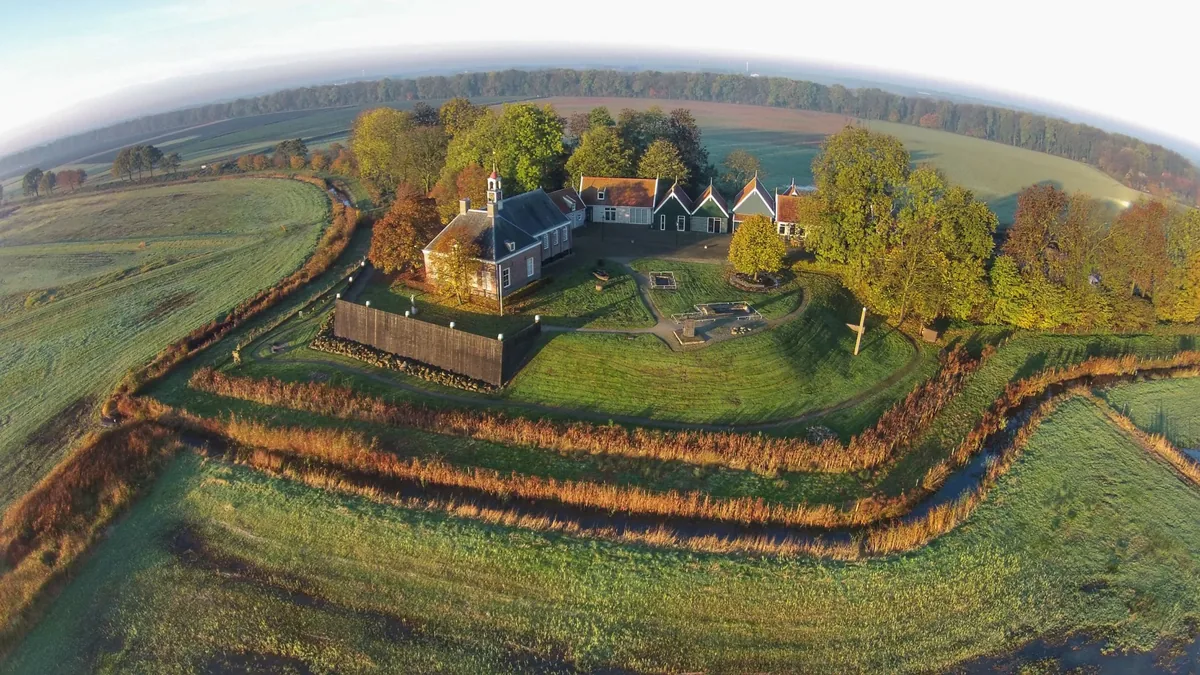
Schokland and Surroundings
Schokland is an island that no longer exists in a sea that was turned into land. From this low ridge in the middle of the Noordoostpolder, you are looking at a phantom of the Dutch landscape. For centuries, Schokland was a narrow, peat-soil island in the middle of the turbulent Zuiderzee, home to a resilient community of fishermen who lived in constant fear of the encroaching waves. In 1859, the situation became so precarious that the King ordered a total evacuation. Today, the island is a UNESCO World Heritage site, but instead of being surrounded by water, it is surrounded by a vast, flat sea of agricultural fields. The 'shoreline' is now a line of trees, and the 'harbor' is a grassy depression. It is a surreal, poignant place that is a monument to the Dutch struggle against the water and the eventual victory of reclamation.
Schokland is an island that no longer exists in a sea that was turned into land.
During the Middle Ages, Schokland
During the Middle Ages, Schokland was part of the mainland, but the rising sea and the subsidence of the peat soil eventually carved it into an island. By the 1800s, the island had shrunk to a fraction of its original size, and its inhabitants were among the poorest in the Netherlands. They lived on 'terpen', man-made mounds, and during storms, they had to move their livestock into the upper floors of their wooden houses. After the 1859 evacuation, the island remained a ghost town, used only by lighthouse keepers and seasonal workers. The ultimate transformation came in 1942, when the Noordoostpolder was drained, and the island was suddenly 'marooned' on dry land. Archaeologists soon discovered that the soil around Schokland was a deep collection, containing everything from prehistoric footprints to the wrecks of medieval merchant ships that had foundered on its shores.
Walking along the old sea dyke,
Walking along the old sea dyke, The strange sensation of looking 'down' at the surrounding fields, which sit several meters below the former sea level. The air is extraordinarily still, and the horizon is so flat that the sky seems to overwhelm the landscape. The texture of the old wooden church in Middelbuurt, its weather-beaten planks standing as one of the few survivors of the original village. An impression of wind sweeping across the polder, unimpeded by hills or valleys, smelling of fresh-turned earth. Frequently skipped is the 'boulder garden,' where massive rocks brought by prehistoric glaciers are displayed. The wind through the poplars, which mimics the sound of the waves that used to crash against the island's edges. What sticks with you is standing at the former harbor entrance and realizing that you are standing where ships once docked, now miles from the nearest coast.
Schokland is best reached by car, as it
Schokland is best reached by car, as it is located in a relatively remote part of the Flevoland province. From Amsterdam, the drive takes about an hour via the A6 highway. Public transport is a challenge; you can take a train to Kampen or Emmeloord and then catch a local bus, but these are infrequent. Cycling from Kampen is a popular option for the fit, as it allows you to see the dramatic transition from the 'old land' of Overijssel to the 'new land' of the polder. The museum at Middelbuurt is the primary visitor center and provides the best context for understanding the island's vanished geography.
Schokland is best reached by car, as it is located in a relatively remote part of the Flevoland province.
The Experience
Light in the Flevoland polder feels different, sharper and more silver than in the rest of the country. The clatter of a distant tractor is the only thing that breaks the silence of the Middelbuurt churchyard. A sense of vertigo when you look at the markers showing where the water once reached on the side of the buildings. Most people miss the prehistoric footprints preserved in the museum, some of the oldest evidence of human life in the Netherlands. The piece that stays with you is the walk to the southern tip of the island, where the old lighthouse station sits in a sea of grass.
Why It Matters
Schokland is the ultimate symbol of the Dutch relationship with the sea, a story of loss, retreat, and eventual conquest. It is a rare 'cultural landscape' that preserves the transition from a maritime society to an agricultural one. Geologically, it is a window into the prehistoric past, revealing layers of human occupation stretching back over 10,000 years.
Why Visit
Visit Schokland to experience the sheer audacity of Dutch engineering. It is one of the few places where you can physically feel the 'old' Netherlands and the 'new' Netherlands meeting at a single point. It is a hauntingly beautiful landscape that offers a perspective on environmental change that is more relevant today than ever.
✦ Insider Tips
- 1
Rent a bike in Emmeloord to cycle the 'coastline' of the island; the 10km loop perfectly illustrates its original shape.
- 2
The museum cafe serves a traditional 'Schokker' lunch that is worth trying for a taste of local history.
- 3
Look for the ship carvings on the walls of the Enkhuizerbuurt church, a quiet tribute from the sailors who once lived here.
- 4
Visit the ruins of the lighthouse on the southern point for the most atmospheric photos of the polder horizon.
- 5
Check the archaeological calendar; sometimes you can watch active digs taking place in the surrounding fields.