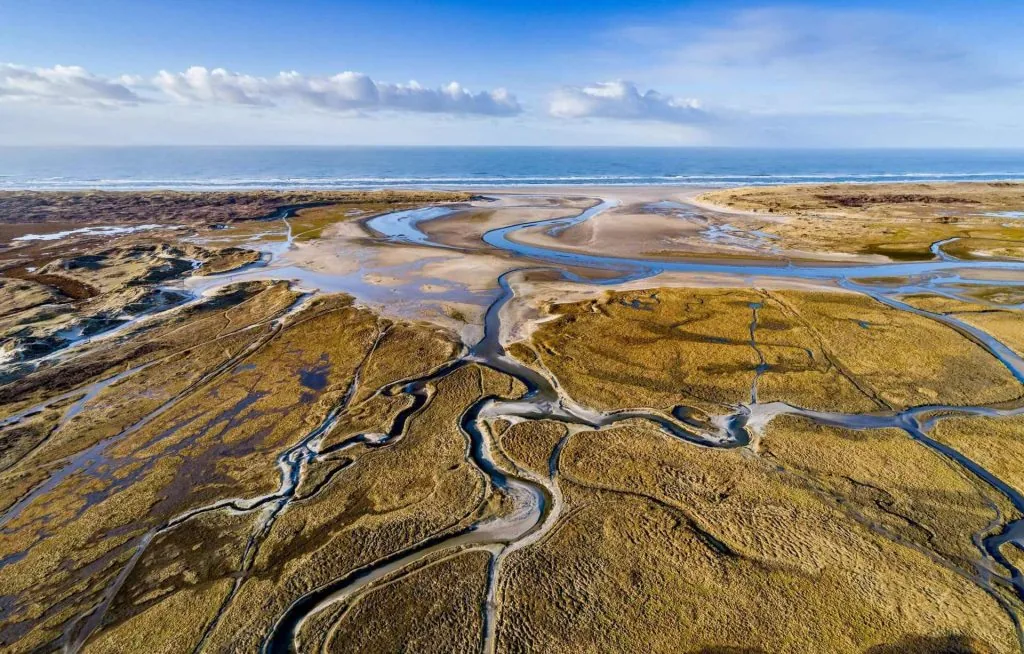
On this island's western fringe, the North Sea is allowed to break through the defenses, turning the landscape into a salt-soaked wilderness of shifting sand and purple lavender.
About Texel Dunes National Park
The dunes of Texel have been a battleground between wind and water since the end of the last Ice Age. While the southern dunes are relatively stable and ancient, the northern 'Eierland' section was once a separate island entirely until it was joined by a man-made polder in the 17th century. The 19th century saw the introduction of the pine forests, which were originally intended as a commercial timber source but have since become a vital habitat for owls and orchids. Today, the park is managed through 'dynamic coastal management,' a philosophy that allows the sea to occasionally flood certain areas to maintain the salt-water ecosystems that are disappearing elsewhere in Europe.
On the western edge of the largest Wadden
On the western edge of the largest Wadden Island, the landscape erupts into a dramatic, windswept theatre of sand and scrub. Texel Dunes National Park (Duinen van Texel) is a rugged mosaic of ecosystems that stretches for nearly the entire length of the island. Unlike the flat, agricultural heart of Texel, this park is a collection of constant verticality and motion. Here, the North Sea wind shapes massive dunes that can reach over twenty meters in height, protecting a hidden interior of salt marshes, wet valleys, and dense pine forests. It is a place of extreme contrast, where the blinding white sand of the beaches meets the dark, honey-scented heathland. The park is a vital sanctuary for rare birds and hardy Highland cattle, offering a sense of wilderness that is rare in the densely populated Netherlands. To walk here is to feel the raw power of the Atlantic and the fragile resilience of the coastal flora.
The dunes were not always
The dunes were not always a protected wilderness. For centuries, they were a dangerous, shifting barrier that threatened to bury the island's villages in sand. In the early 20th century, the Dutch State Forestry Service began an ambitious project to stabilize the dunes by planting millions of pine trees and marram grass. This created the distinct 'forest-meets-sea' aesthetic that defines the park today. Over time, the focus shifted from stabilization to conservation. In 2002, the area was officially designated as a National Park to protect its unique biodiversity. The park includes the Slufter, a unique tidal valley where the sea still breaches the dunes during storms, creating a landscape that is half-terrestrial and half-marine, a rare example of nature being allowed to reclaim land that humans had once tried to dike off.
Walking the trail through the Slufter,
Walking the trail through the Slufter, A heavy, salt-laden mist that tastes like the sea on your lips. The clatter of the wind through the marram grass creates a constant, dry rustle that competes with the distant, rhythmic boom of the North Sea surf. The vibrant purple of the sea lavender in late summer, turning the salt marshes into a vivid carpet of color. The grit of the fine sand in your hair and the surprising softness of the mossy paths in the pine forest. Often missed is the 'Eierland' dunes in the north, preferring the popular southern beaches, but the north offers a more desolate, prehistoric beauty. What gets your attention is the tracks of rabbits and pheasants crossing the sand, a trace of the busy life happening beneath the scrub. The bit that stays with you is reaching the top of a high dune at sunset, looking out over the endless grey-blue of the North Sea.
Accessing the park begins
Accessing the park begins with the TESO ferry from Den Helder, a twenty-minute crossing that runs every hour. Once on the island, the park is easily reached by bicycle, the preferred mode of transport on Texel, or by the 'Texelhopper' bus service which can be booked to stop at various trailheads. Driving is possible, with several large parking areas at the main beach entrances (Paal 15, 17, and 28), though a Texel e-vignette is required for parking. The Ecomare center in De Koog is the main interpretive hub, providing excellent maps and guided tour information for those who want to understand the park's complex geology.
The Experience
What catches you is how the light bounces off the pale sand, making the shadows in the pine forest look almost black by comparison. The scent of the sea-buckthorn berries, sharp, citrusy, and slightly fermented, hangs in the air during the autumn months. The temperature drop as you descend from a sun-drenched dune into a 'duinpan,' a low, sheltered valley where rare orchids grow in the damp soil. Most visitors miss the quiet lagoons of the Muy, where colonies of spoonbills can be seen wading in the shallows. What remains with you is the silence of the beach at Paal 28, where the only tracks in the sand belong to the gulls.
Why It Matters
Texel Dunes National Park is a critical link in the East Atlantic Flyway, providing a rest stop for millions of migratory birds. It is home to the largest colony of spoonbills in the Netherlands and contains a higher concentration of plant species than almost any other part of the country. Geographically, the Slufter is a world-class example of a 'natural breach' ecosystem, showing how the coast functions when human engineering steps aside.
Why Visit
Visit this park for the sheer variety of landscapes contained within a single afternoon's walk. It is the only place in the Netherlands where you can move from a dark forest to a tidal marsh to a Saharan-style dune in under an hour. It offers a sense of 'island time' that makes the mainland feel a thousand miles away.
✦ Photo Gallery
Best Season
🌤 August and September are the most visual months, as the sea lavender is in full purple bloom in the Slufter and the sea-buckthorn turns a brilliant orange.
Quick Facts
Best time to visit
August and September are the most visual months, as the sea lavender is in full purple bloom in the Slufter and the sea-buckthorn turns a brilliant orange.
Getting there
In Den Helder, Netherlands; reach Den Helder first, then continue to the site.
Location
Den Helder, Netherlands
Type
attraction
Insider Tips
- 1
Rent a bicycle with 'fat tires' if you plan on exploring the sandy interior paths; traditional Dutch bikes will struggle.
- 2
The Slufter can flood rapidly during high tide; always check the water levels at Ecomare before walking deep into the valley.
- 3
Look for the Highland cattle in the southern section; they are used as natural lawnmowers to keep the scrub from overtaking the dunes.
- 4
Visit the red lighthouse at the northern tip of the park for the best panoramic views of the Wadden Sea and the North Sea meeting.
- 5
Carry a pair of binoculars; the park is one of the best places in Europe to spot the rare bluethroat in the spring.