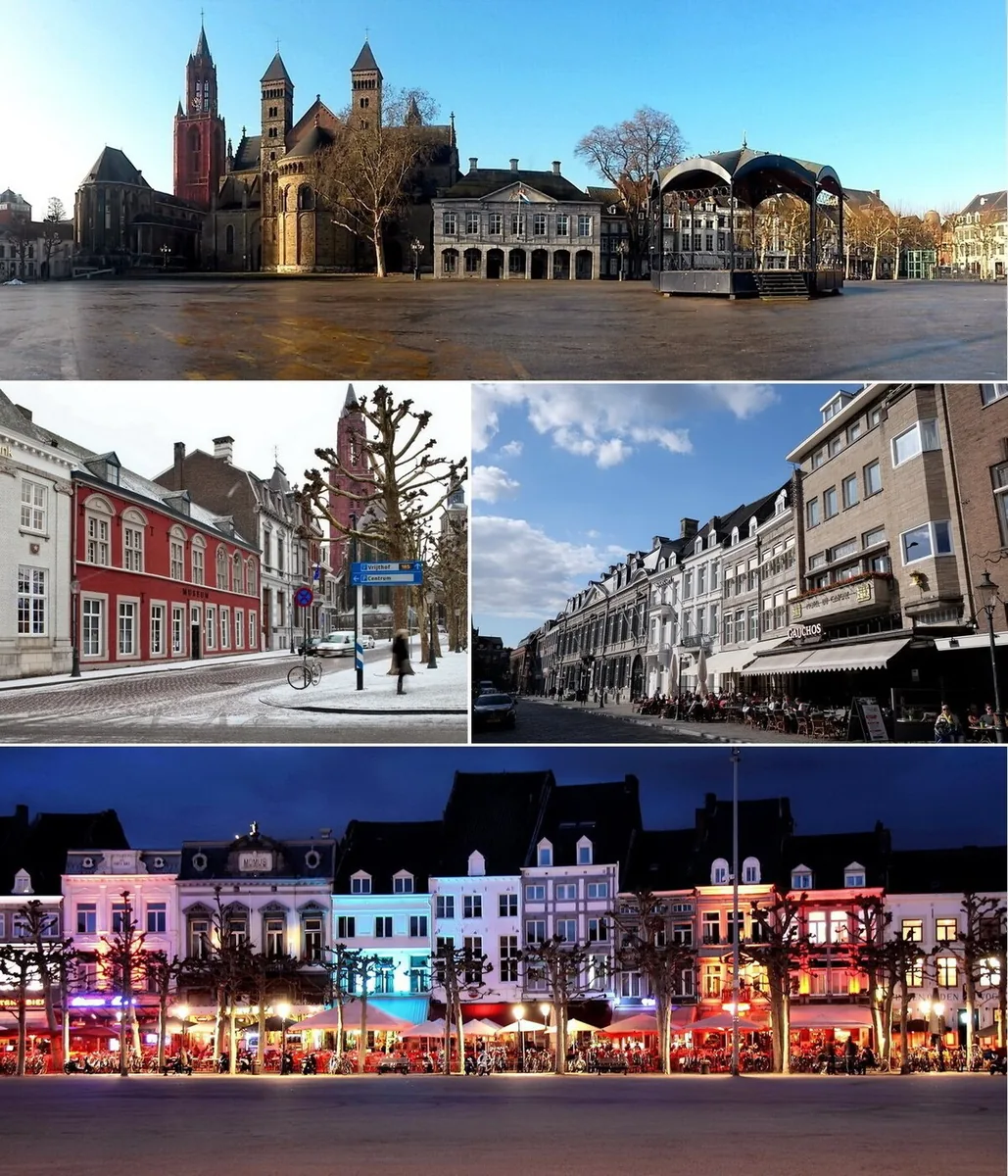
Built over a silent Roman cemetery, this grand square is now the loudest, liveliest, and most unapologetically indulgent corner of the Netherlands.
About Vrijthof
Maastricht is one of the oldest continuously inhabited cities in the Netherlands, and the Vrijthof has been its primary stage for 2,000 years. The Basilica of Saint Servatius, the oldest church in the country, was built over the saint's grave in the 11th century to accommodate the massive crowds of pilgrims. During the 17th century, when Maastricht was a fortified city of the Dutch Republic, the Vrijthof served as a military parade ground. The red tower of the Sint-Janskerk next door was originally painted with ox blood to protect the soft Marl stone from the rain, a tradition that is now maintained with modern paint. The square underwent a massive renovation in the 1970s to remove car traffic, turning it into the pedestrian-friendly social hub it remains today.
What Vrijthof actually is
In the deep south of the Netherlands, Maastricht’s Vrijthof square feels more like a corner of France or Belgium than a typical Dutch plaza. This expansive, cobblestoned space is the city's cultural heart, flanked on one side by a row of lively outdoor cafes and on the other by two of the country’s most significant churches. The air is often full of church bells and the clinking of beer glasses, shaped by Maastricht’s reputation as the most 'Burgundian' city in the country. The Vrijthof is a transition zone between the ancient and the modern; its history as a Roman burial ground and a medieval pilgrimage site is now layered with high-end boutiques and world-class concert venues. The pace of life slows down, inviting you to linger over a coffee while the shadows of the gothic towers stretch across the stones.
Origins
The name Vrijthof derives from the old Dutch word for an enclosed courtyard, specifically a cemetery attached to a church. Archaeologists have found evidence that Romans were burying their dead here as early as the 1st century, and the site became a major destination for pilgrims in the Middle Ages who came to visit the tomb of Saint Servatius. The square has seen everything from medieval executions to military parades under French and Spanish occupation. In the 19th and 20th centuries, it evolved into the social center we see today. The unique visual identity of the square is defined by the side-by-side positioning of the Romanesque Basilica of Saint Servatius and the Gothic Saint John’s Church, whose striking red tower has become the unofficial logo of the city.
Sitting at a terrace on a Saturday afternoon
Sitting at a terrace on a Saturday afternoon, The way the light hits the red paint of the Sint-Janskerk tower, making it glow against the often-grey Dutch sky. Nearby, the square is a pleasant chaos: the tolling of the heavy bells, the laughter from the cafes, and the occasional brass band practicing for a local festival. The texture of the limestone buildings that surround the square, their yellow hue a specific characteristic of the local Marl stone. The vibrant, almost Mediterranean energy of the crowd, which is notably different from the more reserved atmosphere of the northern provinces. What most skip is the archaeological cellar beneath the square, which houses a portion of the original Roman road and burial sites. The thing you pick up on is the scent of 'Vlaai', the local fruit tart, drifting from the nearby bakeries.
The Vrijthof is the central point
The Vrijthof is the central point of Maastricht and is a fifteen-minute walk from the main train station, crossing the Sint Servaasbrug, the oldest bridge in the Netherlands. Maastricht itself is tucked into the tail of the country, bordered by Belgium and Germany, making it a popular weekend destination for Europeans from three different nations. The square is mostly pedestrianized, making it easy to explore on foot. If you are arriving for one of the famous André Rieu summer concerts, be aware that the square is completely cordoned off and requires tickets months in advance; otherwise, it is open and accessible 24 hours a day.
The Experience
Observe the way the square seems to change character by the hour, from a quiet, misty space in the morning to a roaring social scene by nightfall. The hum of a carillon recital from the Sint-Janskerk tower can often be heard above the din of the terraces, providing a high-pitched, melodic soundtrack to your meal. The history beneath your feet, literally, as the uneven cobblestones have been smoothed by centuries of boots and wheels. Most visitors miss the 'Museum aan het Vrijthof,' a small but exquisite art museum housed in a 16th-century Spanish government building on the square's edge. What stays with you is the blue hour, when the church floodlights turn on and the square feels like a perfectly lit movie set.
Why It Matters
The Vrijthof is the symbolic heart of Limburg province and a showcase of Maastricht’s unique cross-cultural history. It represents the Dutch ability to preserve deep religious and Roman history while fostering a modern, hedonistic urban life. It is the site of the TEFAF international art fair’s social events and the world-famous concerts that have made the square a household name in Europe.
Why Visit
Visit the Vrijthof to experience the 'other' Netherlands. It is the best place to see the country's Catholic, southern identity, which is far more exuberant and food-focused than the Protestant north. If you want to sit in a place where 2,000 years of history is condensed into a single glance, this square is unbeatable.
✦ Photo Gallery
Best Season
🌤 December is magical for the 'Magical Maastricht' Christmas market, but July is the peak of the square’s social life when the outdoor concerts take place.
Quick Facts
Best time to visit
December is magical for the 'Magical Maastricht' Christmas market, but July is the peak of the square’s social life when the outdoor concerts take place.
Getting there
In Maastricht, Netherlands; reach Maastricht first, then continue to the site.
What's nearby
Munsterkerk is also close by.
Location
Maastricht, Netherlands
Type
attraction
Coordinates
50.8492°, 5.6884°
Insider Tips
- 1
Order a slice of cherry 'Vlaai' at a cafe; it is the most traditional Maastricht snack and is taken very seriously by locals.
- 2
Visit the 'Schatkamer' or Treasury of the Basilica to see some of the most impressive medieval goldwork in Europe.
- 3
The Sint-Janskerk tower is open for climbing; the view of the Basilica's rooftops from there is the best in the city.
- 4
Look for the statue of the 'Old Woman with the Eggs' in the corner of the square; she is a local folk hero.
- 5
If you want to eat at a terrace, try the ones on the north side, they get the most sun in the afternoon.