“A 1931 disaster wiped this city off the map, leaving architects with a blank canvas and a obsession for pastel colors and geometric sunbursts.”
About Art Deco Historic District
The earthquake not only destroyed the buildings but also lifted the seabed around the city by two meters, creating thousands of hectares of new land. The Napier Reconstruction Committee was formed almost immediately, decreeing that the new city should be safe, modern, and beautiful. Architects like Louis Hay, who was heavily influenced by Frank Lloyd Wright, led the charge. The resulting district is now one of the most comprehensive art deco sites in the world, earning it a place on the tentative UNESCO World Heritage list and spawning a massive preservation movement that saved the buildings from the modernization trends of the 1970s.
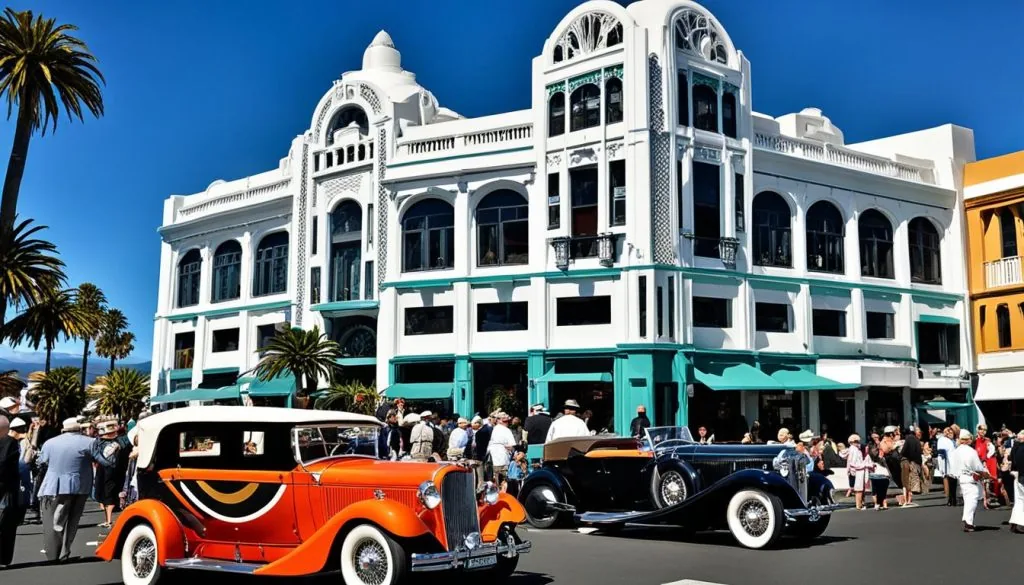
Napier is a city that refused to die
Napier is a city that refused to die, choosing instead to reinvent itself in a burst of pastel geometry and optimistic zig-zags. The Art Deco Historic District is the result of a devastating 7.8 magnitude earthquake in 1931 that leveled the city center in mere minutes. What rose from the rubble was a cohesive, planned townscape built in the height of the 1930s aesthetic. Walking these streets feels like stepping onto a film set for a Great Gatsby adaptation, where sunbursts, chevrons, and stylized flora decorate every facade. It is a rare example of a city built entirely in a single architectural style, a reflection of the resilience of a community that found beauty in the wake of catastrophe.
Napier is a city that refused to die, choosing instead to reinvent itself in a burst of pastel geometry and optimistic zig-zags.
On the morning of February 3
On the morning of February 3, 1931, the earth beneath Napier heaved, and the subsequent fires finished what the shaking started. With the commercial heart of the city gone, local architects faced a choice: rebuild in the traditional, heavy Victorian style or embrace the modern 'Style Moderne' coming out of Paris and Hollywood. They chose the latter, partly because it was fashionable and partly because the reinforced concrete and lack of heavy overhanging cornices made it earthquake-resistant. The reconstruction was remarkably fast, with much of the district completed by 1933. Unlike the art deco of Miami or New York, Napier’s version incorporates indigenous Māori motifs, such as the koru and the zigzag kowhaiwhai patterns, making it a unique South Pacific hybrid of the global style.
Walking down Emerson Street, the sun-drenched
Walking down Emerson Street, the sun-drenched rhythm of a Mediterranean resort town. The buildings are painted in soft shades of peppermint, lemon, and salmon, their smooth surfaces reflecting the bright Hawke’s Bay light. First, the intricate ironwork of the balconies and the way the shadows play across the recessed windows. Nearby, the city is lighter here, often accompanied by the hum of vintage cars during the frequent festivals. Inside the Daily Telegraph Building or the ASB Bank, the marble floors and bronze fittings remain as they were in the thirties, smelling faintly of old paper and wax. It is an oddly cheering environment, designed to lift the spirits of a population that had lost everything.
Napier is the coastal jewel of the North
Napier is the coastal jewel of the North Island's East Coast, about a four-hour drive from Wellington or five hours from Auckland. The airport, just ten minutes from the city center, connects to all major hubs. Once you arrive, the historic district is best explored on foot. The Art Deco Trust on Tennyson Street is the logical starting point, offering maps for self-guided walks or vintage car tours for those who want to arrive at the sights in a 1930s Packard. The compact nature of the district means you can see the major highlights in an afternoon, but the real charm reveals itself during a slow evening stroll when the neon signs begin to glow.
Napier is the coastal jewel of the North Island's East Coast, about a four-hour drive from Wellington or five hours from Auckland.
The Experience
You notice the small details that make Napier unique, like the Māori patterns carved into the concrete pillars of the local buildings. The air smells of sea salt from the nearby Marine Parade, mixing with the aroma of high-end coffee from the many sidewalk cafes. A sense of whimsy in the architecture, where even a simple hardware store or post office looks like it belongs in a jazz-age ballroom. The highlight for many is the sounds of the 'Art Deco Weekend' in February, when the air is filled with the honking of vintage horns and the swing of big band music. Even on a quiet Tuesday, the streetscape feels elegant and intentional.
Why It Matters
Napier is more than just a collection of pretty buildings; it is a global benchmark for urban planning and heritage preservation. It represents a pivot point in New Zealand's history, moving away from British architectural mimicry toward a modern, Pacific-centric identity. It is a living monument to the idea that a city can find its greatest strength in its moment of greatest destruction.
Why Visit
Visit Napier because it is the world’s most accessible time capsule. It offers a sense of glamour and hope that is rare in modern cities. For those who are an architecture buff or simply someone who appreciates a beautiful streetscape, Napier provides a visual delight that is unmatched in the Southern Hemisphere. It’s where history feels fashionable rather than fusty.
✦ Insider Tips
- 1
The 'Self-Guided Audio Walk' from the Art Deco Trust is much better than a paper map for spotting the hidden Māori motifs on the facades.
- 2
Look up; many of the most intricate decorations and sunburst designs are located on the second-story parapets, well above eye level.
- 3
Visit the T&G Building to see the famous clock tower, which has become the unofficial symbol of the city's rebirth.
- 4
The Municipal Theatre is one of the best examples of deco interiors in the world; try to catch a show just to see the neon-lit auditorium.
- 5
Take a walk along the Marine Parade at dusk to see the 'Sound Shell' illuminated, a classic spot for 1930s-style public performances.