“A single piece of paper, translated with dangerous ambiguity, turned this quiet bay into the permanent legal and spiritual lightning rod for an entire country.”
About Waitangi Treaty Grounds
It began as a strategic lookout for local hapū before becoming the residence of James Busby. On February 6, 1840, William Hobson arrived representing Queen Victoria to negotiate with the rangatira. The resulting document was not a conquest but a messy, hurried agreement signed in a large marquee. For a long period, the grounds fell into disrepair, used as farmland until the 1932 gift to the nation triggered a massive restoration. This led to the construction of the Great Waka and the carved meeting house, turning a private residence into a public forum for the national soul.
What Waitangi Treaty Grounds actually is
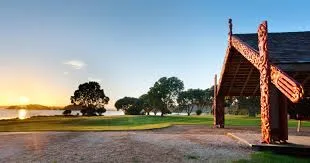
Standing on the manicured lawns of Waitangi, looking out across the turquoise expanse of the Bay of Islands, The weight of a nation’s birth. This site is the literal and figurative cradle of modern New Zealand, where the British Crown and over 500 Māori chiefs entered into a partnership that remains both celebrated and contested. There is a salt of the Pacific and the scent of ancient totara wood, creating an atmosphere that feels simultaneously peaceful and charged with historic gravity. While many national monuments feel static, Waitangi breathes with the ongoing conversation of what it means to be a dual-heritage nation.
Standing on the manicured lawns of Waitangi, looking out across the turquoise expanse of the Bay of Islands, The weight of a nation’s birth.
on this bluff, 1833
James Busby, the British Resident, built his modest timber house on this bluff in 1833. By February 1840, the lawn outside his window became the stage for a geopolitical drama that would define the South Pacific. Over two days of intense debate, the Treaty of Waitangi was drafted and signed, ostensibly to establish a British Governor while protecting Māori land and rights. The house itself survived decades of neglect before being rescued in the 1930s by Lord and Lady Bledisloe, who gifted the estate back to the people. Nearby, the magnificent Te Whare Rūnanga, a carved meeting house, was completed in 1940 to mark the centenary. It stands facing the Treaty House, a permanent architectural dialogue between two very different worldviews that were forced to find common ground on this specific patch of clover.
A visit usually begins with the sound
A visit usually begins with the sound of the pūkāea, a long wooden trumpet, echoing through the trees. Moving from the colonial simplicity of the Treaty House to the overwhelming intricate carvings of the meeting house, where every paua shell eye seems to track your movement. The scale of the Ngātokimatawhaorua, one of the world's largest ceremonial war canoes, is best appreciated by standing at its prow, smelling the oil-rubbed timber. What stands out is the way the light filters through the pohutukawa trees, casting dancing shadows over the memorials. The Te Kongahu Museum provides the intellectual backbone to the experience, using haunting audio and stark visuals to explain the differing translations of the treaty that still spark debate in parliament today.
Reaching this northern sanctuary requires
Reaching this northern sanctuary requires a three-hour drive from Auckland into the heart of Northland. Most travelers base themselves in the charming seaside town of Paihia, from which the grounds are a pleasant twenty-minute stroll along a coastal boardwalk. A small bridge separates the mainland from the treaty estate, acting as a threshold into a space where the rules of the modern world seem to soften. Those arriving by sea can take a ferry from Russell, catching glimpses of the flagpole on the hill that has been cut down in protest and re-erected in peace multiple times throughout history.
Reaching this northern sanctuary requires a three-hour drive from Auckland into the heart of Northland.
The Experience
You feel the grass underfoot is almost too green, a vivid contrast to the dark, weathered wood of the ceremonial canoe. The silence near the flagpole is often broken by the rhythmic chanting of a kapa haka group performing nearby, their voices carrying across the water to the islands beyond. It becomes clear how the British house feels small and fragile compared to the soaring, muscular carvings of the Māori meeting house across the lawn. Most visitors forget to look at the garden, which contains plants specifically mentioned in early colonial journals, offering a botanical map of 19th-century survival.
Why It Matters
Waitangi is the touchstone for New Zealand's identity. It is not just a collection of buildings but a living legal entity that dictates modern law, land rights, and cultural reparations. It represents the ongoing struggle to reconcile a colonial past with an indigenous future, making it the most politically significant patch of land in the Southern Hemisphere.
Why Visit
Visit Waitangi if you want to understand the heartbeat of New Zealand beyond the postcard scenery. This is the only place where the complex, often difficult story of the nation is told with such raw honesty and stunning artistry. You come here to stand on the spot where history happened and realize it is still happening.
✦ Insider Tips
- 1
Join the guided walk early in the day to hear the oral histories that aren't printed on the museum plaques.
- 2
Look for the deliberate imperfections in the meeting house carvings; they are meant to remind us that only the gods are perfect.
- 3
The shoreline café serves a superb seafood chowder that rivals anything in the nearby tourist towns.
- 4
Walk the bush track to the mangrove boardwalk at the edge of the property to see the landscape as it appeared in 1840.
- 5
Check the schedule for the waka (canoe) launching, as seeing the eighty-strong crew move in unison is a rare, powerful sight.