A fallen spire and a gaping roof turned this 19th-century monument into a jagged, open-air reminder that even the most solid stone must eventually answer to the earth.
About Christchurch Cathedral
The foundation stone was laid in 1864, but the building was not consecrated until 1881, and the spire wasn't finished until 1904. It was designed to be the spiritual anchor for the Canterbury settlement, reflecting the high-church Anglican values of its founders. The 2011 earthquake was not the first time the spire was damaged, it had lost its tip in 1881, 1888, and 1901, but it was the first time the entire structure faced total collapse. The current $150 million restoration is one of the most complex heritage projects in the Southern Hemisphere, involving the use of massive remote-controlled machines to stabilize the walls before humans could safely enter.
Standing in the center of Cathedral Square
Standing in the center of Cathedral Square, the Anglican Cathedral of Christchurch is a haunting, powerful symbol of both Victorian ambition and tectonic reality. Once the grand centerpiece of 'the most English city outside of England,' the building was devastated by the 2011 earthquake, leaving its spire toppled and its nave exposed to the sky. For a decade, it stood as a ruin behind chain-link fences, a site of immense grief for the city. Now, as a massive restoration project slowly breathes life back into its stone walls, the cathedral has become a monument to resilience. Here you can see the literal layers of history, from 19th-century limestone to 21st-century steel bracing.
“Standing in the center of Cathedral Square, the Anglican Cathedral of Christchurch is a haunting, powerful symbol of both Victorian ambition and tectonic reality.”
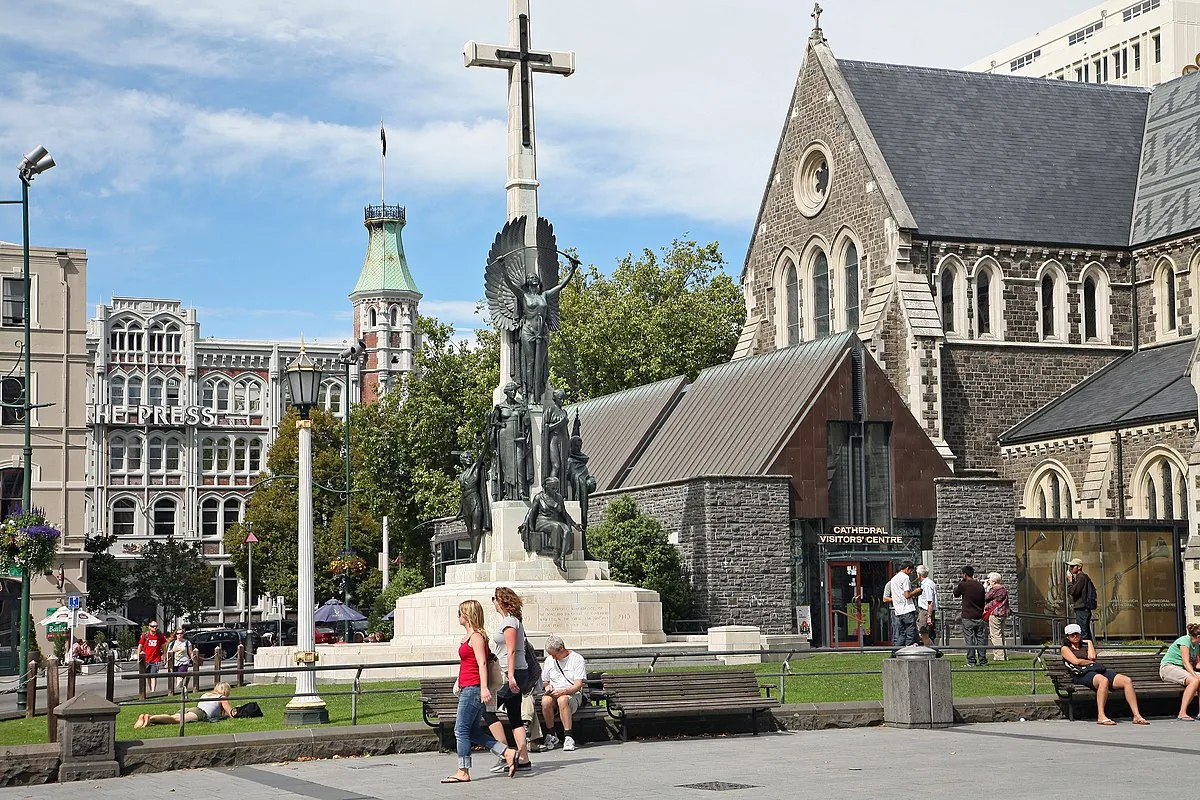
Christchurch Cathedral, New Zealand
Scott, construction began, 1864
Designed by the famed Gothic Revival architect Sir George Gilbert Scott, construction began in 1864, just a few years after the first European settlers arrived in the region. The project was plagued by a lack of funds, taking nearly 40 years to fully complete. The cathedral was built using local basalt and Oamaru limestone, creating a distinctive two-tone aesthetic that defined the city's character. Throughout its life, it survived several smaller tremors, but the 6.3 magnitude quake in February 2011 proved catastrophic. After years of heated public debate over whether to demolish the ruin or rebuild it, the decision was made to restore the cathedral to its former glory, incorporating modern seismic strengthening that will allow it to withstand future shocks while preserving its historic soul.
The cathedral sits at the absolute center
The cathedral sits at the absolute center of Christchurch, where all major streets converge. It is easily reached on foot from any part of the central city. The city’s iconic heritage tram stops right in the square, providing a nostalgic way to arrive at the site. For those coming from further afield, the central bus exchange is a mere five-minute walk away. While you cannot currently go inside the main structure, the surrounding plaza has been revitalized with seating and information boards that explain the complex engineering feat currently underway to save this New Zealand icon.
Currently, the experience
Currently, the experience of the cathedral is one of witnessing a 'work in progress' from the perimeter of the square. There is a feeling of industrial hum of cranes and the sharp sound of stonemasons’ tools as they carefully deconstruct and rebuild the masonry. The smell of dust and wet stone often hangs in the air. First, the contrast between the dark, weathered basalt and the pale, new limestone being used for the repairs. Even as a partial ruin, the scale of the Gothic arches is impressive, casting long, dramatic shadows across the plaza. Nearby, the 'Cardboard Cathedral', a temporary replacement made of shipping containers and cardboard tubes, provides a stunning, lightweight counterpoint to the heavy stone gravity of the original.
The Experience
You notice the resilience of the city in the way the square has returned to life despite the scaffolding and the cranes. There is a strange, quiet beauty in the ruin, especially when the morning light hits the remaining stained glass, sending flashes of red and blue across the broken stonework. The gravity of the city's collective memory as locals stop to look through the viewing windows in the construction fences. Nearby, the square is now a mix of construction and the return of street performers, creating a hopeful, noisy transition between the past and the future. What hits is how the new steel frame is slowly beginning to cocoon the old stone.
Why It Matters
Christchurch Cathedral is the emotional barometer for the Canterbury region. Its destruction was the defining image of the 2011 disaster, and its slow rebirth is the defining image of the city’s recovery. It represents a commitment to heritage that refuses to be erased by nature, serving as a bridge between the Victorian pioneers and the modern, innovative city rising around it.
Why Visit
Visit the cathedral now to witness a once-in-a-lifetime architectural resurrection. This isn't just about looking at an old church; it’s about seeing how a modern city saves its soul through engineering and sheer willpower. Pairing a walk around the site with a visit to the nearby 'Cardboard' Transitional Cathedral offers a profound lesson in how humanity adapts to catastrophe.
Insider Tips
- 1
Visit the Cathedral Transition office nearby to see 3D models and videos of how the restoration will look when finished in 2027.
- 2
Walk two blocks to the 'Cardboard Cathedral' to see the stunning stained-glass window that was salvaged from the original ruin.
- 3
The heritage tram offers a 'hop-on hop-off' ticket that allows you to photograph the cathedral from several different angles around the square.
- 4
Check the viewing windows along the Colombo Street side for the best glimpses of the interior nave restoration.
- 5
Look for the local 'Wizard of Christchurch' who often holds court in the square; he is a living piece of cathedral history.