Steam hisses through cracks in the sidewalk and the ground literally breathes in this valley where a massive geyser dictates the rhythm of daily life.
About Te Puia
The Ngāti Wāhiao people have occupied this valley for over seven centuries, utilizing the geothermal heat for a sustainable lifestyle long before modern technology arrived. In the early 20th century, it became the birthplace of the New Zealand tourism industry, led by legendary guides like Maggie Papakura. The formal institute was created to protect cultural intellectual property, ensuring that Māori art was taught by Māori, for Māori. This institutionalization helped save the distinctive Te Arawa style of carving, which is characterized by its deep, fluid curves and aggressive, powerful figures.
What Te Puia actually is
In the Whakarewarewa Valley, the earth is restless and the air smells strongly of brimstone. Te Puia is a rare collision of geothermic violence and cultural grace, where boiling mud pools bubble like thick gray porridge just a few hundred yards from a world-class carving school. The Pohutu Geyser is the erratic star of the show, erupting up to twenty times a day in a towering pillar of steam and scalding water. This is not just a tourist park; it is the ancestral home of the Tūhourangi Ngāti Wāhiao people, who have used these thermal waters for cooking, bathing, and heating for centuries. It remains a place where the power of the planet is channeled into the preservation of indigenous art.
“In the Whakarewarewa Valley, the earth is restless and the air smells strongly of brimstone.”
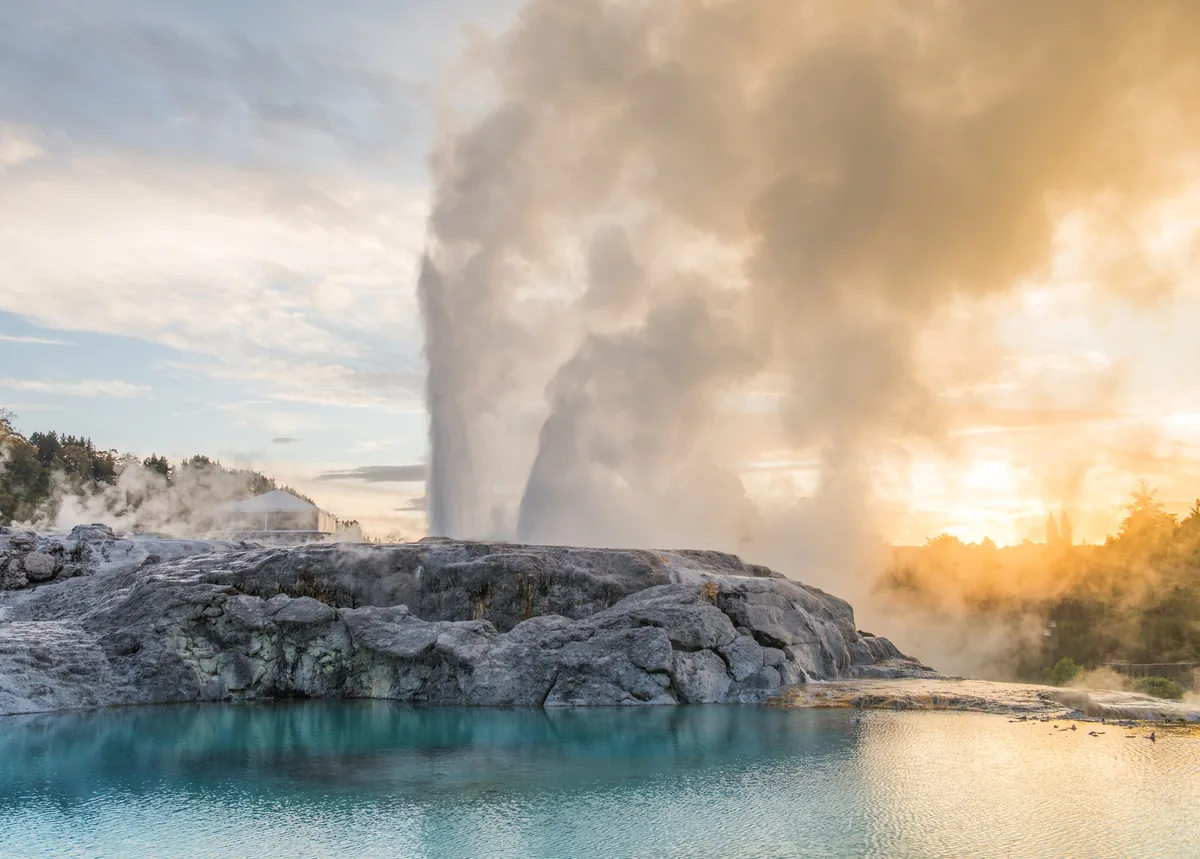
Te Puia, New Zealand
The valley has been a hub
The valley has been a hub for Māori culture since the 1300s, but its modern history as a center for tourism began in the late 19th century. After the devastating 1886 eruption of Mount Tarawera destroyed the nearby Pink and White Terraces, the local Māori moved their guiding expertise to Whakarewarewa. In 1963, the New Zealand Māori Arts and Crafts Institute was established here by act of parliament to ensure that traditional skills like wood carving (whakairo) and flax weaving (raranga) did not vanish. Today, master carvers and weavers train the next generation in workshops that are open to the public, ensuring that the taonga seen in museums around the world remain a living, breathing practice rather than a dead history.
Walking along the boardwalks, the heat
Walking along the boardwalks, The heat of the geothermal vents rising through the soles of your shoes. The hiss of steam is a constant background noise, occasionally punctuated by the sudden, percussive roar of Pohutu erupting. What gets your attention is the silica-encrusted rocks, which turn a strange, ghostly white under the constant spray of mineral-rich water. Inside the dark, cool interior of the Kiwi House, your eyes slowly adjust until seeing the shy, flightless birds foraging in the leaf litter. The carving school provides a sensory shift; the smell of sulphur is replaced by the sweet, heavy scent of freshly cut tōtara wood and the rhythmic 'tap-tap' of mallets hitting chisels. You can watch students painstakingly detail a ceremonial gate, their faces focused in the dusty sunlight of the workshop.
Rotorua is the geothermal capital
Rotorua is the geothermal capital of the North Island, located a three-hour drive south of Auckland. Te Puia sits on the southern edge of the city, easily reached by car or the local Green Line bus. Most visitors arrive in the morning to catch the most reliable eruptions of the geysers, but the 'Te Pō' evening experience offers a different perspective. This night tour includes a traditional hāngī meal cooked in the ground and a visit to the illuminated geysers under the stars, where the steam looks like glowing ghosts against the black Rotorua night.
“Rotorua is the geothermal capital of the North Island, located a three-hour drive south of Auckland.”
The Experience
You notice the fine mist of mineral water on your skin as you stand near the geyser terrace, a warmth that feels surprisingly soft despite its volcanic origin. You hear the boiling mud pools is a wet, glooping staccato that feels almost rhythmic. Something like a sense of reverence in the weaving school, where the silence is only broken by the rustle of dried flax. The smell of the hāngī, earthy, smoky, and rich, rises from the ground in the late afternoon, signaling the preparation of the evening feast. Most visitors stay for the geyser, but the moment that lingers is watching a carver blow sawdust off a nearly finished ancestor figure.
Why It Matters
Te Puia is the lungs of Māori material culture. It is one of the few places on Earth where natural geothermal wonders are secondary to the human artistry they support. By housing the National Schools of Wood Carving and Weaving, it ensures the survival of the Māori visual language, making it a critical site for indigenous sovereignty and cultural pride.
Why Visit
Go to Te Puia because it offers the most authentic synthesis of New Zealand’s two biggest draws: volcanic landscapes and Māori heritage. You aren't just looking at a geyser; you are seeing it through the eyes of the people who have lived beside it for twenty generations. It is a rare chance to see master artists at work in a landscape that feels like the dawn of time.
Insider Tips
- 1
Wait for the geyser to stop erupting to see the colorful mineral formations on the silica terrace, which are often hidden by steam.
- 2
The carvers in the institute are usually happy to answer brief questions about their work if you approach them respectfully between tasks.
- 3
Try the 'sweetcorn' cooked in the geothermal waters; the minerals give it a unique, slightly salty flavor you won't find anywhere else.
- 4
The Kiwi house is most active during feeding times, so check the daily schedule at the entrance to see these elusive birds in motion.
- 5
Wear dark clothing if you plan to sit near the vents, as the mineral-heavy steam can sometimes leave faint white spots on delicate fabrics.