Two mighty oceans clash in a permanent, white-water brawl at the foot of an 800-year-old tree that is a gateway between this world and the next.
About Te Rerenga Wairua
The headland has been a focal point for navigation for centuries, both for Māori voyagers and later European sailors. The current lighthouse is one of the last to be built in New Zealand and was fully automated in 1987. Its beam can be seen for 35 kilometers out at sea. In recent years, the Ngāti Kurī and Te Aupōuri iwi have worked closely with the government to ensure the site is managed as a sacred wāhi tapu, leading to the removal of the old car park from the spirit path to allow the land to heal and return to its natural state.
What Te Rerenga Wairua actually is
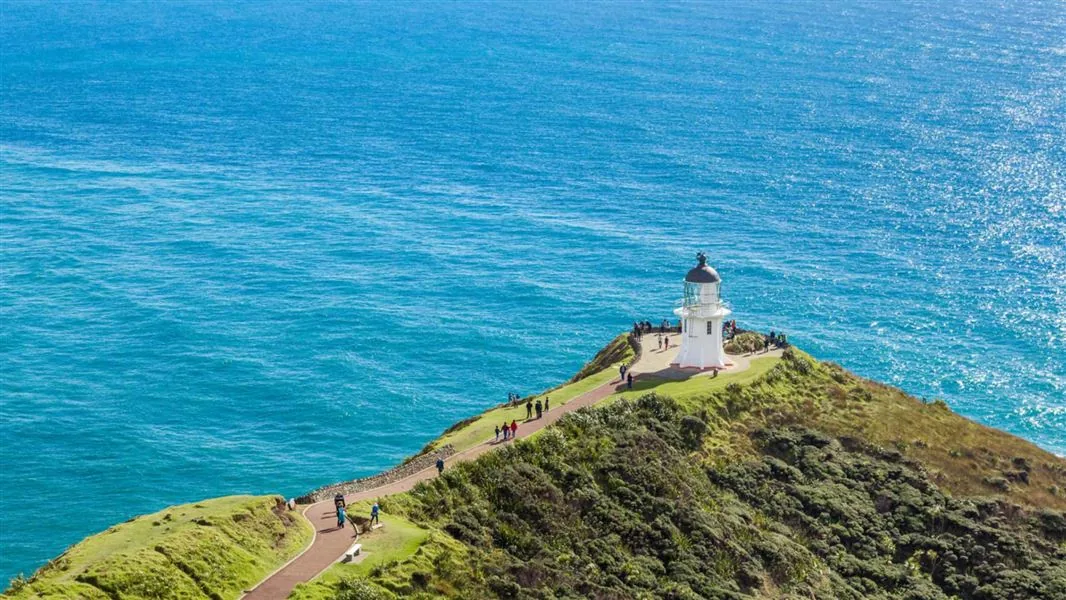
At the northernmost tip of New Zealand, two oceans collide in a violent, foaming display of turquoise and deep indigo. Te Rerenga Wairua, or Cape Reinga, is where the Tasman Sea meets the Pacific Ocean, but its importance is far more than geographical. For Māori, this is the most sacred site in the country, the leaping-off point where spirits begin their final journey back to their ancestral homeland of Hawaiki. The lighthouse is still a lonely sentinel on the cliff, but the true focal point is an ancient, weather-beaten pōhutukawa tree clinging to the rock face below. It is a place of immense elemental power, where the wind feels like a physical force and the horizon seems to go on forever.
The name Te Rerenga Wairua translates
The name Te Rerenga Wairua translates to 'The Leaping Place of Spirits.' According to tradition, the spirits of the dead travel up the coast to this point, descending the roots of the 800-year-old pōhutukawa tree to enter the underworld. Geologically, the 'meeting of the seas' is caused by the collision of the Tasman’s outgoing tide and the Pacific’s incoming flow over a submerged ridge. The first lighthouse was built on nearby Motuopao Island in 1879, but it was moved to its current position on the mainland in 1941. The site was extensively redesigned in 2010 to remove public roads from the most sacred areas, restoring a sense of dignity and silence to the headland.
Walking down the long, winding path toward
Walking down the long, winding path toward the lighthouse, the air become saltier and colder with every step. The distinct line in the water where the two currents clash, creating a chaotic, white-capped ridge that stretches out toward the horizon. The sound is a constant, low-frequency roar of the wind and the surf, a noise that drowns out everything else. There is a sense of profound isolation, as if you are standing at the edge of the world. Most visitors stand in silence at the railing, watching the spirits, as the stories say, make their way toward the gnarled tree. Pay attention to the way the light catches the white spray of the waves, making the ocean look like it is boiling.
Reaching the Cape requires a significant
Reaching the Cape requires a significant journey, located about 100 kilometers north of the town of Kaitaia. Most people take a full-day tour from Kaitaia or Paihia, which often includes a drive along the vast sands of Ninety Mile Beach. If you drive yourself, the road is now fully sealed, winding through rolling farmland and wild coastal scrub. There are no shops or petrol stations at the Cape, so There is a true sense of leaving civilization behind. The best time to arrive is either very early in the morning or at sunset, when the crowds have thinned and the spiritual gravity of the site is at its most potent.
The Experience
What you smell is the scent of wild manuka and salt spray, a sharp, invigorating smell that defines the far north. The path underfoot is smooth and well-maintained, but the sheer drops on either side remind you of the landscape's raw power. The wind tugging at your clothes, a constant reminder of the cape's exposure to the open Pacific. The lighthouse itself is smaller than you expect, a modest white tower that looks fragile against the vast blue backdrop. People often miss the small signage explaining the significance of the pōhutukawa tree, which never flowers, symbolizing its role in the transition from life to death.
Why It Matters
Te Rerenga Wairua is the spiritual heart of Aotearoa. It is the end of the physical land but the beginning of a spiritual journey, making it a site of immense emotional weight for Māori. Geographically, it is one of the few places on earth where you can clearly see the boundary between two major bodies of water, making it a site of global maritime and geological interest.
Why Visit
Visit Te Rerenga Wairua because it is one of the few places where you can feel the pulse of the planet. It is a location that demands respect and rewards you with a sense of perspective that is hard to find in modern life. You come here not just for the photo of the lighthouse, but to stand at the threshold of the unknown.
✦ Photo Gallery
Best Season
🌤 Spring and autumn provide the clearest air for seeing the meeting of the seas, as the summer haze can sometimes blur the horizon where the oceans collide.
Quick Facts
Best time to visit
Spring and autumn provide the clearest air for seeing the meeting of the seas, as the summer haze can sometimes blur the horizon where the oceans collide.
Getting there
In Cape Reinga, New Zealand; reach Cape Reinga first, then continue to the site.
Location
Cape Reinga, New Zealand
Type
attraction
Insider Tips
- 1
Bring water and food, as the nearest shop is nearly an hour's drive away in Kaitaia or Houhora.
- 2
Respect the 'no eating' signs near the spirit path; this is a sacred site where food is considered a tapu (forbidden) intrusion.
- 3
If you have a 4WD, take the Te Paki Stream road on the way back to try sandboarding on the massive dunes.
- 4
Check the tide charts; the 'meeting of the oceans' is most dramatic during the change of the tide.
- 5
Walk slowly; the spirit path is intended to be a contemplative journey rather than a race to the lighthouse.