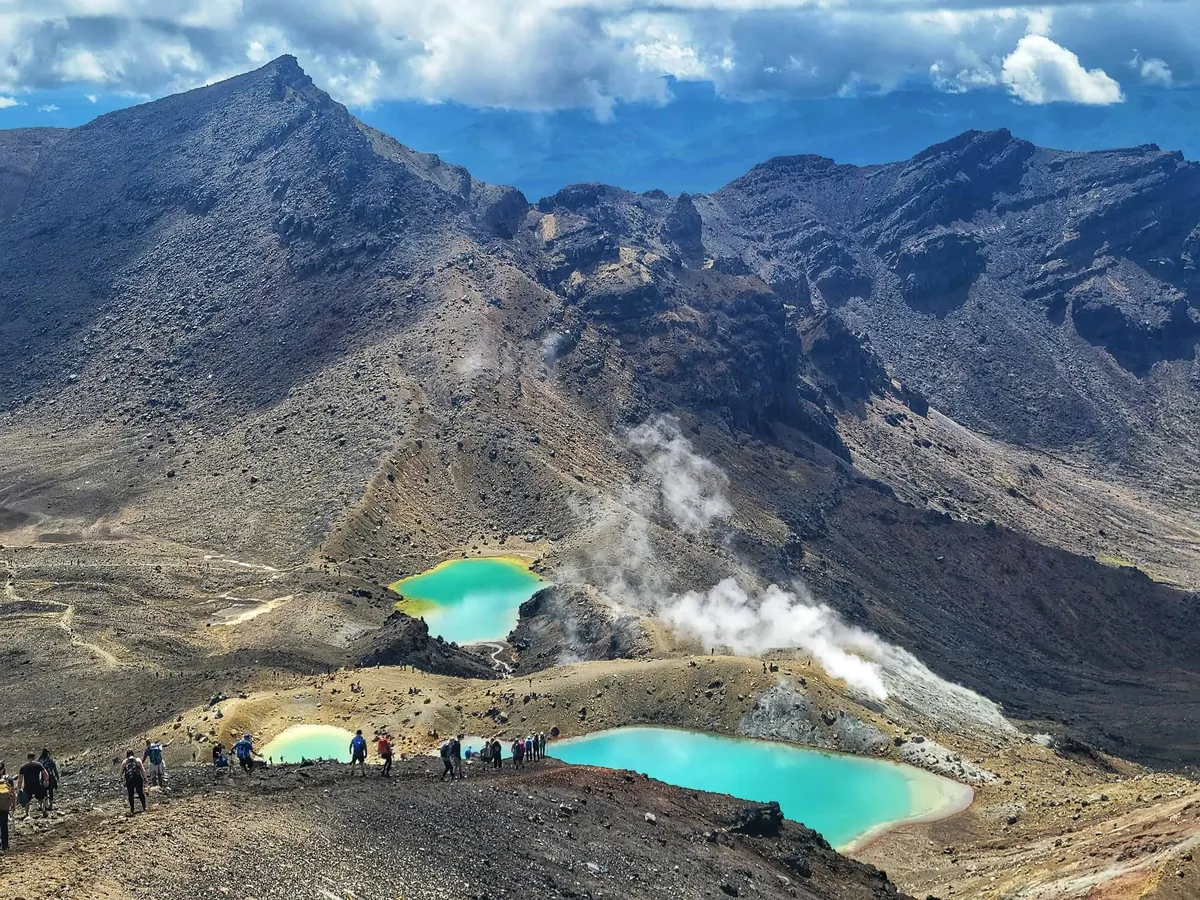
Steam rises from the belly of a volcano while you stand on a ridge of rusted iron, looking down at lakes that glow with the impossible brilliance of liquid emeralds.
About Tongariro Alpine Crossing
The geology of Tongariro is a chaotic timeline of eruptions, collapses, and glacial sculpting that began long before human arrival. When the park was established in the late 19th century, it was only the fourth national park in the world, marking a radical shift in how New Zealanders viewed their wild spaces. During the 1930s, workers constructed the first rudimentary huts and tracks, often battling extreme snow and ash. The landscape gained modern global notoriety in the early 2000s, but for the local iwi, the significance has always been about the mana of the peaks. In 1993, the park became a dual World Heritage site, recognized for both its geological marvels and its profound cultural associations, the first to be honored in this specific way.
What Tongariro Alpine Crossing in New Zealand
Sulfur-stained vents hiss steam into a sky that feels unnervingly close, while the ground beneath your boots shifts from volcanic grit to ancient, frozen lava. The Tongariro Alpine Crossing is a nineteen-kilometer odyssey through a landscape so lunar and volatile that it is like a glimpse into the Earth's violent infancy. The environment carries a sharp, acidic bite from the nearby craters, mixed with a high-altitude chill that can freeze sweat in seconds. You navigate narrow ridgelines that separate the vast, rusted expanse of the Red Crater from the brilliant, toxic neon of the Emerald Lakes. Overhead, the space is a lonely chorus of howling alpine winds and the rhythmic crunch of scoria underfoot.
Why it matters
Mount Tongariro and its siblings, Ngauruhoe and Ruapehu, were gifted to the people of New Zealand in 1887 by Te Heuheu Tukino IV, the paramount chief of Ngāti Tūwharetoa, to ensure their permanent protection as a national park. This was the first such gift in the world, born from a desire to keep these sacred peaks tapu (restricted) in the face of colonial land divisions. The volcanic complex has been active for over 300,000 years, with the most recent major eruption at Te Maari Craters in 2012 serving as a reminder that the trail is merely a guest in an active tectonic zone. This high-altitude desert has was a training ground for Antarctic explorers and a cinematic stand-in for the fires of Mordor, yet its true power remains rooted in the spiritual ancestry of the Māori people who have lived in its shadow for centuries.
Climbing the Devil’s Staircase, the thin air burning in your lungs as the vegetation vanishes, leaving behind a collection of jagged black rock and iron-red earth. The first thing you register is the way the light reflects off the Blue Lake, a cold, acidic body of water that remains still even when the mountain wind is at its fiercest. The smell of rotten eggs, characteristic of hydrogen sulfide, becomes your constant companion as you descend toward the steaming thermal vents of the northern slopes. Something like a sudden surge of heat through the soles of your shoes near the crater rim, a tactile warning of the geothermal energy surging just below the surface. The thing you pick up on is the sheer scale of the Oturere Valley, a wasteland of volcanic debris that looks like the aftermath of a planetary collision. The most haunting moment is standing in the center of the South Crater, a flat, silent pan of dust where the silence is so heavy it feels physical. The crossing is a point-to-point hike, typically beginning at Mangatepopo and ending at Ketetahi, requiring a pre-booked shuttle service to manage the logistics. Travelers usually base themselves in nearby National Park Village or Turangi, where transport operators monitor the erratic mountain weather with obsessive precision. Arriving at the trailhead at dawn is a requirement, not just for safety but to witness the first light turning the volcanic peaks into silhouettes of glowing copper. The walk takes between seven and nine hours depending on fitness and how long you linger at the craters. Because the environment is fragile and sacred, you must stay strictly on the marked path and carry out every scrap of waste you generate.
The Experience
The atmosphere on the crossing is one of raw, unshielded exposure. The first thing you register is the smell of sulfur, a dry, yellow scent that sticks to the back of your throat, reminding you that the mountain is essentially a massive chemical factory. The grit of volcanic ash in your hair and eyes, a constant reminder of the trail's violent origins. The light is exceptionally bright and harsh, stripping away shadows and saturating the reds and oranges of the crater walls. The thing you pick up on is the sound of the wind is different here; it doesn't rustle leaves but moans through the gaps in the lava flows. The most striking detail is the descent through the golden tussock at the end of the day, where the landscape finally softens back into a collection of green and gold. It is an exhausting, soul-clearing journey.
Why It Matters
Tongariro is a sacred pilar of Māori identity and a UNESCO World Heritage site of immense geological importance. It represents the successful preservation of indigenous spiritual values within a modern conservation framework. Historically, it is born from the foresight of Te Heuheu Tukino IV, whose gift created a sanctuary for both nature and the human spirit.
Why Visit
The appeal is that you want to walk through the world’s most accessible apocalypse. While other hikes offer forests and views, Tongariro offers a visceral encounter with the planet’s internal fire. You come here to stand on a smoking crater and to see colors, neon greens and deep ochres, that don’t seem to belong in nature. It is the only place where the earth feels truly alive beneath your feet.
✦ Photo Gallery
Best Season
🌤 February and March provide the most stable weather and snow-free paths, allowing the deep colors of the lakes and craters to shine without the interference of alpine mist.
Quick Facts
Best time to visit
February and March provide the most stable weather and snow-free paths, allowing the deep colors of the lakes and craters to shine without the interference of alpine mist.
Getting there
In Tongariro, New Zealand; reach Tongariro first, then continue to the site.
Location
Tongariro, New Zealand
Type
attraction
Insider Tips
- 1
Wear wool or synthetic layers even if the sun is shining at the base; the temperature at Red Crater is often twenty degrees colder than the car park.
- 2
Fill your water bottles before you arrive; there is no drinkable water on the mountain, and the lakes are too acidic for consumption.
- 3
Check the 'Metservice' mountain forecast specifically for Tongariro; a sunny day in the town can still mean gale-force winds on the ridge.
- 4
Bring a pair of gaiters to keep the fine, sharp volcanic scoria out of your boots during the steep descent from Red Crater.
- 5
Treat the peaks with respect; avoid climbing the actual summits of Ngauruhoe or Tongariro, as they are considered sacred to the Māori people.