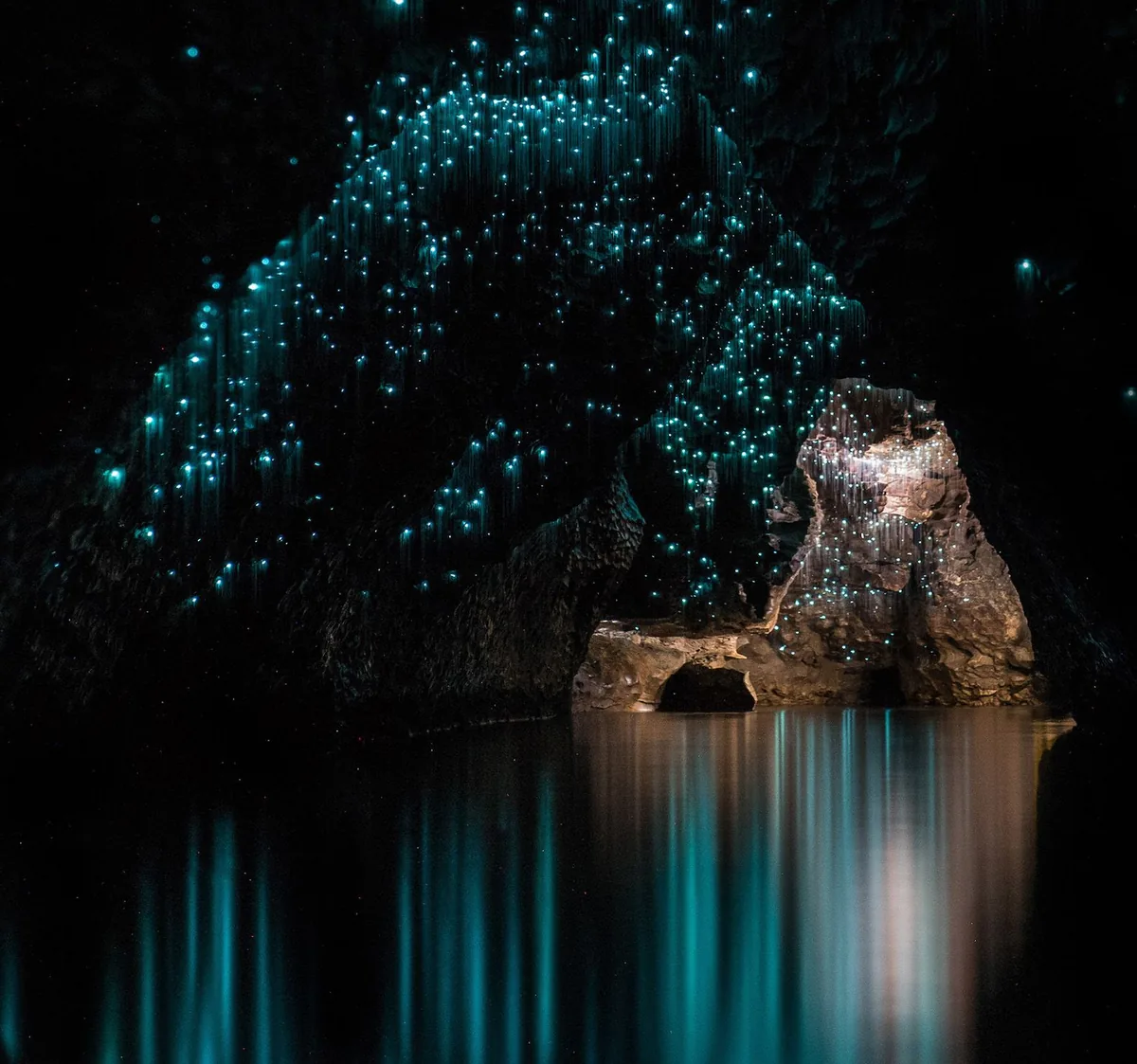
Deep beneath the green hills of the Waikato, thirty million living stars hang from a stone ceiling, waiting to light your way through a river of absolute darkness.
About Waitomo Glowworm Caves
The Waitomo caves began as a coral reef thirty million years ago, eventually pushed above the sea and carved by acidic rainwater into the limestone honeycomb we see today. The Arachnocampa luminosa, or New Zealand glowworm, is unique to these islands, using its bioluminescence to lure prey into sticky silk threads. During the early 20th century, the caves became an international sensation, drawing royalty and celebrities who traveled for days to witness the 'Eighth Wonder of the World.' The management of the cave is now a scientific operation, with sensors monitoring carbon dioxide levels to ensure the breath of visitors doesn't damage the ancient rock formations or the delicate life cycles of the larvae.
Waitomo Glowworm Caves in New Zealand
A silent boat glides through a subterranean river where the only light comes from a celestial canopy of thirty million tiny, bioluminescent creatures clinging to the limestone ceiling. The Waitomo Glowworm Caves are a dark, liquid cathedral where the laws of the surface world are replaced by a soft, pulsating indigo glow. The interior the cave system is still and carries the earthy, mineral scent of wet rock and ancient limestone. You descend through the Cathedral, a massive cavern with world-class acoustics. Notice how the sound of a dripping stalactite echoes for several seconds. Layered on top of this is a fragile silence, as even a whisper can cause the glowworms to dim their lights in defense. It feels like floating through a star-filled galaxy that has been buried deep inside the King Country hills.
Māori people knew of the caves for generations
Māori people knew of the caves for generations, but the labyrinth remained largely unexplored until 1887, when local chief Tane Tinorau and English surveyor Fred Mace built a raft of flax stems and ventured into the dark. Using candles for light, they discovered the Glowworm Grotto and were awestruck by the subterranean constellations. By 1889, Tane Tinorau and his wife Huti began guiding visitors through the caves for a small fee, establishing one of New Zealand's first tourism businesses. The government took over the administration in 1906, but after decades of petitions, the caves were returned to the descendants of the original Māori owners in 1989. Today, many of the guides are direct descendants of Chief Tinorau, ensuring that the stories told in the dark are part of an unbroken family lineage.
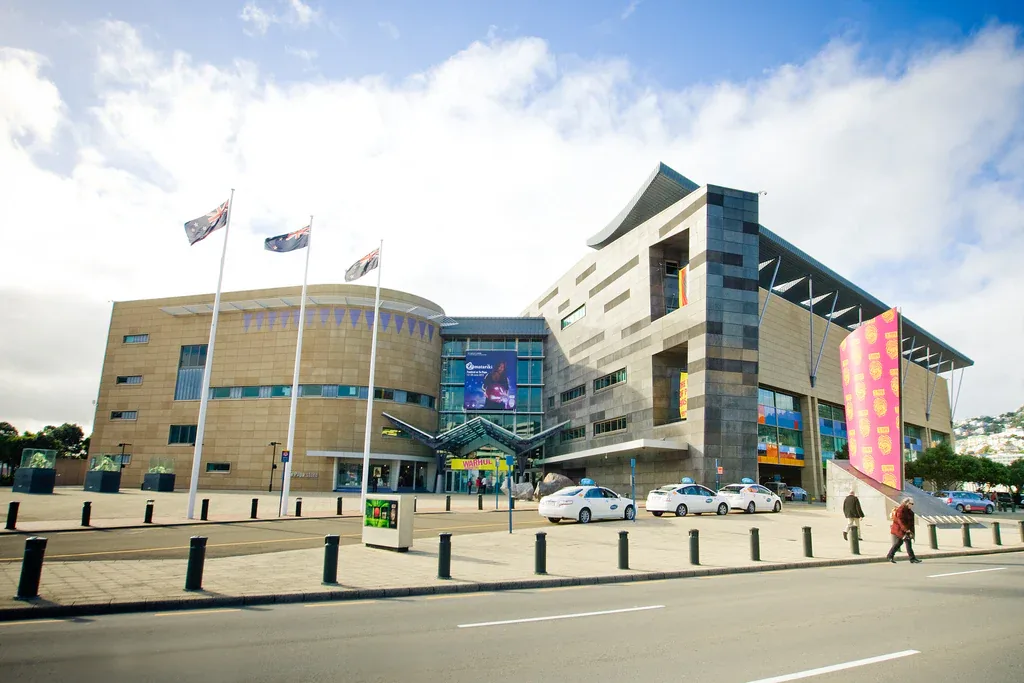
Walking through the upper levels , the cool, damp texture of the limestone walls, shaped by millions of years of water erosion. What registers is the delicate, straw-like stalactites that hang from the ceiling, each one a slow-motion miracle of geology. The smell of the cave is neutral and clean, proof of the sophisticated air-flow systems that protect the delicate ecosystem. A sense of anticipation stepping into the boat and the guide instructs everyone to remain perfectly silent. What gets your attention is the way the light from the glowworms reflects off the dark water, creating an illusion of infinite depth. The most striking moment is when the guide uses a rope to pull the boat deeper into the grotto, and the indigo stars become so dense they illuminate the faces of your fellow travelers in a ghostly blue light. Waitomo is located in central the North Island, roughly two and a half hours south of Auckland and two hours from Rotorua. Those visiting arrive via car or organized day tours, winding through the lush, rolling green pastures of the Waikato region. The cave complex is well-signposted and features a modern visitor center with a distinctive woven-timber roof. Tickets should be booked in advance, as tour sizes are strictly limited to protect the air quality and the glowworms themselves. Because the caves maintain a constant temperature of 14°C, a light jacket is necessary regardless of the weather outside. For those seeking a more rugged experience, nearby operators offer black-water rafting, where you navigate the darker corners of the system on an inner tube.
The Experience
Walking into Waitomo is one of hushed, reverent wonder. What lands is the smell of wet stone and the slight humidity that clings to your skin as you move deeper into the earth. The gravity of the silence in the Glowworm Grotto, a silence that is necessary to prevent the larvae from retreating into their burrows. The light is ethereal, a soft, cool blue that doesn't cast harsh shadows but instead creates a dreamlike glow. The rhythmic 'plink' of water hitting a pool somewhere in the dark, the only clock in a place without sun. The most evocative detail is the realization that each 'star' is a living hunter, a tiny spark of life thriving in total isolation.
Why It Matters
Waitomo is a site of immense natural and cultural importance, representing the longest-running Māori-owned tourism venture in New Zealand. It is an ecological treasure that houses a species found nowhere else on Earth. Culturally, it serves as a bridge between ancestral Māori knowledge and modern scientific conservation.
Why Visit
What makes it worth the trip: you need to see a light that isn't man-made. While other caves offer impressive rocks, Waitomo offers a living, breathing cosmos. You come here to experience the rarest of things: a journey into total darkness that ends in a galaxy of indigo fire. It is the only place on the planet where you can feel like an astronaut while sitting in a wooden boat.
✦ Photo Gallery
Best Season
🌤 Spring and early summer (October to December) are ideal, as the increased insect activity outside means the glowworms inside are at their brightest and most active.
Quick Facts
Best time to visit
Spring and early summer (October to December) are ideal, as the increased insect activity outside means the glowworms inside are at their brightest and most active.
Getting there
In Waitomo, New Zealand; reach Waitomo first, then continue to the site.
Location
Waitomo, New Zealand
Type
attraction
Insider Tips
- 1
Photography is strictly forbidden in the glowworm grotto; put your phone away early to allow your eyes to fully adjust to the dark.
- 2
Book the first tour of the day at 9:00 AM to experience the caves before the large tour buses from Auckland arrive.
- 3
Wear flat shoes with good grip; the cave floors are naturally damp and can be slippery even on the well-maintained walkways.
- 4
If you are prone to claustrophobia, the main Waitomo cave is quite spacious with high ceilings, making it more comfortable than the smaller Ruakuri cave.
- 5
Look for the 'tomos', deep vertical shafts that connect the surface world to the cave system, which were the original entrances used by early explorers.