Beneath the golden cloisters of Lima’s most beautiful library, 25,000 skeletons lie in geometric patterns, a silent, subterranean city of the dead.
About Convento de San Francisco
The convent was the headquarters of the Franciscan Order in Peru, playing a vital role in the evangelization of the Andes. Its construction was a marvel of the time, surviving the devastating 1746 earthquake that leveled most of Lima. The library served as a center of intellectual life in the viceroyalty, preserving forbidden books and scientific texts alongside religious works. The catacombs remained the city's primary burial site for over a century, regardless of social status, until Enlightenment-era reforms regarding public hygiene led to their closure. Today, the complex is part of the UNESCO World Heritage listing for the Historic Centre of Lima, preserved as a pinnacle of colonial art and architecture.
In the historic core of Lima, the bright
In the historic core of Lima, the bright yellow facade of the Basilica and Convent of San Francisco stands as one of the finest examples of Spanish Baroque architecture in the New World. This sprawling religious complex is a sanctuary of quiet cloisters, intricate 'mudéjar' ceilings, and one of the most beautiful colonial libraries in the world. However, most visitors come for what lies beneath: the catacombs. In the 17th and 18th centuries, the basement of the church was the city’s primary cemetery, housing the remains of an estimated 25,000 people. The atmosphere transitions abruptly from the sun-drenched, pigeon-filled plaza outside to the dim, cool, and silent vaults below. It is a place of profound architectural beauty and somber mortality, where the history of Lima is literally stacked in bones beneath the feet of the living.
“In the historic core of Lima, the bright yellow facade of the Basilica and Convent of San Francisco stands as one of the finest examples of Spanish Baroque architecture in the New World.”
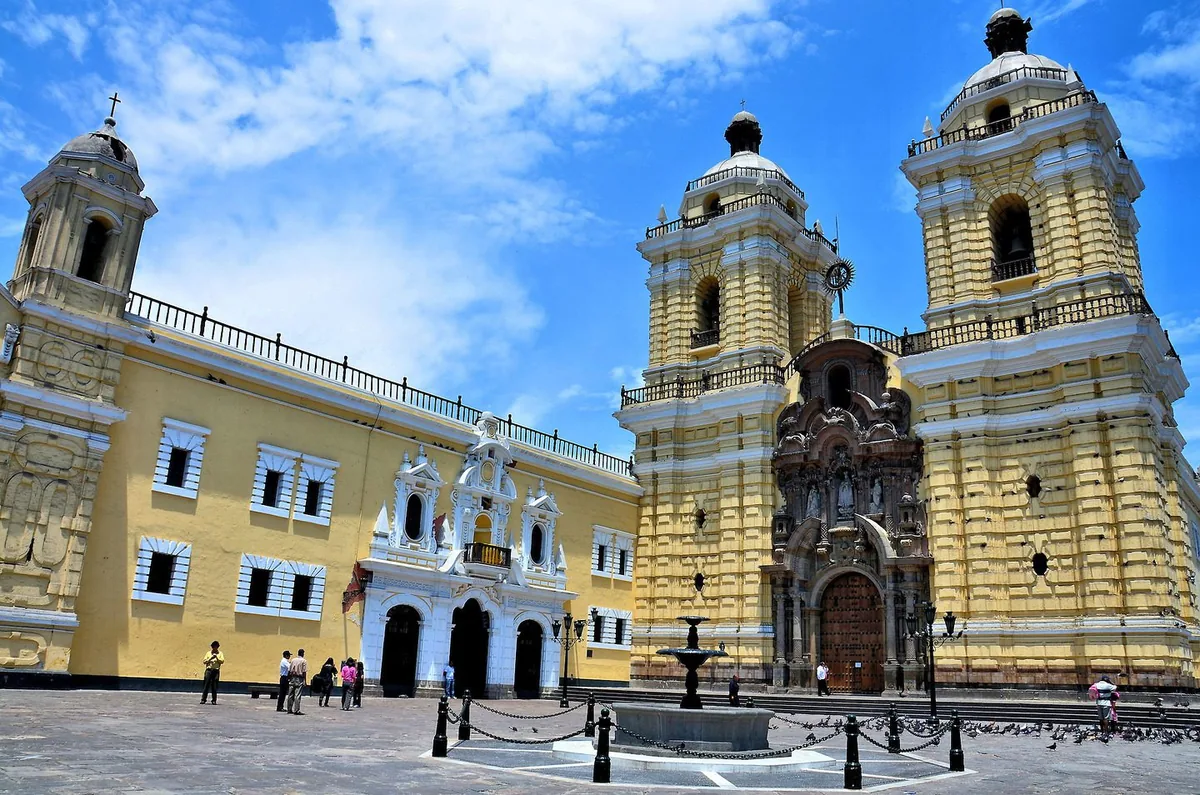
Convento de San Francisco, Peru
church was completed, 1674
The current church was completed in 1674 after the previous structure was destroyed by an earthquake. It was designed to be one of the most earthquake-resistant buildings in the city, using a mix of wood and 'quincha' (reed and mud) for its upper sections to provide flexibility. The Franciscan order, known for their focus on education and the poor, built a library here that remains one of the most significant in the Americas, containing over 25,000 antique volumes, including a Bible from 1572. The catacombs were used until 1808 when the city's general cemetery was opened outside the walls. For decades, the vaults were forgotten and filled with debris until they were rediscovered and opened to the public in 1947. Since then, they have become a haunting reminder of the city's colonial past and the shared fate of its inhabitants.
The Convento de San Francisco is located just
The Convento de San Francisco is located just two blocks from the Plaza Mayor (Plaza de Armas) in central Lima. It is easily reached by taxi or the 'Metropolitano' bus system (get off at Jirón de la Unión). The site can only be visited via a guided tour, which is included in the entrance fee. Tours run frequently in English and Spanish. Be aware that the catacombs have low ceilings and uneven floors, which may be difficult for those with claustrophobia or mobility issues.
Visiting Convento de San Francisco
Walking through the cloisters, The vibrant 'azulejos', glazed tiles from Seville, that line the walls, depicting scenes from the life of St. Francis. The light filters through the carved wooden screens, casting geometric patterns on the polished stone floors. The smell of old wood, beeswax, and ancient paper passing the library doors. As you descend into the catacombs, the air becomes noticeably cooler and takes on a damp, mineral scent. The silence is heavier here, muffled by the thick stone walls. The bones are arranged in geometric patterns, circles of skulls and lines of femurs, a 19th-century attempt to organize the remains for visitors. An impression of low ceilings pressing in, a visceral reminder of the subterranean depth. Most visitors miss the 'Last Supper' painting in the refectory, where the apostles are served a local Andean delicacy: roasted guinea pig. The intricate, Moorish-style carvings on the ceilings, evidence of the Spanish architects' diverse cultural influences.
The Experience
Notice the way the bright yellow exterior of the church glows in the Lima sun, a sharp contrast to the dark, bone-filled vaults below. You hear hundreds of pigeons in the plaza creates a chaotic energy that vanishes the moment you step through the heavy wooden doors. The history in the creak of the library’s floorboards, even if you can only peek at the shelves from the entrance. Most visitors are so focused on the skulls in the catacombs that they overlook the stunning 'mudéjar' cupola over the main staircase, a masterpiece of interlocking wood without a single nail. The detail that stays with you is the walk through the 'bone wells,' where the sheer volume of history becomes a tangible, physical weight.
Why It Matters
Convento de San Francisco is a masterwork of Spanish Baroque and Mudéjar styles, representing the architectural fusion of the colonial era. Its library is one of the most important historical archives in the Southern Hemisphere. The catacombs provide a unique, if macabre, sociological record of colonial Lima, while the complex as a whole serves as a symbol of the Franciscan order's enduring influence on Peruvian society.
Why Visit
Visit San Francisco for the duality of the experience. It offers both the intellectual heights of a world-class colonial library and the visceral depths of the city’s ancient catacombs. It is the best place in Lima to feel the weight of three centuries of history in a single, beautifully preserved building.
Insider Tips
- 1
No photography is allowed inside the convent or the catacombs; respect this rule to help preserve the sensitive artwork and the dignity of the remains.
- 2
The library is often closed to the public, but the guided tour will usually let you see it through the doorway; it is worth the ticket alone.
- 3
If you are tall, mind your head in the catacombs; the brick arches were built for 17th-century heights.
- 4
Visit the refectory specifically to see the 'Last Supper' painting; it’s a brilliant example of 'Cusco School' art where local culture is blended with biblical scenes.
- 5
The plaza in front is famous for its pigeons; buy a small bag of corn from a vendor if you want the classic 'bird-swarm' photo.