“Thousands of individual families still harvest salt from these three thousand ponds using a gravity-fed plumbing system designed before the Inca ever rose to power.”
About Salineras de Maras
The origin of Maras lies in a geological fluke where an ancient sea, trapped deep beneath the Andes, feeds a warm spring that surfaces at Qoripujio. Archaeological evidence suggests the salt was a primary trade commodity for the Wari and later the Inca, who used it for food preservation and ritual offerings. When the Spanish arrived, they were fascinated by the site but left the management to the local communities, recognizing the complexity of the communal ownership rules. Today, the Salineras are managed by the Maras salt cooperative, ensuring that every grain harvested supports the local economy rather than a distant corporation.
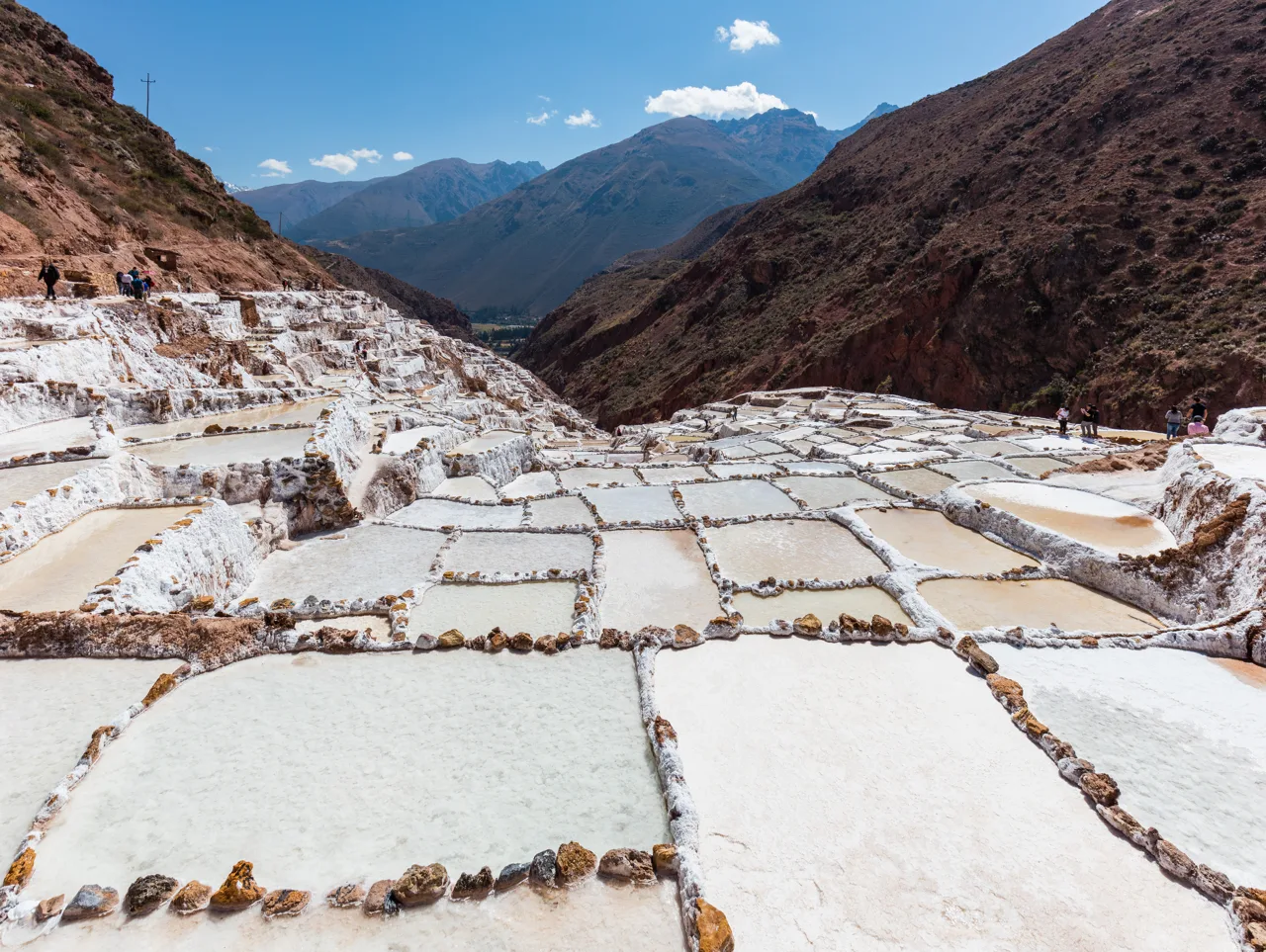
Tucked into a jagged fold of the Sacred
Tucked into a jagged fold of the Sacred Valley, over three thousand terraced salt pans cling to the canyon wall like a frozen white waterfall. These ancient ponds, known as the Salineras de Maras, create a geometric spectacle that defies the organic curves of the surrounding Andes. Each pool is fed by a single, subterranean stream of hyper-saline water that emerges from the mountain at a constant warmth. As the fierce high-altitude sun evaporates the water, a thick crust of pinkish-white salt crystallizes on the surface, ready to be harvested by hand. The sight is nearly blinding at midday, a stark contrast to the deep terracotta reds and forest greens of the Urubamba mountain range. This is a living industrial site where modern machinery has no place, and the rhythmic scraping of wooden tools provides the only soundtrack to the mountain wind.
Tucked into a jagged fold of the Sacred Valley, over three thousand terraced salt pans cling to the canyon wall like a frozen white waterfall.
Long before the Inca expanded their empire across
Long before the Inca expanded their empire across these peaks, the Chanapata culture discovered the salt-rich spring and began carving the first rudimentary ponds into the slope. The Inca later perfected the engineering, creating a sophisticated gravity-fed system of narrow channels that distributes the brine with mathematical precision across the entire hillside. Ownership of these ponds has remained remarkably consistent through the centuries, passed down through local families in the town of Maras. Every pond belongs to a specific communal member, and the right to harvest depends on active participation in the town’s collective labor system. Even the Spanish conquest and the subsequent centuries of republican rule failed to disrupt this ancient economic cycle. The salt produced here, prized for its mineral complexity, remains a staple of the regional diet and a symbol of Andean resilience.
Standing on the viewing platform,
Standing on the viewing platform, The air takes on a sharp, mineral tang that tickles the back of your throat. Audible: the mountain is dominated by the steady, liquid trickle of the salt-water spring as it navigates the narrow clay channels. The texture of the salt crust, which varies from a delicate frost to a coarse, jagged crystalline sheet depending on how long the water has sat. The light reflects off the thousands of pools with an intensity that requires squinting, turning the entire valley into a shimmering, fractured mirror. Something of heat radiating from the white surfaces, even when the alpine air is crisp. What most skip is the tiny, mud-brick huts scattered among the pans where harvesters store their tools and find shade during the peak of the day. First, the physical toll of the work as local men and women carry heavy sacks of salt up the steep, narrow paths with a grace born of lifelong practice.
Maras is easily reached
Maras is easily reached from Cusco or Urubamba, usually as part of a combined trip with the nearby circular terraces of Moray. The drive involves navigating winding dirt roads that offer expansive views of the snow-capped Vilcabamba range. While local buses can drop you in the town of Maras, the salt mines themselves are a few kilometers further and are best accessed by private car, taxi, or a guided mountain bike tour. For those with a sense of adventure, hiking down from the town through the traditional agricultural fields provides a much more intimate introduction to the landscape.
Maras is easily reached from Cusco or Urubamba, usually as part of a combined trip with the nearby circular terraces of Moray.
The Experience
The way the water in the channels feels warm and oily to the touch, saturated with more minerals than the dead sea. The silence of the canyon is deep, broken only by the occasional clink of a shovel against the salt crust. There is a feeling of grit of the earth under your fingernails and the salt spray on your skin, a physical connection to a process that hasn't changed in a millennium. Most visitors miss the subtle color variations in the ponds, ranging from snow-white to a muddy brown, which mark the different stages of the evaporation process. What remains with you is watching a harvester balance on the narrow rim of a pond, silhouetted against the blinding white mountainside.
Why It Matters
Maras is a rare example of pre-Columbian industry that remains fully functional and economically viable in the modern era. It represents a masterclass in hydraulic engineering and communal resource management. Beyond the aesthetic beauty, it is a cultural anchor for the people of the Sacred Valley, proving that ancient techniques can survive and thrive alongside global tourism.
Why Visit
Go to Maras to see a landscape that looks like it belongs on another planet. While the temples of the valley tell stories of the dead, Maras tells the story of the living. It is the best place in Peru to witness the intersection of ancient engineering and daily labor, all set within a dramatic canyon that defies photography.
✦ Insider Tips
- 1
Buy a bag of the 'Flor de Sal' directly from the entrance stalls; it is the highest quality harvest and significantly cheaper than in Cusco boutiques.
- 2
Arrive before 9:00 AM to see the harvesters at work before the heat and the majority of the tour buses arrive.
- 3
The path down to the mines is steep and can be slippery with salt dust, so choose footwear with a reliable grip.
- 4
Taste a drop of the water from the main spring channel at the top to understand just how saturated the source actually is.
- 5
Don't attempt to walk on the actual salt pans; they are fragile private property and the crust can be surprisingly thin.